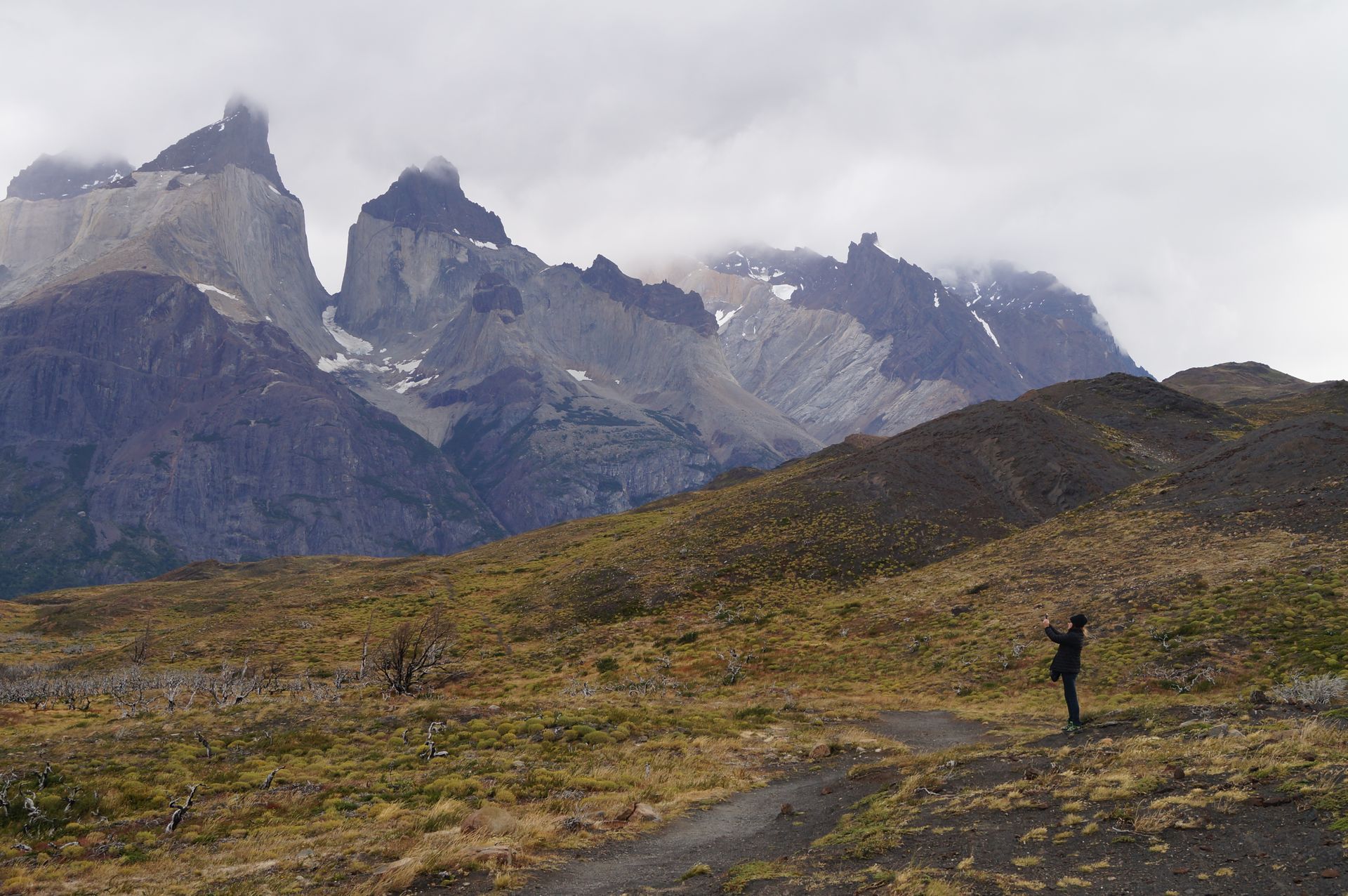
Patagonia does not ease you in. The wind at Puerto Natales or the Torres del Paine trailhead removes any lingering uncertainty about where you are, then the sky clears for thirty seconds and three granite spires rise 2,500 meters from the steppe with an implausibility that makes the wind stop mattering entirely. Experienced travelers describe Patagonia with the vocabulary reserved for life-changing experiences rather than merely excellent ones.
What Patagonia gives back for the effort is disproportionate to the investment — the scale that reduces the self to its appropriate proportion.
Torres del Paine: The W Trek and O Circuit
The W Trek (4–5 days) covers the park's three defining arms: the Torres base, reached via a 4–5am pre-dawn departure for the rose-gold alpenglow on the granite towers; the Valle del Francés, where calving hanging glaciers provide a constant background thunder; and the Grey Glacier, whose 6km-wide calving face is the most directly impressive glacial encounter accessible on foot in Patagonia.
The O Circuit (8–10 days) adds the remote back section via the 1,241-meter Paso John Gardner, whose sudden emergence onto the Southern Patagonian Ice Field — the third-largest freshwater reserve on Earth — is the unrepeatable moment experienced trekkers consistently cite. Visitor density on the back section runs at roughly 10–15% of the W's equivalent.
Los Glaciares: The Argentine Side
El Chaltén, Argentina's trekking-town counterpart to Puerto Natales, offers direct trailhead access with no transport required. The Laguna de los Tres hike (4–5 hours each way) ends in a steep 45-minute scramble to a lagoon at Fitz Roy's base — go at dawn, since the peak is famously cloud-obscured most afternoons. The Perito Moreno Glacier, one of the world's few advancing glaciers, calves into Lago Argentino with a thunder audible across its entire viewing boardwalk.
Beyond the Famous Treks: Carretera Austral and Tierra del Fuego
For backpackers with time beyond the two flagship parks, Chile's Carretera Austral — a 1,240km gravel highway from Puerto Montt to Villa O'Higgins, built through fjord terrain so difficult it still requires several ferry crossings — takes in Parque Pumalín's ancient alerce rainforest and the hanging glacier of Queulat National Park. At the continent's southern tip, Tierra del Fuego and the town of Ushuaia — the southernmost inhabited settlement on Earth, 1,000km from Antarctica — add subantarctic beech forest hiking and a Beagle Channel boat tour past penguin and sea lion colonies to a Patagonia itinerary extended south.
Weather: The Variable That Changes Everything
"Four seasons in one hour" is not an exaggeration — frontal systems can shift conditions from clear calm to horizontal rain and 100+ km/h gusts in under 30 minutes. Mornings statistically offer the best weather window; the 6am departure for the Torres sunrise isn't just about avoiding crowds, it's operating within the highest-probability clear window. Build flexibility into hut bookings for weather-forced layover days.
Permits and the Critical Booking Timeline
Torres del Paine's W Trek and O Circuit hut accommodation opens for booking on October 15 for the following season and the most popular huts fill within hours. Book through Vértice Patagonia and Fantástico Sur directly. El Chaltén's Fitz Roy trails, by contrast, are largely free and permit-free, with only the technical Huemul Circuit requiring registration.
The Essential Gear
A Gore-Tex Pro-standard hardshell jacket and trousers are non-negotiable — Patagonia's sustained horizontal precipitation defeats lesser waterproofing within 20 minutes. Pack a full layering system (merino base, packable insulation, hardshell), waterproof boots broken in beforehand, trekking poles for the moraine and pass sections, and a 0°C (huts) or −5°C (camping) rated sleeping bag.
Budget Planning
A 7-night W Trek runs $800–1,200 camping/self-catering, $1,500–2,200 with hut half-board, or $2,500–4,000+ in comfort. Shop for trail food in Puerto Natales before departure — on-trail refugio prices run 3–4x higher. November and late February/March offer 20–30% lower prices than the December–January peak with acceptable weather.
Final Thoughts
Book early. Pack right. Arrive humble. The towers, when they finally emerge from cloud in the first light of a clear Patagonian dawn, feel genuinely earned.