This guide covers the practical infrastructure — internet, workspace, time zones, tools — and the psychological clarity that determine whether working while traveling is genuinely productive and fulfilling, or an anxious middle ground that does neither well.
The working traveler's life at its finest is not the laptop-on-beach fantasy. It's genuinely good work produced in genuinely interesting places, where travel deepens the work rather than competing with it.
The Fundamental Tension and the Connectivity Stack
Productive work requires predictability that genuine travel presence resists — acknowledging this trade-off honestly beats pretending both can coexist without compromise. Build a four-layer connectivity stack: local SIM or eSIM data (via Airalo) as the primary layer, a portable Wi-Fi hotspot for multi-device setups, coworking space internet for serious work sessions, and a second SIM as emergency backup. Never rely solely on hotel Wi-Fi.
Workspace: Coworking, Cafés, and Accommodation
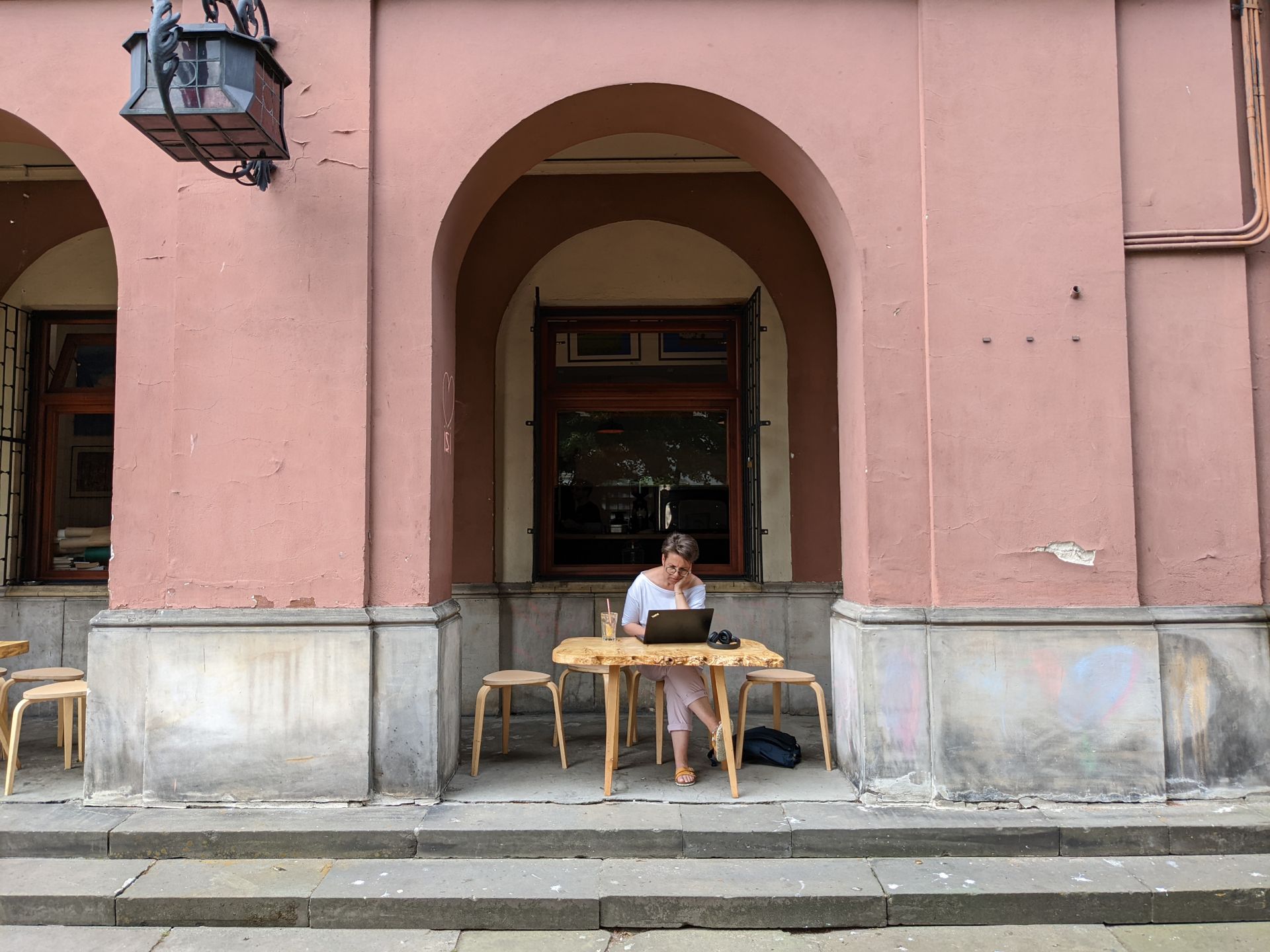
Coworking spaces (Hubba in Bangkok, Dojo in Bali, Selina globally) are worth their €10-25 day pass — the productivity gain over hotel-room or café working typically exceeds the cost. Cafés work for unbounded, non-video-call tasks under two to three hours; for longer stays, book accommodation with a genuine desk rather than a writing shelf.
Time Zone Management
Map your work's time zone compatibility before choosing destinations — a US East Coast job has workable overlap with Western Europe but structural conflict with Southeast Asia. Negotiating asynchronous, deliverable-based work arrangements rather than hours-based ones is the single highest-return preparation for genuine location independence.
Essential Tools
A sub-1.5kg laptop (MacBook Air, Dell XPS 13, ThinkPad X1 Carbon), noise-cancelling headphones (Sony WH-1000XM5), a VPN for public Wi-Fi security, a password manager, and offline-cached cloud documents form the core toolkit. World Time Buddy and Calendly reduce the coordination overhead of multi-time-zone scheduling.
Structuring the Day and Managing Relationships
Work first, travel second — complete obligations before exploring rather than weaving work into a tourism-structured day. Treat transit days as non-working days. Be more transparent about your location with employers and clients than feels necessary, and communicate proactively so a three-day silence doesn't read as a missed deadline.
The Psychological Management
The "guilt loop" — working while feeling guilty about not exploring, exploring while feeling guilty about not working — is resolved by a clear boundary between work time and travel time, honored consistently. Measure your own productivity by output rather than visible presence, which travel inherently disrupts.
Final Thoughts
Get the connectivity infrastructure right, build deliberate daily structure, and honor the boundary between the working self and the traveling self. The rewards of doing both well — genuinely — are considerable.