Europe's rail network — over 240,000 kilometers connecting more than 40 countries — is the finest in the world, dropping you in the city center rather than an airport suburb. This guide covers how the network fits together, Eurail passes versus point-to-point tickets, booking strategy, the best scenic routes, overnight sleeper trains, and the practical rules that keep a rail trip running smoothly.
The train drops you in the city center, lets you watch the countryside, and — if you book correctly — costs less than flying. This guide teaches you to book correctly.
Understanding the Network
Europe's rail system is a patchwork, not a single operator: national operators (SNCF, Deutsche Bahn, Trenitalia, Renfe, SBB, ÖBB) run domestic and many international routes; high-speed lines (TGV, ICE, Frecciarossa, AVE, Thalys/Eurostar) connect major cities at 250-320 km/h and require seat reservations; regional trains reach smaller towns, often with no advance booking needed; and overnight sleepers are experiencing a genuine renaissance, led by Austria's ÖBB Nightjet network connecting Vienna, Zurich, Brussels, Amsterdam, Paris, and Rome.
Eurail Pass vs Point-to-Point Tickets
The Eurail Global Pass covers 33 countries on a day-based system and suits spontaneous, multi-country, long-distance itineraries — but high-speed trains still charge reservation fees of €4-40 on top, which can erase the savings. Point-to-point advance tickets booked 6-12 weeks ahead (SNCF's Ouigo from €19, Germany's DB Sparpreis, Trenitalia and Renfe promotional fares) are almost always cheaper for a fixed itinerary with a moderate number of high-speed journeys. Single-country passes (Eurail France, Germany) can beat the Global Pass for focused trips.
How to Book
Book directly with national operators when possible (sncf-connect.com, bahn.de, trenitalia.com) to avoid third-party fees and access the cheapest promotional fares. Omio and Rail Europe are the best aggregators for complex cross-border itineraries; Trainline is popular but always compare against direct booking. Book high-speed trains the moment 90-day advance fares release — the cheapest tiers on Eurostar and TGV sell out within hours. Regional trains carry fixed fares with no rush to book early.
The Best Scenic Routes
Paris to London via Eurostar (2h15m through the Channel Tunnel) is the great city-to-city connection; the Glacier Express (Zermatt-St. Moritz, 8 hours, 291 bridges, 91 tunnels) and Bernina Express (Chur-Tirano, crossing at 2,253m) are UNESCO-listed Alpine masterpieces; Norway's Flåm Railway climbs through waterfalls and gorges to 867m; and Paris-Nice along the French Riviera, Vienna-Salzburg through the Austrian Alps, and Spain's Seville-Madrid AVE (2h30m at 300 km/h) round out Europe's finest rail journeys. The overnight Budapest-Bucharest service through Transylvania's Carpathian landscapes, the short and scenic Cinque Terre coastal train linking all five Ligurian villages, and Scotland's Highland Mainline from Edinburgh to Inverness — crossing the desolate beauty of Rannoch Moor — round out the list for travelers with more time to explore.
Overnight Trains and Rail Passes
ÖBB Nightjet is the gold standard of overnight rail, offering seats, couchettes, and private sleeper cabins with breakfast included on routes like Vienna-Paris and Zurich-Barcelona — book private cabins weeks to months ahead as they sell out fast. Newer operators like European Sleeper (Brussels-Berlin-Prague) and Spain's Trenhotel services (Madrid-Lisbon) are extending the overnight revival further. Beyond Eurail, Interrail offers the same coverage as Eurail exclusively to European residents, often slightly cheaper; the Swiss Travel Pass (unlimited trains, buses, boats, and 500+ museums) is exceptional value since Switzerland has no advance-fare discounts; BritRail covers unlimited travel across England, Scotland, and Wales for non-UK residents; and Germany's Deutschlandticket (€58/month unlimited regional and local transit) is transformative value for exploring beyond the ICE network.
Practical Rules That Matter
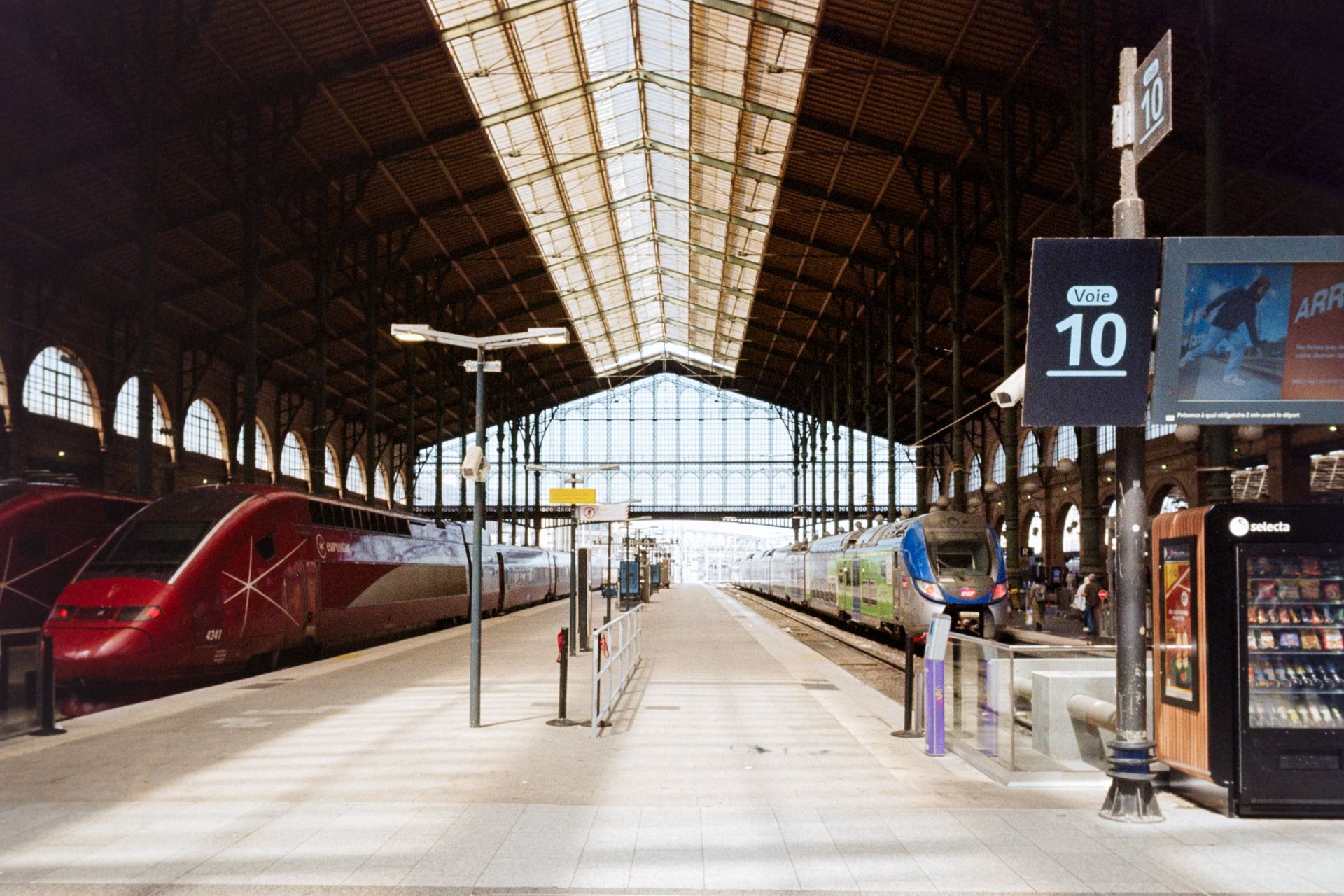
Validate paper tickets in France, Italy, and Spain's yellow/orange platform machines before boarding — an unvalidated ticket can mean a €50-100 fine. Arrive 10-15 minutes before departure since European trains leave on time and doors close early. Download DB Navigator, SNCF Connect, Trenitalia, or SBB Mobile for live platform and delay information. Allow 30-45 minutes for connections at intermediate stations, and check both Trenitalia and Italo on Italian high-speed routes since prices and times vary meaningfully between them. Watch the departure board for platform assignments in major stations (often announced only 10-20 minutes ahead), use station left-luggage facilities (€3-10/day) for baggage-free day trips, and consider first class on long journeys — often only 30-50% more than second class for meaningfully more space and quiet.
Sample Rail Itineraries
A classic western Europe loop runs London to Paris, Lyon, Nice, Barcelona, Madrid, and Lisbon over two weeks entirely by rail. An Alpine circuit on the Swiss Travel Pass connects Zurich, Chur, Zermatt (via the Glacier Express), Geneva, Lausanne, Bern, and Lucerne in ten days. A central European loop links Vienna, Salzburg, Munich, Prague, Kraków, and Budapest over twelve days of Habsburg cities and mountain landscapes. And a Scandinavian rail journey — Copenhagen, Gothenburg, Oslo, Bergen, and Stockholm — includes the Bergen Railway's mountain crossing, one of Europe's great scenic journeys.
Common Mistakes and the Carbon Case
Buying tickets at the station on travel day can cost three to five times the advance fare; assuming a Eurail pass covers everything ignores reservation surcharges; and non-refundable advance fares punish any change of plans. On the environmental side, the numbers are stark — a Paris-London flight produces roughly 100-150 kg of CO₂ per passenger versus about 6 kg for the Eurostar, a 95% reduction that makes rail the clearly more ethical choice for any European route with a train alternative.
Final Thoughts
European rail travel treats the journey as part of the experience rather than an obstacle to it — you arrive in the city center, not the suburbs, with no gate, no carousel, no security line. Book early, sit by the window, and let the landscape do the rest. The journey is the destination.