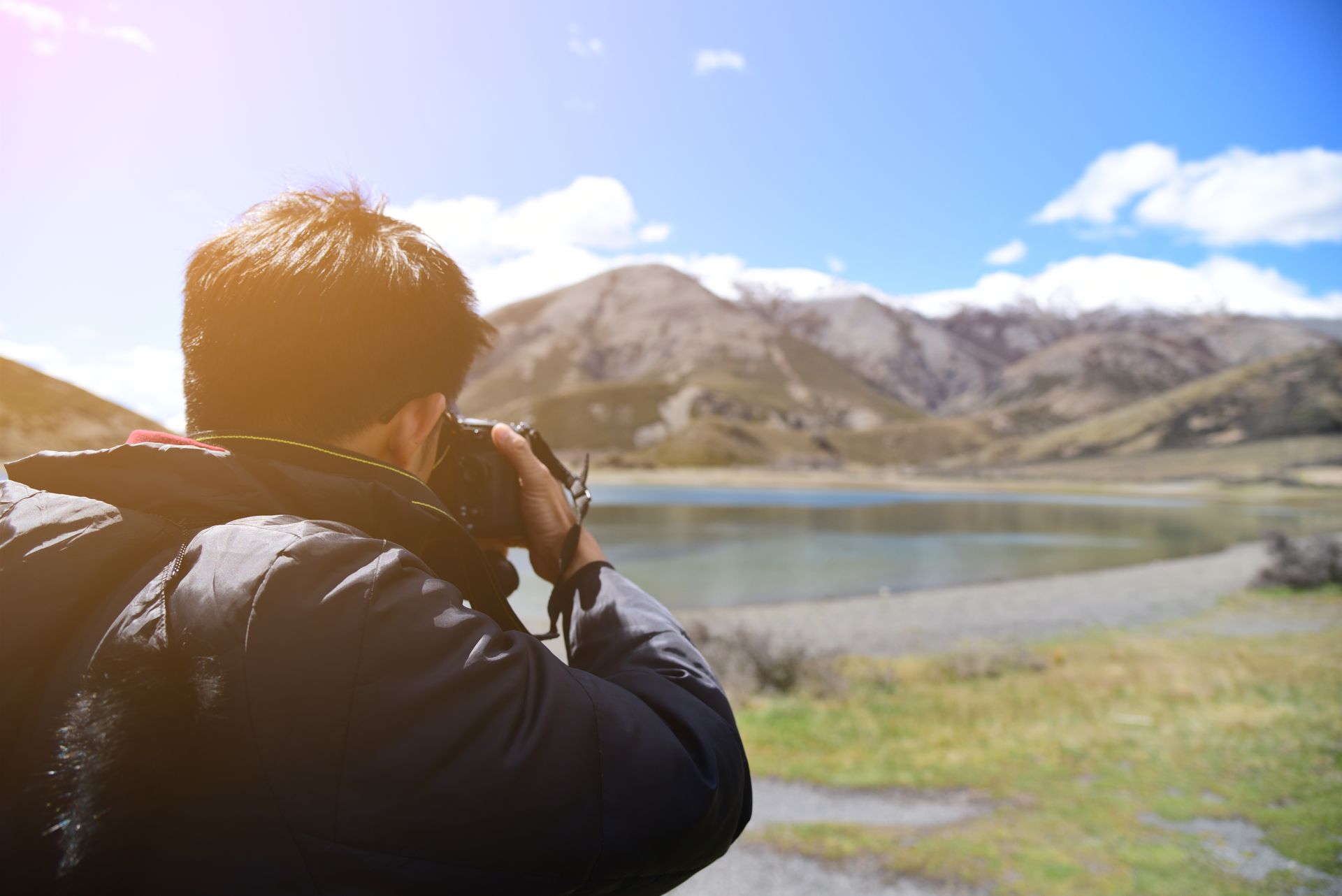
Photography is not documentation — it's communication. The tourist photographs a place to record they were there; the blogger photographs it to produce a specific emotional response in a reader who wasn't. Before raising the camera, ask what you want the viewer to feel — awe, intimacy, longing, adventure — and let that answer determine position, framing, and moment of capture.
The gap between the extraordinary scene in front of you and the mediocre image you're producing is almost never closed by better gear. It's closed by seeing.
Gear That Actually Matters
Current flagship smartphones produce entirely viable blog and social photography — their limitation is skill, not hardware. Shoot in RAW where the phone supports it for far more editing latitude than the computational JPEG, lock exposure and focus separately with a long press so a bright sky doesn't underexpose a shaded subject, and stay within the optical zoom range rather than degrading quality with digital zoom. For dedicated cameras, entry-level mirrorless (Fujifilm X-T30 II, Sony a6400, £600–1,000) covers most bloggers' needs; a single 24–70mm-equivalent zoom is the best one-lens travel kit. A lightweight carbon fiber tripod enables the long-exposure dawn cityscapes and silky waterfalls that handheld shooting can't produce.
Composition That Transforms Images
Leading lines — roads, staircases, canal reflections, market stalls receding into depth — are travel photography's most powerful tool; position yourself at the origin of the line rather than perpendicular to it. Foreground interest (a rock, a wildflower, a pair of boots) placed deliberately in relation to a background subject is what separates immersive compositions from ones that merely document a view. Environmental portraits — people photographed within their specific context of color and commerce — communicate a place more directly than any landscape shot, but build a genuine human connection before raising the camera and ask permission wherever practical; subjects who feel respected produce a warmth in the frame that a telephoto snapshot from a distance never captures.
Mastering Light
Golden hour (30–60 minutes after sunrise, before sunset) isn't preference — it's physics: low-angle light reveals texture through long shadows and gives subjects three-dimensional shape. Blue hour (20–30 minutes before sunrise, after sunset) produces the illuminated-building-against-deep-blue-sky images that consistently perform across platforms. Overcast light, often dismissed, is genuinely ideal for food, waterfall, and market photography where harsh shadows would otherwise ruin the shot.
Beating the Crowds at Iconic Sites
Dawn arrivals at famous locations routinely deliver 30–60 minutes of near-zero crowd presence that midday visits never approach. When you can't avoid the crowd, reframe: the standard Santorini blue-dome shot is so reproduced it's essentially invisible to audiences — a side street, a close-up of ceramic tile texture, or a long exposure that blurs moving crowds into ghostly impressions against sharp architecture all tell a fresher story. Interior and architecture shots bring their own fixes: correct converging verticals by shooting level from further back rather than tilting up, and bracket exposures to blend a bright window with a darker interior rather than blowing one out. Don't retreat when weather turns — mist, rain-slicked cobblestones reflecting neon, and heavy storm cloud over a mountain range produce some of travel photography's most atmospheric frames, provided you protect the gear with a rain cover and a lens hood.
Editing and Consistency
Edit to enhance what was actually there rather than to create what wasn't — the most enduringly compelling images capture genuine light and color rather than pushing toward a stylized extreme. Build custom presets that encapsulate your exposure approach and color grading tendencies; batch-apply them to images from similar conditions, then fine-tune individually. Visual consistency matters more than any single image's technical excellence — audiences follow accounts because they know what world they'll enter when they click. That consistent style develops in stages over a couple of years: imitating photographers whose work resonates with you, synthesizing multiple influences into something your own, then finally shooting with a specific point of view rather than technical competence alone. Compose slightly wider than you need so the same frame can crop to a landscape blog header and a vertical Instagram or Pinterest pin without reshooting.
Final Thoughts
Learn the technical foundations, internalize them through practice, then put the technical thinking in the background and pay attention to the extraordinary world in front of you. The images will follow.