This guide covers the world's most dramatically sited cities — those built on cliffs, mountains, and open water — from Machu Picchu and Santorini to Venice and Bangkok's floating neighborhoods, and why their settings are as unforgettable as their monuments.
A city built where a city shouldn't be able to exist is, almost without exception, one of the most memorable places you'll ever stand.
Mountain Cities
Machu Picchu, perched at 2,430m in the Peruvian Andes, remains the definitive example — an Inca citadel built on a mountain saddle so precisely engineered that its stonework and drainage systems have survived over 500 years of earthquakes. Cusco, the former Inca capital at 3,400m, and La Paz, Bolivia's seat of government at up to 4,150m, both demonstrate entire modern metropolitan populations living and functioning at altitudes that would leave most visitors gasping for the first 48 hours. Thimphu in Bhutan and Innsbruck in the Austrian Alps round out the mountain category, both ringed by peaks that dominate every view down the main street.
Cliffside Cities
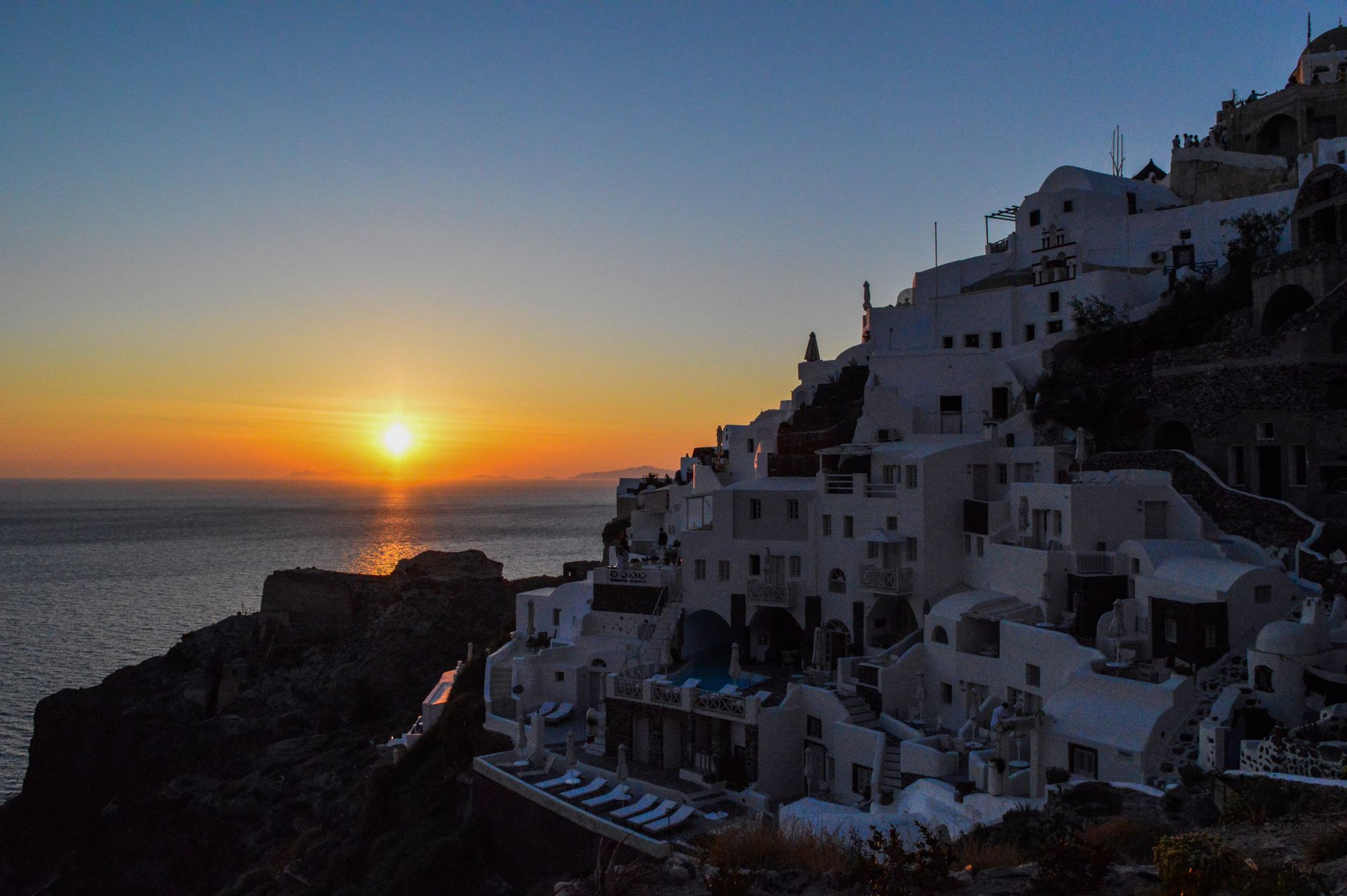
Santorini's Fira and Oia are the most photographed cliffside towns in the world — whitewashed Cycladic buildings clinging to a caldera rim formed by a volcanic eruption roughly 3,600 years ago, with sunset views over the Aegean that draw millions of visitors annually. Ronda in Spain splits dramatically across the El Tajo gorge, connected by a single 18th-century bridge with a 100-meter drop beneath it, while Mali's Bandiagara Escarpment settlements, built directly into a 150km sandstone cliff face by the Dogon people, represent one of the world's most remarkable examples of vertical human settlement. Positano on Italy's Amalfi Coast completes the picture — a town that appears to pour down a cliff face directly into the Tyrrhenian Sea.
Cities on the Water
Venice remains unmatched — 118 islands connected by 400-plus bridges across a lagoon, with no roads and canals serving as the city's primary transport arteries, an urban planning experiment with no true equivalent anywhere else. Amsterdam and Bruges both built extensive canal networks that shape daily movement through the city, while Bangkok's older floating neighborhoods along the Chao Phraya River preserve a traditional water-based way of life that predates the city's modern skyscraper skyline.
Stilt Villages and River Islands
Ganvié in Benin, often called "the Venice of Africa," is a village built entirely on stilts over Lake Nokoué, home to around 20,000 people who conduct daily life — markets, schools, commuting — entirely by canoe. Paris's river islands, the Île de la Cité and Île Saint-Louis, show a subtler version of the same idea: a capital city whose founding core sits literally on water in the middle of the Seine, with Notre-Dame anchoring the older of the two islands.
Why These Cities Matter to Visit
Beyond the visual drama, these settings usually explain the city's entire history — Machu Picchu's remoteness protected it from Spanish conquest for centuries; Venice's lagoon offered defensive security that shaped an entire maritime empire; the Dogon's escarpment settlements provided protection from historical slave raids. Visiting with this context transforms a scenic photo opportunity into a genuine understanding of why a city exists exactly where it does.
Final Thoughts
Flat ground is easy. These cities chose — or were forced onto — terrain that made building extraordinarily difficult, and the result is some of the most visually unforgettable urban environments on the planet. If a dramatic setting matters to your next trip, these are the places to start.