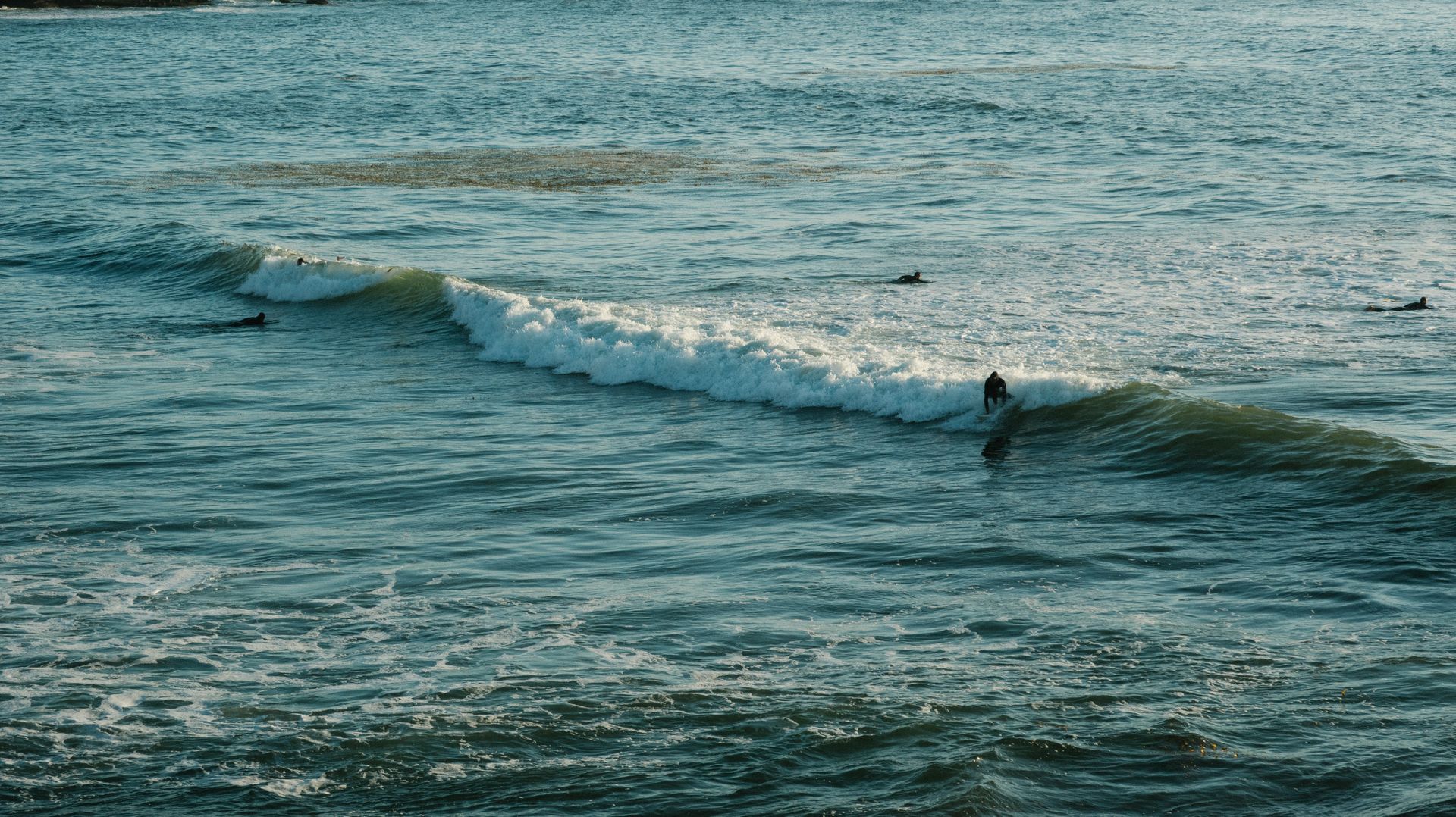
The most common mistake in surf travel planning is choosing a destination by reputation rather than suitability. This guide matches wave conditions to skill level across beginner, intermediate, advanced, and expert big-wave destinations, plus the essentials of planning a surf trip and surfing safely.
The wave you traveled to find is there — clean and powerful and exactly as you imagined it. And you paddle out.
Best for Beginners
Taghazout, Morocco has become one of the world's premier beginner destinations — mellow, consistent Atlantic beach breaks at Tamraght and Aourir, paired with the most developed surf camp ecosystem in the world for price and instruction quality. Kuta Beach in Bali offers a long, slow-peeling beach break in 28°C water that removes the intimidation of falling and accelerates progression; surf early before the onshore wind arrives. Sagres in Portugal's Algarve and Playa Dominical in Costa Rica round out the finest learning environments, both pairing gentle, consistent waves with excellent surf school infrastructure and rich out-of-water scenery. Newquay in Cornwall remains the standard beginner destination for UK and northern European surfers, its Fistral and Towan beach breaks paired with Britain's most developed surf school infrastructure and a genuine, deeply embedded local surf culture.
Best for Intermediates
Ericeira, Portugal — Europe's first World Surfing Reserve — packs seven distinct breaks within walking distance, giving intermediate surfers the variety that accelerates progression past the beginner plateau. Fuerteventura's Corralejo area delivers reliable winter Atlantic swell across beach and reef breaks. Nosara, Costa Rica's Playa Guiones is widely considered the world's finest intermediate training ground, home to elite-level coaches who've relocated specifically to teach there. Jeffreys Bay in South Africa is more aspirational than beginner-friendly — its Supertubes section produces some of the world's longest, most mechanically consistent right-hand point break rides — but the adjacent Kitchen Windows and Albatross breaks offer intermediate surfers excellent quality waves in a less saturated lineup.
Best for Advanced Surfers
Uluwatu in Bali is one of the world's finest left-hand reef breaks, its backhand-heavy wave developing exactly the skill most intermediate surfers plateau on. Hossegor, France produces some of Europe's most powerful beach break barrels outside Hawaii, driven by a deep offshore canyon that concentrates Atlantic swell energy. Siargao's Cloud 9 in the Philippines and Peniche's Supertubos in Portugal round out the world's finest advanced destinations, both offering world-class barrels with meaningfully less crowd pressure than their more famous counterparts.
Big Wave and Expert Destinations
Pipeline on Oahu's North Shore is surfing's most iconic and most dangerous wave, requiring not just expert surfing but navigation of one of the world's most established local lineup hierarchies. Teahupoo, Tahiti is widely considered the heaviest wave on earth — accessed by boat only, requiring jet ski safety support and genuine expert-level reef break competence. Nazaré, Portugal has produced the world's largest verified surfed waves via an underwater canyon that amplifies Atlantic swell to over 25 meters, surfed exclusively with jet ski assistance by a small professional community.
Planning Your Trip
Travel with a board slightly longer and more volume-forward than your home board for unfamiliar conditions — it paddles easier and lets you focus on technique rather than catching waves. Research your destination's optimal swell season specifically; a week in prime season beats two weeks outside it. Confirm your travel insurance explicitly covers surfing as a declared activity, marine injury treatment, and medical evacuation from remote breaks. Surf etiquette — priority to the surfer closest to the peak, paddling around rather than through the break, calling your direction on takeoff — is a functional safety system, not optional courtesy.
Final Thoughts
Surf travel demands a specific patience: the forecast is a probability, not a promise, and the swell that looked perfect online sometimes isn't. Choose the destination that matches your level, book the trip, and be patient with the ocean — it will deliver.