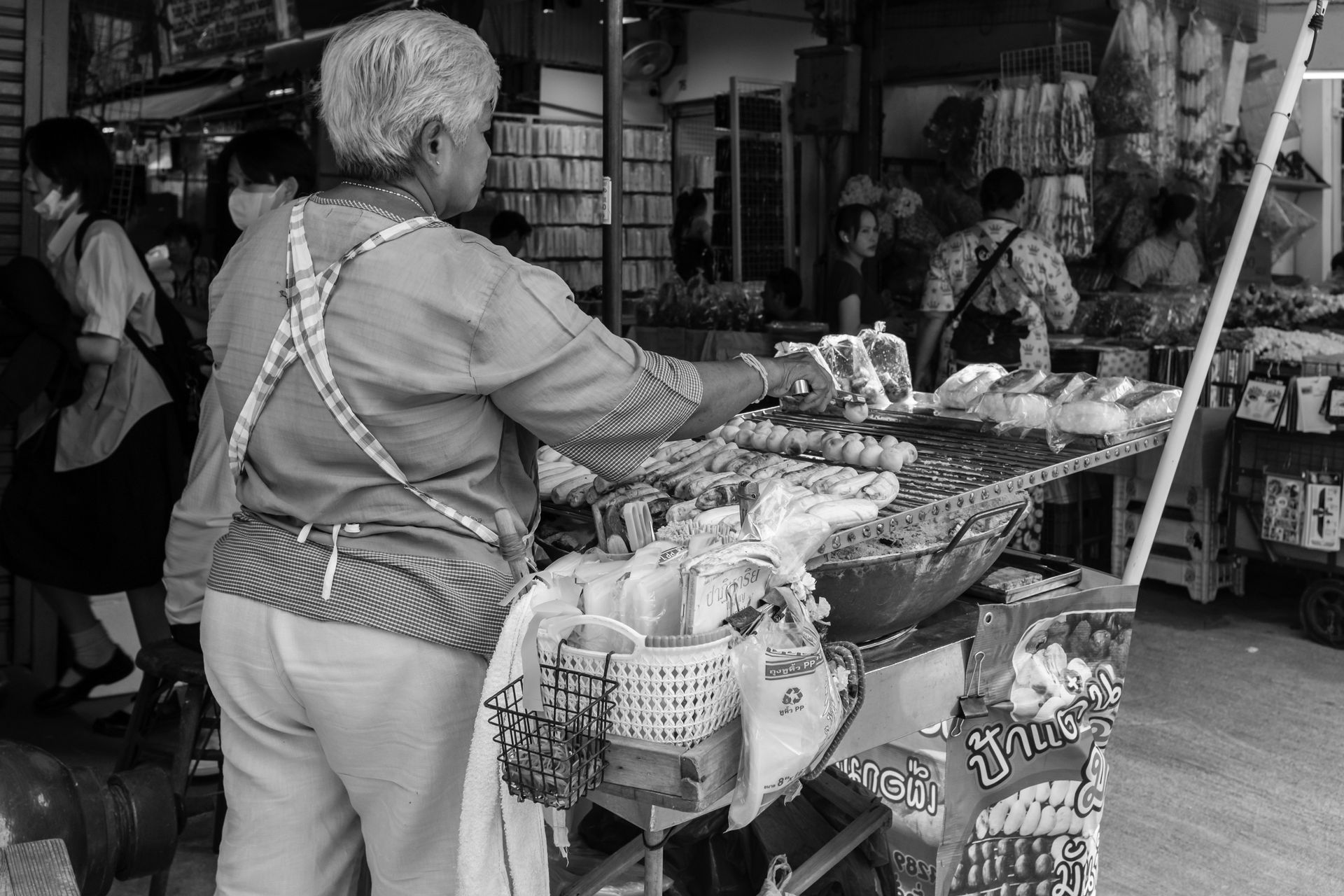
This guide covers 50 of the world's finest street foods across Asia, the Middle East, Africa, Latin America, Europe, and beyond — what they are, where to find them, and the safety principles that let you eat them with confidence.
Eating street food is not slumming. It is paying attention to what a place actually is — how it feeds itself, what it values.
Asia's Street Food Supremacy
Bangkok's pad thai, cooked at extreme wok heat with the exact sour-sweet-salty-nutty balance that no restaurant version replicates, is the starting point for a continent whose street carts consistently outperform its restaurants. Vietnam's bánh mì — an inherited French baguette transformed into something infinitely superior — and Hanoi's bánh cuốn steamed rice rolls show the same principle. Osaka's takoyaki, Singapore's Hainanese chicken rice, and India's pani puri (eaten in a single explosive bite before the shell dissolves) round out a region where the finest cooking happens standing up, at a plastic stool, for under two dollars.
More of Asia's Essential Street Foods
Hong Kong's dim sum trolleys (har gow, siu mai, char siu bao), Malaysia's roti canai (stretched, ghee-laden dough griddled until flaky-crisp and dipped in dhal), and Penang's char kway teow (wok-charred noodles with lap cheong sausage and cockles) sit alongside Korea's stone-bowl bibimbap, China's steamed baozi and soup-filled Shanghai xiaolongbao, and Beijing's jianbing — a folded savory crepe assembled in under two minutes that's one of street food's great live performances.
The Himalayas contribute momo (Nepal and Tibet's steamed dumplings, dipped in a tomato-sesame achar), while Singapore and Malaysia's laksa (a coconut-curry noodle soup enriched with dried shrimp paste) and Southeast Asia's charcoal-grilled satay skewers with peanut sauce round out the region. India's chaat family — aloo tikki, bhel puri, papdi chaat — layers sweet tamarind, sharp lime, and crunch into something more complex than most restaurant dishes, and Vietnam's bánh xèo (a sizzling turmeric rice crepe folded around pork and shrimp) shows the same principle. Indonesia's gado-gado (vegetables and tempeh in peanut sauce) and Thailand's pounded green papaya salad, som tum, close out the region's range.
The Middle East, Africa, and the Americas
Beirut's shawarma, Cairo's koshari (Egypt's most satisfying vegetarian street food, layering rice, lentils, macaroni, and crispy onions), and Marrakech's Djemaa el-Fna night market — hundreds of stalls igniting at sunset — represent some of the oldest and most theatrical street food cultures in the world. Mexico City's tacos al pastor, cut straight from a vertical spit adapted from Lebanese shawarma technique by immigrant communities in the 1930s, is arguably the single greatest taco on Earth. Lima's ceviche and anticuchos, and Bogotá-adjacent Colombia's arepas, show Latin America's street food operating at the same level of sophistication as any tasting menu.
Africa's Deeper Street Food Traditions
Egypt's ta'ameya (the original fava-bean falafel, greener and more herbal than the chickpea version that spread through Israel and Lebanon), Nigeria's suya (peanut-spiced grilled beef wrapped in newspaper), and Ethiopia's injera with tibs (a sourdough flatbread that doubles as plate and utensil for spiced meat and lentils) show a continent of street food traditions still underrepresented on most lists. South Africa's bunny chow — a hollowed quarter-loaf filled with curry, a Durban Indian invention — and Uganda's rolex, a chapati rolled around a fried egg omelette, complete a continent-wide range from elegant simplicity to slow-built spice.
Latin America Beyond the Taco
Mexico's elote and esquites (grilled corn dressed with mayonnaise, cotija cheese, chili, and lime) apply the same fat-salt-acid-heat logic that makes al pastor so effective. Argentina, Chile, and Colombia each claim their own empanada tradition — baked or fried pastry filled with everything from spiced beef and olives to cheese and corn — while Brazil contributes coxinha (a teardrop-shaped chicken and cream-cheese fritter) and brigadeiro, the condensed-milk chocolate truffle that closes out nearly every Brazilian street gathering.
Europe's Underrated Street Culture
Berlin's currywurst and döner kebab (a German innovation by Turkish immigrant communities, arguably superior to its Turkish original for handheld eating) prove that great street food isn't confined to Asia and Latin America. Sicily's arancini, Madrid's churros with hot chocolate at Chocolatería San Ginés (open since 1894), and Lisbon's pastel de nata show Europe's own deep street food traditions, often overlooked in favor of its restaurant reputation.
Europe's Remaining Classics, and Beyond
Brittany's buckwheat crêpe (the galette complète, filled with ham, cheese, and egg) and the Netherlands' poffertjes — fluffy yeasted mini pancakes dusted with sugar — sit alongside Hungary's fried langos and the Balkans' spiral phyllo burek, a Sarajevo specialty eaten with kefir. Britain's fish and chips, battered and fried in dripping and doused in malt vinegar, remains one of Europe's finest handheld traditions. Further afield, New York and Chicago-style hot dogs, Maine's butter- or mayonnaise-dressed lobster roll, Jamaica's allspice-smoked jerk chicken, and Australia's mince-and-gravy meat pie round out a genuinely global list, alongside Istanbul's sesame-ringed simit, sold from carts since before the Ottoman Empire.
Eating Street Food Safely
Look for the crowd — high turnover means fresh food rather than food that's been sitting for hours. Watch the cook: anything prepared to order in front of you at high heat (a wok, a grill, a fryer) carries far less risk than food prepared in advance and reheated. Eat where locals eat at local hours, peel your own fruit rather than buying pre-cut, and give your gut a few days to adjust — the traveler's stomach of day one is not the same stomach as day ten.
What Makes It the Point
The taco vendor who has shaved meat from the same trompo for thirty years, the Penang hawker whose wok has been seasoned by decades of cooking, the Istanbul simit seller whose cart rolls out at 6am sustaining a bread tradition older than the Ottoman Empire — each has accumulated a knowledge of craft that no culinary school teaches.
Final Thoughts
Street food is the most direct education in culture that travel provides. Eat everything. Eat it where it comes from. Let it tell you where you are.