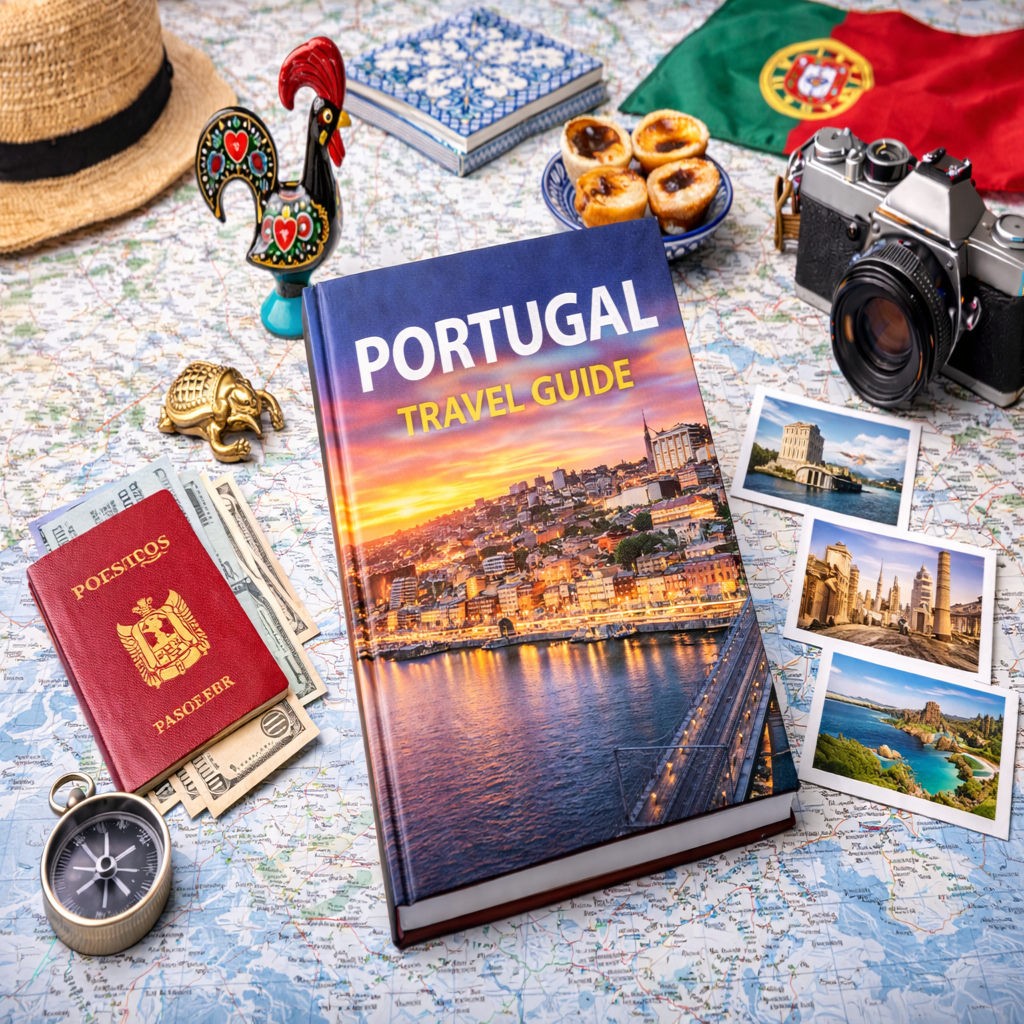
Portugal has a way of catching people off guard. You arrive expecting pleasant weather, good wine, and pretty tiles — and you leave having experienced something far deeper and more lasting than you anticipated. A country of extraordinary historical reach, whose explorers once mapped the known world and whose language is now spoken by 250 million people across five continents, Portugal wears its remarkable past with a quiet, unhurried grace that is entirely its own.
It is a country of profound contrasts. The ancient, labyrinthine Alfama district of Lisbon, where fado music drifts from open doorways on warm evenings, sits minutes from some of Europe’s most vibrant contemporary restaurants and design hotels. The Alentejo’s vast, cork-forested plains stretch in near-biblical silence between villages where time moves at its own pace. The Algarve’s dramatic golden coastline alternates between world-class beach resorts and wild, wind-sculpted clifftops where almost no one goes. The Douro Valley rises in terraced vineyard steps above a river so beautiful that UNESCO has protected its entire landscape.
For first-time visitors, Portugal offers something increasingly rare in European travel: genuine authenticity. It has not been smoothed into a theme-park version of itself. The food is honest and ingredient-driven. The people are warm without being performative about it. The cities are walkable and human in scale. And despite a decade of tourism growth that has brought significant global attention, there remains an extraordinary amount of Portugal that most visitors never reach — waiting quietly for those willing to look a little further.
This Portugal travel guide for first timers covers everything you need: the best time to visit, how to get around, where to go, what to eat, where to stay, and the insider knowledge that will help you fall in love with one of Europe’s most rewarding and underestimated destinations.
Why Portugal Should Be Every First-Time Traveler’s European Dream
Portugal has spent much of its modern history as Europe’s westernmost secret — overshadowed by its larger Iberian neighbor Spain, underestimated by travelers who assumed the continent’s big names had more to offer. That era is emphatically over. Lisbon and Porto have emerged as two of Europe’s most exciting and livable cities. The Algarve has long been established as one of the continent’s finest coastal destinations. And the interior — the Alentejo, the Douro, the Minho, the Beiras — continues to reward the traveler who ventures beyond the obvious.
What makes Portugal special is difficult to reduce to a list but easy to feel. It is the saudade — a Portuguese word with no direct English translation, describing a bittersweet longing for something beautiful and lost — that permeates the country’s music, literature, and soul. It is the blue-and-white azulejo tiles covering church facades, railway stations, and ordinary house fronts with an artistry that turns the entire country into an open-air museum. It is the pastéis de nata, eaten warm from the oven at a Lisbon pastelaria, that make you understand why food culture matters. It is the Atlantic light — cleaner and cooler than the Mediterranean’s — that makes every landscape glow.
Portugal also offers outstanding value by Western European standards. A three-course meal with wine at a good Lisbon restaurant costs a fraction of what you would pay in Paris or London. A night in a beautifully restored historic hotel in the Alentejo is priced below equivalent accommodation in Tuscany. The country’s extensive, well-maintained rail network makes independent travel affordable and straightforward.
Best Time to Visit Portugal
Portugal enjoys one of Western Europe’s most enviable climates — more than 300 days of sunshine per year in the south, mild winters, and warm but rarely oppressive summers. Every season has its merits.
Spring (March to May) — The Finest Season
Spring is widely considered the best time to visit Portugal. The countryside is at its most spectacularly green and wildflower-covered, temperatures are warm and comfortable across the country (16°C–24°C / 61°F–75°F), and the tourist crowds have not yet reached their summer peak. The almond blossoms of the Algarve in late February and early March are among the most beautiful natural spectacles in Europe. Lisbon and Porto are at their most enjoyable — warm enough for outdoor café life but cool enough for long days of walking. The Festa das Cruzes in Barcelos (May) and other regional spring festivals add cultural richness to any itinerary.
Summer (June to August) — Peak Season and Atlantic Beaches
Summer brings Portugal’s largest crowds and highest prices, particularly in Lisbon, the Algarve, and the islands. Temperatures in Lisbon and Porto are very pleasant (25°C–28°C), though inland regions like the Alentejo can reach 40°C or above. The Atlantic coast beaches are at their best — the water remains cooler than the Mediterranean but the waves and surf are magnificent, particularly on the west-facing Costa Vicentina. The NOS Alive and Super Bock Super Rock music festivals in Lisbon, and the Festas de Lisboa (June 12–13, the city’s most important popular festival, centered on the grilled sardine feast of Santo António) are summer highlights. Book everything well in advance.
Autumn (September to November) — The Insider’s Choice
September and October are arguably the finest months of all for experienced travelers. The summer heat softens, the crowds thin dramatically after mid-September, and the country settles into a golden, unhurried autumn rhythm. The Douro Valley wine harvest (vindima) in September and October is one of Europe’s great seasonal events — the terraced vineyards turn amber and red, quintas (wine estates) open their gates, and the air smells of fermentation and wood smoke. Prices fall significantly after the summer peak, and the mild weather remains ideal for walking, cycling, and outdoor dining well into November.
Winter (December to February) — Mild, Affordable, and Quietly Beautiful
Portugal’s winter is the mildest in mainland Europe. Lisbon rarely sees temperatures below 8°C, and the Algarve enjoys average winter highs of 15°C–18°C — warm enough for comfortable sightseeing and the occasional beach walk. Rain is more common, particularly in the north, but the cities are at their most authentically local. Prices drop substantially, museums are uncrowded, and the Christmas and New Year celebrations in Lisbon and Porto are genuinely lovely. The Algarve in January and February is one of Europe’s best-kept winter sun secrets.
How to Get to Portugal
By Air: Lisbon’s Humberto Delgado Airport (LIS) and Porto’s Francisco Sá Carneiro Airport (OPO) are the main international gateways, with extensive connections to Europe, North America, Brazil, and Africa. TAP Air Portugal operates as the national carrier with good transatlantic coverage. From London, flights to Lisbon take around 2.5 hours; from New York approximately 7 hours; from Brazil 9–10 hours. Faro Airport (FAO) in the Algarve receives extensive European charter and low-cost flights, particularly from the UK, Ireland, Germany, and the Netherlands, making it the most convenient entry point for Algarve-focused trips.
Getting from Lisbon Airport to the City: The Lisbon Metro’s Red Line connects the airport to the city center (Alameda, Oriente, and Marquês de Pombal) in 20–30 minutes for approximately €1.70 on a Viva Viagem card. Taxis charge a flat rate of approximately €15–€20 to the historic center. Uber and Bolt are widely available and usually slightly cheaper than taxis. The Aerobus coach service also runs to key city stops for around €4.
Getting from Porto Airport to the City: Metro Line E (Violet) connects the airport to central Porto (Casa da Música, Trindade, Bolhão) in 30–40 minutes for approximately €2.00 on an Andante card. Taxis cost approximately €20–€25 to the historic center.
By Rail from Spain: The Lusitânia Comboio Hotel overnight train connects Madrid to Lisbon (approximately 10 hours), and the high-speed Alfa Pendular connects Vigo (Spain) to Porto. Both are scenic and atmospheric options for travelers combining Portugal and Spain.
Getting Around Portugal
Portugal is a relatively small country — roughly the size of the US state of Indiana — with a good transport infrastructure that makes independent travel very manageable.
Train (CP — Comboios de Portugal): Portugal’s national rail network is affordable, comfortable, and covers the main tourist routes very well. The Alfa Pendular high-speed service connects Lisbon and Porto in approximately 3 hours and runs via Coimbra (1.5 hours from Lisbon). The Lisbon–Faro Algarve route takes around 3.5 hours. The Douro Line from Porto to Pocinho is one of the most scenic train journeys in Europe — winding along the river through vineyard terraces for over 150 km. Book tickets in advance on the CP website for the best prices.
Bus (Rede Expressos and FlixBus): Rede Expressos is the national bus network, covering destinations not served by rail — particularly in the Alentejo and interior regions. Generally comfortable and affordable. FlixBus also operates several Portuguese routes. For reaching smaller towns, villages, and rural areas, buses are often the only public transport option.
Car Rental: For exploring the Alentejo, the Douro Valley, the Minho, the interior Algarve, and the country’s many smaller villages and landscapes, a rental car is invaluable and offers a freedom that public transport cannot match. Roads are excellent, traffic outside Lisbon and Porto is light, and parking is straightforward in most rural areas. Driving in central Lisbon and Porto is not recommended — both cities have very limited parking, extensive restricted zones, and confusing one-way systems. Rent a car for rural legs of your trip and use public transport in the cities.
Lisbon’s Public Transport: The iconic yellow Tram 28, which rattles through the Alfama and Mouraria neighborhoods, is as much a sightseeing experience as a practical transport option. The Lisbon Metro covers the main tourist areas efficiently. Historic funiculars (ascensores) — the Glória, Bica, and Lavra — navigate the city’s steep hills. A Viva Viagem card (rechargeable, available at Metro stations) covers all of these modes.
Porto’s Public Transport: Porto’s Metro covers six lines and connects most key neighborhoods and the waterfront. The historic Tram Line 1, running along the Douro riverfront from Ribeira to Foz, is a delightful and scenic journey. The Porto Card (24, 48, or 72 hours) includes unlimited public transport and free or discounted entry to major museums and attractions.
Taxis and Rideshares: Taxis are metered, reliable, and affordable by Western European standards. Uber, Bolt, and Free Now all operate in Lisbon and Porto and are generally convenient and transparent in pricing.
Top Destinations in Portugal for First-Time Visitors
Portugal rewards both the city traveler and the nature seeker, the history lover and the food obsessive. Here is a region-by-region guide to the country’s finest destinations.
1. Lisbon — Europe’s Most Captivating Capital
Lisbon is one of Europe’s oldest and most beautiful cities, set across seven hills above the broad estuary of the Tagus River. Its neighborhoods each have a distinct personality: Alfama, the ancient Moorish quarter with its maze of whitewashed alleys and the São Jorge Castle perched above; Mouraria, the multicultural heart of the city and birthplace of fado; Belém, the riverside district from which Vasco da Gama set sail in 1497, home to the magnificent Jerónimos Monastery and the iconic Torre de Belém; and the Bairro Alto, the hilltop neighborhood of bars, restaurants, and fado houses that comes alive after dark.
The Museu Nacional do Azulejo (National Tile Museum), housed in a 16th-century convent, is one of the world’s most distinctive and rewarding museums — a comprehensive survey of the Portuguese tile-making tradition from its Moorish origins to the present. The Museu Calouste Gulbenkian houses one of Europe’s finest private art collections, spanning ancient Egypt to the 20th century. And the MAAT (Museum of Art, Architecture and Technology) on the Tagus riverfront is among Europe’s most architecturally striking contemporary art venues.
Pro tip: Ride Tram 28 from Martim Moniz through the Alfama early in the morning before the tourist crowds arrive. The views from the Portas do Sol and Santa Luzia viewpoints (miradouros) are among the finest in the city.
2. Porto — Wine, Bridges, and Soul
Porto is one of Europe’s most characterful cities — raw, hilly, densely layered, and deeply atmospheric in a way that is entirely different from Lisbon’s sun-drenched elegance. The Ribeira district, a UNESCO World Heritage Site, tumbles down to the Douro riverfront in a cascade of colorful, tilework-clad buildings that are simultaneously crumbling and beautiful. The Dom Luís I Bridge, designed by a pupil of Gustave Eiffel and spanning the river between Porto and Vila Nova de Gaia, is one of Europe’s great iron bridges and best crossed on foot for the views.
Vila Nova de Gaia, on the south bank of the Douro, is the home of the port wine trade — dozens of historic lodges (caves) including Taylor’s, Graham’s, Sandeman, and Quinta do Crasto offer tours and tastings of the fortified wine that made Porto famous. The Livraria Lello, one of the world’s most beautiful bookshops — a neo-Gothic interior of sweeping staircases and ornate woodwork that allegedly inspired J.K. Rowling — is a pilgrimage site for book lovers. The São Bento railway station, with its vast azulejo panels depicting scenes from Portuguese history, is a masterpiece of decorative art hiding in plain sight as a working train station.
3. The Algarve — Cliffs, Beaches, and Golden Light
The Algarve’s 155 km of coastline is one of Europe’s most celebrated stretches of beach — and deservedly so. The western Algarve, centered on Sagres and the Costa Vicentina, is wild, dramatic, and largely undeveloped — towering red and gold cliffs, powerful Atlantic surf, and an empty, wind-swept beauty that is deeply different from the more developed eastern coast. Praia da Marinha, Praia de Benagil (home to the famous sea cave accessible by kayak or boat), and Praia da Bordeira are among the finest beaches in Europe.
Sagres, at Portugal’s southwestern tip, was the base from which Prince Henry the Navigator organized the great voyages of exploration that defined the 15th century. The fortress and wind compass at Cabo de São Vicente — mainland Europe’s most southwestern point — are among the most historically evocative sites in the country.
The central and eastern Algarve, around Lagos, Albufeira, and Tavira, offers a more developed tourism infrastructure with excellent restaurants, golf, and resorts. Tavira, with its Roman bridge, whitewashed churches, and refined, unhurried atmosphere, is widely considered the most beautiful and authentic town in the Algarve.
4. Sintra — Fairy-Tale Palaces and Forest Mist
Just 40 minutes by train from Lisbon, Sintra is one of the most extraordinary day trip destinations in Europe — a UNESCO World Heritage landscape of forested hillsides, romantic fog, and a concentration of palaces and estates that has no equal in Portugal. The Palácio Nacional da Pena, perched on a hilltop and painted in vivid yellow and red, is a 19th-century Romantic fantasy of towers, turrets, and battlements. The Quinta da Regaleira, with its initiatic well (a spiral staircase descending 27 meters into the earth), is deeply mysterious and beautiful. The ruined Moorish Castle, overrun with moss and lichen and open to the Atlantic sky, offers one of the finest views in the entire country.
Pro tip: Arrive in Sintra before 9 AM or after 4 PM to avoid the worst of the summer crowds. Book palace tickets in advance and consider cycling or hiking between sites rather than relying on the overcrowded tuk-tuks.
5. The Douro Valley — Vineyards, River, and Quinta Life
The Douro Valley is one of Europe’s most spectacular landscapes — a UNESCO World Heritage Site where terraced vineyards rise in perfect symmetry from the banks of the Douro River for over 100 km into the interior. It is the birthplace of port wine and one of Portugal’s finest table wine regions, and exploring it — by train along the river, by boat cruise, or most rewardingly by car along the narrow vineyard roads — is one of the great travel experiences in Europe.
Staying at a quinta (wine estate) in the Douro is an outstanding experience. Many quintas open their doors to guests, offering rooms, cellar tours, and tastings of port and Douro wines in settings of extraordinary beauty. Peso da Régua and Pinhão are the most practical bases for Douro exploration. The vintage (harvest) season in September and October, when the grapes are picked and the valley fills with the smell of fermentation, is the finest time to visit.
6. The Alentejo — Plains, Cork, and Slow Living
The Alentejo — covering roughly a third of Portugal’s land area but containing just 7% of its population — is the country’s best-kept secret. Vast, rolling plains of cork oak, olive, and wheat stretch in every direction beneath an enormous sky. Medieval walled towns rise from hilltops as they have for a thousand years. And the food and wine — Alentejo cuisine and its big, oak-aged red wines are among the finest expressions of Portuguese gastronomy — reward the traveler who ventures this far.
Évora, the Alentejo’s capital, is a UNESCO World Heritage city of extraordinary richness — Roman temple, medieval cathedral, university founded in 1559, and the haunting Capela dos Ossos (Chapel of Bones), whose walls and ceiling are covered with the bones of some 5,000 monks, are all within the ancient city walls. Monsaraz, a perfectly preserved medieval village on a hilltop above the Alqueva lake, and Marvão, a fortified village at 900 meters in the Serra de São Mamede, are two of the most beautiful small towns in Portugal.
7. The Minho and Northern Portugal — Green, Ancient, and Undiscovered
Northern Portugal’s Minho region — the greenest and wettest part of the country — is largely unknown to international visitors and contains some of Portugal’s most rewarding experiences. The Peneda-Gerês National Park, Portugal’s only national park, is a landscape of granite mountains, ancient oak forests, and traditional Minho villages that is unlike anywhere else in the country. The Caminho Português (Portuguese Way of St. James) passes through the region on its route to Santiago de Compostela.
Guimarães, where Portugal was born in 1128 and where Afonso Henriques was proclaimed the country’s first king, is a UNESCO World Heritage city of medieval streets and extraordinary historical significance — and is almost entirely free of the tourist crowds that define Lisbon and Porto. Braga, the religious capital of Portugal, with its extraordinary churches and the iconic Bom Jesus do Monte sanctuary (reached by a zigzag baroque stairway), is equally rewarding.
8. Madeira and the Azores — Atlantic Island Paradise
Portugal’s Atlantic island territories offer two of the world’s most extraordinary island travel experiences. Madeira, 1,000 km southwest of Lisbon, is a volcanic island of dramatic mountain scenery, lush laurel forests (a UNESCO World Heritage remnant of a prehistoric ecosystem), extraordinary levada (irrigation channel) walking trails, and a sophisticated food and wine culture built around espetada (beef skewers), black scabbardfish, and Madeira wine.
The Azores — nine volcanic islands scattered across the mid-Atlantic 1,500 km from Lisbon — are one of Europe’s most spectacular and undervisited destinations. São Miguel, the largest island, offers steaming volcanic calderas, crater lakes of vivid blue and green, hot spring thermal baths, and some of the finest whale watching in the world. Flores and Corvo, the westernmost islands, are among the most remote and beautiful places in Europe.
What to Eat in Portugal: A First-Timer’s Food Guide
Portuguese cuisine is one of Europe’s most honest and rewarding — built on the finest Atlantic seafood, exceptional cured meats and cheeses, fragrant olive oil, and an extraordinary repertoire of slow-cooked, deeply flavored dishes that reflect centuries of domestic culinary tradition.
Pastéis de Nata: The custard tart that has conquered the world — a flaky pastry shell filled with a rich, wobbly custard cream, sprinkled with cinnamon, and eaten warm from the oven. The original, perfected recipe belongs to the Pastéis de Belém bakery in Lisbon, in continuous operation since 1837. Eating one at the counter, dusted with cinnamon and icing sugar, with a bica (espresso) alongside, is one of the great small pleasures of travel in Europe.
Bacalhau (Salt Cod): Portugal’s most beloved ingredient — dried and salted cod, rehydrated and cooked in hundreds of ways. It is said there are 365 bacalhau recipes, one for every day of the year. Bacalhau à Brás (shredded salt cod with scrambled eggs and crisps), Bacalhau com Natas (with cream and potato gratin), and Bacalhau à Gomes de Sá (with boiled eggs, olives, and onion) are among the most celebrated preparations. To eat bacalhau in Portugal is to participate in a centuries-old national tradition.
Grilled Sardines (Sardinhas Assadas): Charcoal-grilled fresh sardines, seasoned with sea salt and a drizzle of olive oil, served with roasted peppers and cornbread, are the definitive summer dish of Portugal — eaten standing up at street festivals, at fishing village restaurants, and at the Festas de Lisboa in June. The sardines of June and July, when they are fattest and most flavourful, are exceptional.
Caldo Verde: Portugal’s most beloved soup — a thick, silky broth of potato and onion with fine ribbons of couve galega (Portuguese kale) and slices of chouriço. Simple, cheap, deeply comforting, and found on virtually every restaurant menu in the country. It is almost invariably better than it looks.
Francesinha: Porto’s extraordinary contribution to global sandwich culture — layers of cured meats and ham between thick bread, covered with melted cheese and drenched in a spiced tomato and beer sauce, served with fries. It is extraordinarily rich, deeply flavored, and completely excessive. Order it at least once in Porto and be prepared to not eat again for several hours.
Leitão da Bairrada: Roasted suckling pig from the Bairrada region, between Coimbra and Aveiro — crisp-skinned, tender, and deeply porky. The Bairrada region has built an entire culinary tourism industry around this dish, and the roadside restaurants (assadores) between Mealhada and Anadia are legendary among Portuguese food lovers.
Petiscos: Portugal’s answer to tapas — small dishes of cheese, presunto (cured ham), linguiça (spiced sausage), amêijoas à Bulhão Pato (clams cooked in garlic, white wine, and coriander), pataniscas de bacalhau (salt cod fritters), and many more, shared across a table with a jug of house wine. Petiscos culture is at its best in Lisbon’s Mouraria and Intendente neighborhoods.
Wine: Portugal is one of the world’s great wine countries, with a remarkable diversity of indigenous grape varieties found nowhere else. Vinho Verde from the Minho — light, slightly sparkling, refreshingly acidic — is the perfect warm-weather wine. The powerful, age-worthy reds of the Alentejo and Douro are world-class. The whites of the Douro, Dão, and Bairrada are increasingly celebrated. And port wine — fortified, sweet, complex — from the Taylor’s Late Bottled Vintage to the extraordinary aged tawnies of Ramos Pinto — is a wine tradition unlike any other in the world.
Where to Stay in Portugal
Lisbon: The historic neighborhoods of Alfama, Mouraria, Mouraria, Bairro Alto, and Príncipe Real offer boutique hotels and guesthouses of great character. The Chiado and Baixa districts are well located and convenient. For luxury, the Bairro Alto Hotel, Bettina & Niccolò Corallo, and the Memmo Alfama are among the finest small luxury hotels in Southern Europe.
Porto: The Ribeira waterfront and the Miragaia neighborhood put you at the heart of Porto’s most atmospheric areas. The Foz do Douro neighborhood, where the river meets the Atlantic, is charming and slightly residential. Mid-range boutique guesthouses in Porto offer excellent value compared to equivalent accommodation in Lisbon.
The Algarve: For beach access, the western Algarve around Lagos, Sagres, and the Costa Vicentina is recommended for character and natural beauty. The central Algarve near Portimão and Carvoeiro offers a wider range of family resorts and mid-range hotels. Tavira in the east is the most elegant and quietly authentic base.
The Alentejo: Staying in an herdade (country estate) or a restored palace hotel in Évora is one of Portugal’s finest accommodation experiences. The Convento do Espinheiro (a converted 15th-century convent outside Évora) and the L’And Vineyards resort are benchmarks for Alentejo luxury.
The Douro Valley: Quintas (wine estates) that receive guests offer the most immersive and memorable Douro experience. Quinta do Crasto, Quinta de la Rosa, and Quinta Nova are among the finest.
Madeira: The Reid’s Palace in Funchal, open since 1891 and set on clifftops above the Atlantic, is one of the world’s great classic hotels. A broad range of more affordable options exists across the island.
Portugal Travel Tips for First Timers
- Learn a few words of Portuguese. Bom dia (good morning), obrigado/obrigada (thank you, male/female speaker), por favor (please), and faz favor (excuse me / waiter’s attention) are warmly appreciated. Do not assume that speaking Spanish will be equally well received — Portuguese people are proud of their distinct language.
- Book Sintra and popular Lisbon attractions in advance. Sintra’s palaces, the Jerónimos Monastery, and the Torre de Belém all benefit enormously from pre-booked tickets, particularly in summer.
- Validate your transport tickets. Always validate train and bus tickets before boarding in Portugal, as inspectors do check. Metro tickets are validated at the turnstile.
- Eat the set lunch (menu do dia). Almost every Portuguese restaurant offers a two or three-course set lunch on weekdays for €8–€13 — soup, main course, dessert or coffee, and often a glass of wine or water included. This is one of Europe’s great budget-travel secrets and the standard of cooking is frequently excellent.
- The sun is powerful. Even in spring and autumn, Portugal’s Atlantic sun is stronger than it feels. Use sunscreen, wear a hat, and stay hydrated, particularly in the Alentejo’s summer heat.
- Tipping is appreciated but not obligatory. Rounding up the bill or leaving 5–10% at restaurants is appreciated and becoming more common, but is not the expected cultural norm that it is in the United States.
- Driving in Lisbon and Porto is not recommended. Both cities have very limited parking, confusing one-way systems, and extensive restricted zones. Use public transport, taxis, and rideshares within the cities and save the car rental for rural exploration.
- The Portuguese coastline has powerful waves and currents. Atlantic beaches, particularly on the west coast, can have strong rip currents. Always swim at beaches with lifeguards present (indicated by a green flag) and respect red or yellow flag conditions.
- Visit miradouros at golden hour. Portugal’s miradouros (viewpoints) — Lisbon’s Santa Catarina, Porto’s Serra do Pilar, Sintra’s Castelo dos Mouros — are among Europe’s finest sunset spots. Build at least one golden hour viewpoint into each day.
- The interior is extraordinary and overlooked. Most first-time visitors stick to Lisbon, Porto, Sintra, and the Algarve. Venturing into the Alentejo, Alentejo Litoral, Beiras, or northern Minho will reward you with an experience of Portugal that feels genuinely undiscovered.
Suggested 7-Day Portugal Itinerary for First Timers
Days 1–3: Lisbon
Day 1: Arrive in Lisbon. Afternoon walk through Baixa and Chiado. Evening in Bairro Alto for dinner and fado. Day 2: Morning in Alfama — São Jorge Castle, viewpoints, fado museum. Afternoon in Belém — Jerónimos Monastery, Torre de Belém, and pastéis de nata at Pastéis de Belém. Day 3: Museu Nacional do Azulejo in the morning. Afternoon in LX Factory (weekend market) or the Museu Gulbenkian. Evening petiscos in Mouraria.
Day 4: Sintra Day Trip
Take the early train to Sintra from Rossio station (40 minutes). Morning at Palácio Nacional da Pena and the Moorish Castle. Afternoon at Quinta da Regaleira. Return to Lisbon for the evening.
Days 5–6: Porto
Take the Alfa Pendular from Lisbon to Porto (3 hours). Day 5 afternoon: Ribeira waterfront, Dom Luís I Bridge, Livraria Lello, and São Bento station. Evening: port wine tasting in Vila Nova de Gaia. Day 6: morning walk through Bonfim and Cedofeita neighborhoods. Afternoon: Serralves Museum of Contemporary Art and Foz do Douro. Evening: francesinha at a classic Porto tasca.
Day 7: Douro Valley Excursion and Departure
Take the morning train from Porto along the scenic Douro Line to Pinhão (2.5 hours). Wine tasting at a quinta overlooking the river. Return to Porto for evening departure, or continue directly to the airport.
Portugal on a Budget: Is It Possible?
Portugal remains one of Western Europe’s most affordable destinations, particularly for food and drink. The menu do dia at a local tasca or café provides a remarkable amount of food and drink for €8–€12 at lunch. A glass of excellent house wine costs €1.50–€3.00. A pastéis de nata is 1.20–€1.50. A bica (espresso) is €0.80–€1.00. A city-to-city train journey from Lisbon to Porto costs €15–€25 booked in advance.
Accommodation is more expensive than it was a decade ago — Lisbon’s tourism boom has pushed prices up significantly — but mid-range guesthouses and boutique hotels in less central neighborhoods still offer excellent value. Outside of Lisbon, Porto, and the peak Algarve season, accommodation prices are considerably more modest.
A comfortable daily budget of €80–€100 per person covers a mid-range guesthouse in a central location, excellent restaurant meals (menu do dia lunch, petiscos dinner), all transport, and two or three paid attractions. Budget travelers eating menu do dias, visiting free museums on the first Sunday of the month (most Portuguese national museums are free), and staying in well-run hostels can experience Portugal very well for €50–€60 per day.
Final Thoughts: Portugal Will Make You Wonder Why You Waited So Long
There is a particular feeling that Portugal gives first-time visitors — and it tends to arrive quietly, without announcement. It might come over a glass of Douro white at a quinta terrace as the river turns gold below. Or at the Jerónimos Monastery, standing in the nave and understanding for the first time the full ambition of what a small country on the edge of the Atlantic once achieved. Or simply at a Lisbon miradouro at dusk, watching the light change over the Tagus and listening to fado drifting up from the Alfama.
It is the feeling of having found somewhere that has not been packaged and processed for your consumption — somewhere that is still genuinely, quietly, stubbornly itself. A country that has been through empire and revolution, prosperity and austerity, isolation and discovery, and arrived at something like contentment without losing its essential character.
Portugal does not dazzle on arrival the way Tokyo or Istanbul or Marrakech does. It works differently — slowly, subtly, accumulating beauty and meaning in layers until, somewhere around day three or four, you realize you are completely and irreversibly in love with it. And that you are already thinking about coming back.
We hope this Portugal travel guide for first timers has given you the inspiration and practical foundation to plan a trip you will never forget. For more destination guides, regional deep-dives, and travel inspiration, keep exploring GlobeTrailGuide — your trusted companion for smarter, deeper travel.
GlobeTrailGuide.com | Travel Smarter. Explore Deeper.