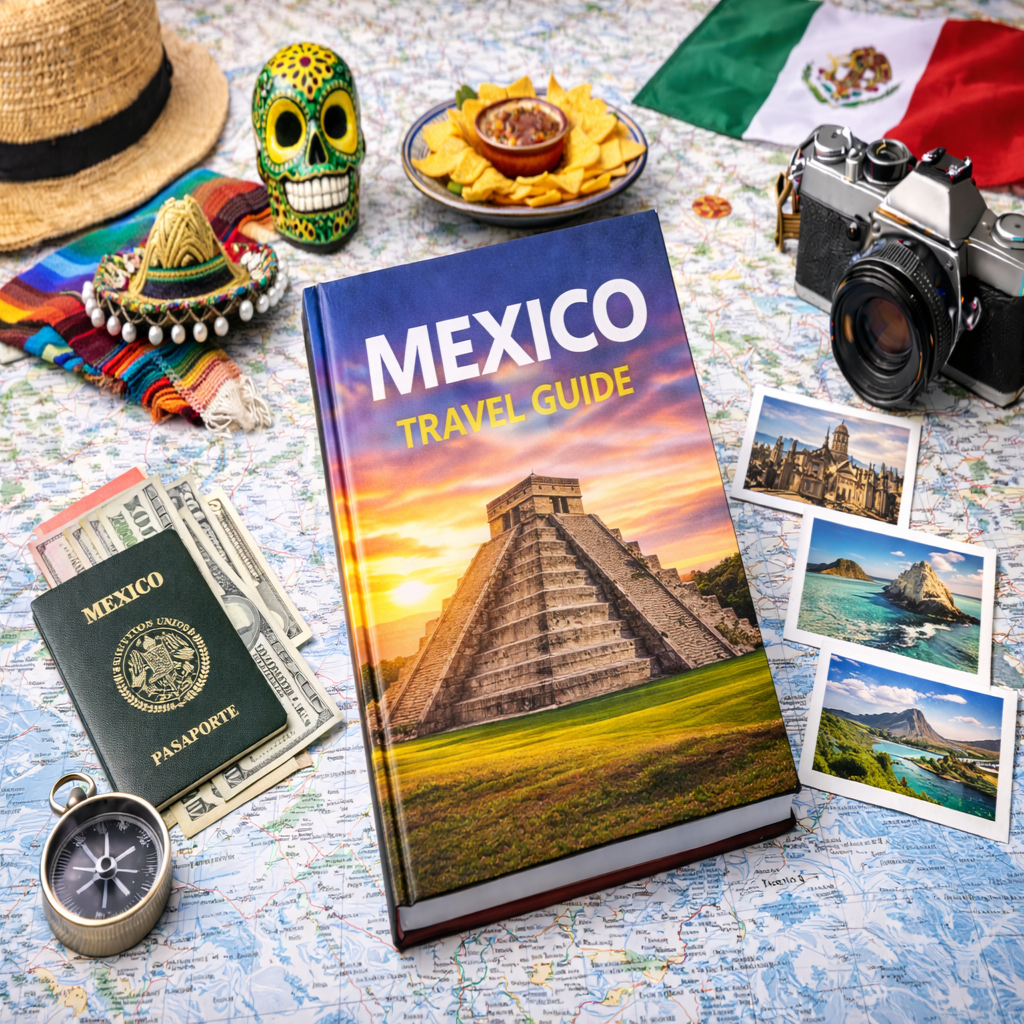
Mexico is a country that operates at a scale and depth that consistently surprises first-time visitors. Most people arrive expecting beaches and tacos — and they find those, in extraordinary abundance — but what catches them off guard is everything else. The pyramids of Teotihuacan rising from the central plateau at dawn, their scale almost impossible to reconcile with the civilization that built them two thousand years ago. The colonial cities of Oaxaca, San Miguel de Allende, and Guanajuato, their baroque churches and cobblestone streets saturated with color and history. The jungle-swallowed Maya ruins of Palenque and Calakmul, so remote and so monumental that standing before them produces a specific, irreducible feeling of awe. The cenotes of the Yucatán, those cathedral-like sinkholes of crystalline water threading through the limestone underworld below the peninsula.
And then there is the food. Mexican cuisine — recognized by UNESCO as an Intangible Cultural Heritage of Humanity — is not a cuisine. It is dozens of cuisines, as distinct from each other as French is from Italian, shaped by the extraordinary biodiversity of the country’s landscapes, the deep roots of indigenous culinary traditions, and centuries of Spanish, African, and global influence. Eating your way through Mexico is one of the great food travel experiences anywhere on Earth, and it will permanently ruin supermarket salsa and chain-restaurant guacamole for you.
This Mexico travel guide for first timers covers everything you need to know: the best time to visit, how to get around, where to go, what to eat, where to stay, safety considerations, and the practical and cultural knowledge that will help you fall in love with one of the world’s most complex, beautiful, and endlessly rewarding destinations.
Why Mexico Should Be on Every First-Time Traveler’s List
Mexico is the fourteenth largest country in the world by area and the tenth most populous, with a geography that encompasses snow-capped volcanoes, tropical rainforests, high-altitude deserts, Caribbean and Pacific coastlines, and some of the most biodiverse ecosystems on Earth. It is the most visited destination in Latin America and one of the top ten most visited countries in the world — and yet, for all its tourism infrastructure, it retains a wildness and depth that rewards exploration far beyond the resort zones.
The country’s pre-Columbian heritage is among the richest in the world. The Olmec, Teotihuacan, Maya, Zapotec, Mixtec, Toltec, and Aztec civilizations each left behind monumental architecture, sophisticated art, and complex social systems whose influence is still felt in contemporary Mexican culture. The National Museum of Anthropology in Mexico City is widely considered one of the finest museums in the world — a building that could occupy an entire day and still not be fully absorbed.
Mexico’s colonial heritage, layered over this indigenous foundation, produced some of the most beautiful cities in the Americas. Oaxaca, Guanajuato, Puebla, Mérida, San Cristóbal de las Casas, and Zacatecas are all UNESCO World Heritage cities of extraordinary character. And Mexico’s contemporary culture — its art, music, cinema, literature, and design — continues to produce work of global significance.
Above all, Mexico is its people — warm, proud, generous, and possessed of a deep cultural richness expressed in everything from the elaborate traditions of Día de los Muertos to the fierce regional loyalties over mole recipes.
Understanding Mexico: Geography and Regions
Mexico’s size and diversity mean that understanding its regions before you plan is essential. The country divides naturally into several distinct travel zones.
Mexico City and Central Mexico is the cultural, historical, and gastronomic heart of the country. Mexico City — one of the world’s great metropolises — sits at 2,240 meters above sea level in the Valley of Mexico, surrounded by volcanoes. The surrounding central highlands contain the colonial cities of Puebla, Tlaxcala, Cuernavaca, and the extraordinary ruins of Teotihuacan and Monte Albán (the latter in Oaxaca, the most culturally rich state in the country).
Oaxaca deserves its own category. This southern state, centered on the beautiful colonial city of the same name, is Mexico’s most celebrated food and indigenous culture destination — home to seven distinct Zapotec and Mixtec peoples, extraordinary mole traditions, mezcal production, textile crafts of the highest order, and some of the most vibrant markets and festivals in the country.
The Yucatán Peninsula — comprising the states of Yucatán, Campeche, and Quintana Roo — is the heart of Maya civilization and the center of Mexico’s Caribbean beach tourism. Cancún and the Riviera Maya (Playa del Carmen, Tulum, Bacalar) offer world-class beaches, cenotes, and resort infrastructure. Mérida, the Yucatán’s elegant capital, is one of Mexico’s most culturally sophisticated cities. Chichén Itzá, Uxmal, Palenque, and Calakmul are among the greatest archaeological sites in the Americas.
Chiapas is Mexico’s southernmost and most indigenous state — a landscape of highland cloud forests, jungle-covered ruins, colonial cities (San Cristóbal de las Casas), and the stunning Sumidero Canyon. It is one of the country’s most visually spectacular regions and among its poorest, giving it a raw, complex, deeply affecting character.
The Pacific Coast runs from Baja California in the north through Nayarit, Jalisco, Colima, Michoacán, Guerrero, and Oaxaca state to Chiapas in the south. Puerto Vallarta, Sayulita, Mazatlán, Huatulco, and Puerto Escondido are the main coastal destinations. The surf at Puerto Escondido’s Zicatela Beach is world-class; the whale-watching off Baja California is among the finest in the world.
Baja California — the long peninsula stretching 1,247 km south from the US border — is a destination in its own right, with its stark desert landscapes, excellent wines from the Valle de Guadalupe, gray whale breeding lagoons, and the extraordinary marine biodiversity of the Sea of Cortez.
The Colonial Heartland — the states of Jalisco, Guanajuato, Querétaro, San Luis Potosí, Michoacán, and Zacatecas — contains some of Mexico’s most beautiful and historically significant cities: Guadalajara (birthplace of tequila, mariachi, and the Mexican hat dance), Guanajuato (a gem of a colonial mining city built into a ravine), San Miguel de Allende (an architectural jewel beloved by artists and expatriates), and Morelia (one of the finest colonial cities in the country).
Best Time to Visit Mexico
Mexico’s vast size means that the best time to visit varies significantly by region. However, some general patterns apply across most of the country.
November to April — The Dry Season and Peak Travel Time
For most of Mexico, the dry season from November through April represents the ideal travel window. Temperatures are warm but not extreme, rainfall is minimal, and the country’s colonial cities, archaeological sites, and Pacific beaches are at their most accessible and enjoyable. December and January are peak season — book flights and accommodation well in advance, particularly for Oaxaca (Día de los Muertos in early November is extraordinarily popular), San Miguel de Allende, and any Caribbean coast destination. February and March offer an excellent combination of good weather and slightly reduced crowds.
May and June — Shoulder Season
May and June are transition months — the dry season is ending and the rains have not yet fully arrived. Temperatures climb significantly, particularly in the lowlands and Yucatán (where May can be genuinely oppressive), but the beaches are less crowded and prices begin to soften. The Valle de Guadalupe wine harvest begins in August, making late summer a good time for wine tourism in Baja California.
July and August — Summer and School Holidays
July and August see a significant domestic tourism spike — Mexican families travel during school holidays, making resort destinations like Cancún, Puerto Vallarta, and Los Cabos very busy. This is also the height of hurricane season on the Caribbean coast (June through November, peaking August–October), which can bring significant weather disruption to the Yucatán and Quintana Roo. The Pacific coast is generally drier in summer. The interior highlands (Mexico City, Oaxaca, the colonial cities) experience afternoon rains during the wet season but remain very visitable.
September and October — Quiet and Atmospheric
September and October are Mexico’s quietest months for international tourism — prices are lower, crowds are thinner, and the country has a more authentically local character. The risk of Caribbean hurricanes is real in September, but the Pacific and interior destinations are excellent. Early November, centered on Día de los Muertos (November 1–2), is one of the most extraordinary cultural events in the world — Oaxaca, Mérida, Pátzcuaro, and Mexico City’s cemeteries host celebrations of extraordinary beauty and emotional depth that are among the most memorable experiences any visitor to Mexico can have.
How to Get to Mexico
By Air: Mexico City’s Benito Juárez International Airport (MEX) is the main international gateway, with extensive connections to North America, Europe, Latin America, and Asia. The new Felipe Ángeles International Airport (NLU), about 50 km north of the city, handles some domestic and international routes. Cancún International Airport (CUN) is the busiest tourist gateway, with direct connections from the US, Canada, UK, and Europe. Guadalajara (GDL), Monterrey (MTY), Los Cabos (SJD), Puerto Vallarta (PVR), and Mérida (MID) all handle significant international traffic.
Getting from Mexico City Airport to the City: The new Tren Suburbano express train connects Terminal 1 to Buenavista station in central Mexico City in approximately 30 minutes. The Metro Line 5 connects Terminal 1 to the metro network. Official airport taxis (booked at fixed-price counters inside the terminal) are the safest option for visitors unfamiliar with the city — fares to most central neighborhoods cost 250–400 MXN. Uber operates reliably from the airport.
By Land from the United States: Mexico shares a 3,145 km border with the United States, with major crossing points at Tijuana–San Diego, Ciudad Juárez–El Paso, Nogales, Nuevo Laredo, and Matamoros. Driving into Mexico requires a Temporary Vehicle Import Permit (TIP) for most destinations. Several US bus companies and Mexico’s ADO and Primera Plus networks operate cross-border services. Always check current safety advisories for specific border regions before planning overland travel.
Getting Around Mexico
Mexico’s size and the dispersal of its attractions mean that domestic flights are often the most practical way to cover significant distances. However, the country also has an excellent long-distance bus network and, in certain regions, good rail options.
Domestic Flights: Aeromexico, Volaris, and VivaAerobus connect major cities and tourist destinations at competitive prices. Booking in advance yields significant savings. Routes between Mexico City and Oaxaca, Cancún, Guadalajara, Mérida, and San Cristóbal de las Casas are frequent and affordable when booked ahead.
Long-Distance Buses: Mexico’s first-class bus network is one of the finest in the Americas. ADO (serving southeastern Mexico and the Yucatán), ETN, Primera Plus, and Omnibus de México operate modern, air-conditioned coaches with assigned seating, Wi-Fi, and onboard entertainment on most major routes. Travel between Mexico City and Oaxaca (6–7 hours), Mexico City and Guadalajara (6 hours), Mérida and Cancún (4 hours), and many other routes is comfortable, affordable, and a genuine pleasure. Bus travel is significantly safer than driving in many regions.
Mexico City Metro and Metrobús: Mexico City has one of the world’s largest metro systems — 12 lines, 195 stations, and an astonishingly cheap flat fare of approximately 5 MXN per journey. The Metrobús (Bus Rapid Transit) system complements the metro on key corridors. Together they provide excellent coverage of the city’s major neighborhoods and attractions. Always be vigilant of pickpockets on crowded metro lines, particularly Lines 1, 2, and 3 during rush hour.
Taxis and Rideshares: Uber is by far the safest and most recommended way to take a private vehicle in Mexico City and most major tourist destinations. It provides fare transparency, driver accountability, and a digital record of your journey. In cities where Uber is unavailable or limited, use officially marked taxi stands (sitios) rather than hailing from the street. Never enter an unmarked or unofficial taxi anywhere in Mexico.
Car Rental: A rental car is invaluable for exploring the Yucatán’s cenotes and ruins, the Oaxacan valleys, Baja California, and rural regions inaccessible by public transport. Drive confidently during daylight hours on main roads, avoid driving at night in unfamiliar areas, and always take full insurance coverage. Toll roads (cuotas) are excellent and significantly safer than free roads (libres) in most regions.
Colectivos: Shared minivans that run fixed routes between towns and villages, particularly in the Yucatán, Oaxaca, and Chiapas. Cheap, frequent, and an authentic way to travel between smaller destinations. Ask locals for the correct departure point and agree on the fare before boarding.
Top Destinations in Mexico for First-Time Visitors
1. Mexico City — One of the World’s Great Metropolises
Mexico City is a destination that consistently overwhelms first-time visitors with its scale, energy, and extraordinary cultural richness. A city of 22 million people spread across a high-altitude valley, it is simultaneously chaotic and deeply civilized — a place where world-class museums, restaurants, galleries, and parks exist alongside the raw vitality of one of the Americas’ largest and most complex urban environments.
The historic center (Centro Histórico) — a UNESCO World Heritage Site — is built directly over the ruins of Tenochtitlan, the Aztec capital destroyed by Hernán Cortés in 1521. The Zócalo, one of the world’s largest public squares, is flanked by the Metropolitan Cathedral (begun in 1573 and completed only in 1813) and the Templo Mayor — the great Aztec pyramid whose ruins were only rediscovered in 1978 when electrical workers accidentally exposed them beneath the city streets. The adjacent Templo Mayor Museum houses extraordinary Aztec artifacts of staggering beauty and historical significance.
The National Museum of Anthropology in Chapultepec Park is widely considered one of the finest museums in the world. Its 23 rooms trace the full arc of Mexico’s pre-Columbian civilizations — the Olmec colossal heads, the Aztec Sun Stone, the Maya jade funerary mask of Pakal — in a building whose architecture is itself a masterwork. Allow at least four hours, ideally a full day.
The neighborhoods of Coyoacán (Frida Kahlo’s birthplace and home, now the extraordinary Casa Azul museum), Roma Norte, Condesa, Polanco, and San Ángel each offer distinct and rewarding experiences — from the Frida Kahlo Museum and Diego Rivera murals to some of the finest contemporary restaurants and design hotels in Latin America.
2. Oaxaca — Mexico’s Cultural and Culinary Soul
Oaxaca is, for many experienced Mexico travelers, the country’s single most rewarding destination. The city — a jewel of colonial architecture in warm green cantera stone, surrounded by mountains and the ancient valleys of the Zapotec and Mixtec civilizations — is the epicenter of everything that makes Mexican culture extraordinary: food, craft, indigenous tradition, and a creative energy that has made it one of the most talked-about destinations in the Americas.
The Zócalo and the surrounding streets are among the most beautiful public spaces in Mexico. The Mercado Benito Juárez and the Mercado 20 de Noviembre — where charcoal grills produce plumes of smoke and the smell of tasajo (dried beef) and tlayudas fills the covered market hall — are outstanding food experiences. Monte Albán, the ancient Zapotec capital on a leveled mountain above the city, is one of the great archaeological sites of the Americas and offers panoramic views over the Oaxacan valleys at sunset.
The surrounding valleys are extraordinary for day trips: the artisan villages of Teotitlán del Valle (hand-woven rugs), San Bartolo Coyotepec (black clay pottery), and Arrazola (hand-carved and painted alebrijes figures) preserve craft traditions of great beauty. The Saturday market at Tlacolula is one of the finest indigenous markets in Mexico.
3. The Yucatán Peninsula — Maya Ruins, Cenotes, and Caribbean Coast
The Yucatán Peninsula is Mexico’s most visited tourist region and, for good reason, offers an extraordinary concentration of world-class attractions within a manageable geographical area.
Chichén Itzá — one of the New Seven Wonders of the World — is the most visited archaeological site in Mexico. The Pyramid of Kukulcán (El Castillo), with its perfect astronomical alignment and the shadow serpent that appears on the equinoxes, is one of the most sophisticated architectural achievements of the ancient world. Visit at opening time (8 AM) to experience it before the tour bus crowds arrive.
The cenotes of the Yucatán are among the peninsula’s most extraordinary natural features — thousands of sinkholes connected to a vast underground river system, their crystalline water illuminated by shafts of light filtering through jungle canopy above. Cenote Ik Kil near Chichén Itzá, the Dos Ojos system near Tulum (outstanding for snorkeling and diving), and the cenotes of Valladolid are all exceptional.
Tulum — built on a clifftop above the Caribbean and the only walled Maya city built by the sea — offers a postcard-perfect combination of ancient ruins and turquoise water. The surrounding Tulum town has developed a sophisticated boutique hotel and restaurant scene. Bacalar, further south on a lake of extraordinary turquoise clarity, is one of Mexico’s most beautiful and rapidly emerging destinations. Mérida, the Yucatán’s colonial capital — elegant, culturally rich, and gastronomically outstanding — is one of the finest cities in Mexico and still largely under the radar of international first-timers.
4. San Miguel de Allende and Guanajuato — The Colonial Heartland
San Miguel de Allende is arguably the most architecturally beautiful city in Mexico — a perfectly preserved colonial gem of pink stone churches, bougainvillea-draped courtyards, and cobblestone streets that climb steeply above a broad agricultural valley. The neo-Gothic Parroquia de San Miguel Arcángel, its pink stone towers rising above the main square, is one of the most photographed churches in Mexico. The city has a significant expatriate community and a sophisticated international arts and food scene.
Guanajuato, 100 km west, is a different kind of wonder — a colonial mining city built into a narrow ravine, its streets so steep and winding that much of the city’s traffic travels through a network of underground tunnels. Its colorful allejones (narrow alleyways), the famous Callejón del Beso (Alley of the Kiss — so narrow that balconies on either side almost touch), the Mummy Museum, and the Universidad de Guanajuato’s striking neoclassical facade make it one of Mexico’s most memorable cities. The Festival Internacional Cervantino, held every October, is one of the most important performing arts festivals in the Americas.
5. Palenque and Chiapas — Jungle Ruins and Highland Culture
Palenque is arguably the most hauntingly beautiful Maya archaeological site in Mexico — a complex of temples, palaces, and tombs emerging from dense jungle in the Chiapas lowlands, with a perpetual mist hanging over the surrounding canopy. The Temple of the Inscriptions, which conceals the extraordinary tomb of King Pakal (discovered in 1952 and now celebrated in the Anthropology Museum in Mexico City), and the Palace complex are architectural masterworks. Arrive at opening to explore in morning mist before the day heats up.
San Cristóbal de las Casas, in the Chiapas highlands, is one of Mexico’s most atmospheric colonial cities — a cool, misty highland town of brightly painted buildings, indigenous markets, and a creative, politically charged energy that reflects the region’s complex indigenous and revolutionary history. The surrounding Tzotzil and Tzeltal Maya communities of San Juan Chamula (with its extraordinary syncretic Catholic-Maya church) and Zinacantán are among the most culturally immersive destinations in Mexico.
6. Puerto Escondido and the Oaxacan Coast
While Cancún and the Riviera Maya dominate Mexico’s beach tourism narrative, the Pacific coast of Oaxaca offers a completely different and, for many travelers, more rewarding coastal experience. Puerto Escondido is a former fishing village that has evolved into one of Mexico’s most dynamic beach destinations — centered on Zicatela Beach, one of the world’s great surf breaks (the annual Mexipe Surf Tournament draws the world’s best big-wave surfers), but extending to the calmer, swimmable Playa Carrizalillo and the sea turtle nesting beaches of Mazunte and La Ventanilla nearby.
The Oaxacan coast combines outstanding seafood, a creative restaurant scene, excellent surf culture, and the proximity of the extraordinary Oaxacan interior into one of Mexico’s most compelling regional combinations.
7. Teotihuacan
Just 50 km northeast of Mexico City, Teotihuacan is one of the greatest archaeological sites in the world — a city that, at its peak around 450 AD, had a population of over 125,000 people and covered an area larger than imperial Rome. The Pyramid of the Sun, the third largest pyramid in the world, and the Pyramid of the Moon, connected by the two-kilometer Avenue of the Dead, create a ceremonial landscape of almost incomprehensible ambition and scale. Climbing the Pyramid of the Sun at dawn, watching the light spread across the valley below and the mountains emerge from the haze, is one of the great travel experiences in the Americas.
What to Eat in Mexico: A First-Timer’s Food Guide
Mexican cuisine is a universe, not a dish. Its extraordinary diversity — built on a foundation of corn, chiles, chocolate, tomatoes, squash, and beans, enriched by Spanish, African, Caribbean, and global influences — has produced a culinary tradition of world-historical significance. Here is an introduction to what you must eat.
Tacos: The taco is not a dish — it is a delivery system for an infinite variety of fillings. Tacos al pastor (marinated pork shaved from a vertical spit, served with pineapple, cilantro, and onion) are the most iconic Mexico City street food. Tacos de canasta (basket tacos, steamed and stuffed with beans, chicharrón, or potato) are the city’s lunch staple. Tacos de carnitas from Michoacán (slow-braised pork, every part of the animal), tacos de pescado from Baja California (beer-battered fish, cabbage slaw, crema), and tacos de barbacoa (slow-cooked lamb wrapped in maguey leaves) from Hidalgo are all extraordinary in their own right.
Mole: Mexico’s most complex and celebrated sauce — a deep, multi-ingredient preparation that can contain over thirty components including chiles, chocolate, nuts, seeds, spices, and dried fruit, ground and cooked together over hours. Oaxaca’s seven moles (negro, rojo, coloradito, amarillo, verde, chichilo, and manchamanteles) are the most celebrated in the country. Mole negro, the darkest and most complex, served over turkey with sesame seeds and tortillas, is one of the great dishes of world cuisine.
Pozole: A hearty, ancient soup of hominy corn and slow-cooked pork or chicken in a rich broth — red (with dried chiles), white (without), or green (with tomatillo and herbs) — served with a garnish bar of shredded cabbage, dried oregano, lime, and tostadas. It is deeply comforting, deeply Mexican, and found in dedicated pozolería restaurants across the country.
Chiles en Nogada: Mexico’s most patriotic dish — poblano chiles stuffed with a baroque mixture of picadillo (spiced minced meat with dried fruits and nuts), covered in a walnut cream sauce and garnished with pomegranate seeds and parsley, reflecting the green, white, and red of the Mexican flag. It is a seasonal dish, available in August and September when pomegranates are fresh, and Puebla is its spiritual home.
Tamales: Corn masa dough stuffed with mole, cheese, chiles, or beans, wrapped in corn husks or banana leaves and steam-cooked — one of Mexico’s most ancient foods, its preparation dating back three thousand years. They are eaten at breakfast from street vendors, at Christmas gatherings, and at the Día de la Candelaria festival in February. Every region has its own version — the large, banana-leaf-wrapped Oaxacan tamales negro and the Veracruz tamales de rajas are both extraordinary.
Tlayudas: Oaxaca’s signature dish — a large, crispy corn tortilla spread with black bean paste, topped with tasajo (dried beef) or chorizo, Oaxacan string cheese (quesillo), and a mound of fresh greens dressed with lime. Eaten at a wooden table in a Oaxacan market, with a clay cup of mezcal alongside, it is one of the most satisfying meals in Mexico.
Seafood on the Coast: Mexico’s dual coastlines produce extraordinary seafood. Ceviche — fresh fish or shrimp cured in lime juice with tomato, onion, chile, and cilantro — is as good on the Pacific as on the Caribbean. Pescado a la talla, a whole fish marinated in adobo and grilled over wood coals, is the great dish of the Oaxacan coast. Cochinita pibil from the Yucatán — slow-roasted pork marinated in achiote and sour orange, wrapped in banana leaves and cooked in an earth oven — is one of the most magnificent preparations in the Mexican canon, and the cochinita pibil tacos sold from market stalls in Mérida on weekend mornings are unmissable.
Mezcal: Mexico’s most complex and storied spirit — distilled from agave in small batches by maestros mezcaleros in Oaxaca, Guerrero, Durango, and other states — is having a well-deserved global moment. Unlike industrially produced tequila (which is mezcal’s more famous cousin, made exclusively from blue agave in Jalisco), artisanal mezcal is made from dozens of agave varieties and expresses extraordinary diversity of flavor, from smoky and vegetal to floral and citrusy. Drinking mezcal in Oaxaca — neat, in a clay copita, with an orange slice and sal de gusano (worm salt) — is a ritual and an education.
Where to Stay in Mexico
Mexico City: Roma Norte, Condesa, and Polanco are the most desirable neighborhoods for boutique hotels and design accommodation — excellent restaurants, galleries, and parks on the doorstep. The historic center has a growing number of excellently restored colonial hotels with extraordinary architecture. Avoid staying in areas without clear safety reputations — research specific neighborhoods before booking.
Oaxaca: The historic center within walking distance of the Zócalo is ideal — boutique hotels in converted colonial mansions offer the most immersive experience. Casa Oaxaca and Quinta Real Oaxaca are among the finest. Book well in advance for Día de los Muertos (late October–early November) when the city fills months ahead.
Yucatán and Riviera Maya: Mérida’s historic center for colonial elegance; Tulum’s jungle-edge boutique hotels (book early, prices are high and they fill fast); Playa del Carmen for a mid-range resort base; and Bacalar’s lakeside guesthouses for a quieter, more atmospheric experience.
San Miguel de Allende: The city’s centro histórico is compact and entirely walkable — stay within or immediately adjacent to it. Boutique hotels and guesthouses in converted haciendas and colonial mansions are the outstanding accommodation option.
Pacific Coast: Puerto Escondido for surf culture and fresh seafood at every price level; Huatulco for a more resort-style experience; Sayulita near Puerto Vallarta for a charming surf village with good boutique accommodation.
Mexico Safety: What First-Time Visitors Need to Know
Mexico’s safety reputation is complex and, in many respects, significantly more nuanced than international headlines suggest. The country receives over 45 million international visitors annually, and the vast majority have safe, wonderful experiences. However, informed and vigilant travel is essential.
The primary risks that affect tourists are petty theft (pickpocketing in crowded markets and metro stations), opportunistic street crime in certain urban areas, and highway robbery on secondary roads in some regions. Violent crime, while a serious issue in parts of Mexico, is concentrated in specific regions and is largely connected to organized crime conflicts that do not typically target foreign tourists.
The key practical rules for safe travel in Mexico are straightforward: always use Uber or official taxis rather than hailing from the street; do not display expensive equipment, jewelry, or cash publicly; avoid traveling on secondary roads at night; research specific destinations through current travel advisories from your government before visiting; and trust your instincts — if a situation or location feels wrong, leave.
The main tourist destinations covered in this guide — Mexico City’s tourist neighborhoods, Oaxaca, the Yucatán Peninsula, San Miguel de Allende, Guanajuato, Puerto Vallarta, and Puerto Escondido — are all generally safe for tourists exercising normal urban vigilance. Several states, including parts of Guerrero, Tamaulipas, Colima, and Sinaloa, carry elevated risk and warrant careful review of current advisories before any travel.
Travel insurance covering medical evacuation is essential for Mexico. Healthcare quality varies enormously — private hospitals in major cities are excellent, but rural and remote areas may have very limited medical facilities.
Mexico Travel Tips for First Timers
- Always use Uber or pre-booked taxis. In Mexico City and most major destinations, never hail a taxi from the street. Use Uber, Didi, or officially marked taxi stands. This single precaution eliminates the most common safety risk that affects tourists.
- Carry cash in pesos. While major hotels and restaurants accept cards, street food, markets, colectivos, and smaller establishments operate on cash. Have sufficient pesos available — particularly outside major cities.
- Drink bottled or purified water. Tap water is not safe to drink in most of Mexico. Bottled water is cheap and universally available. Many restaurants and hotels provide purified water — ask before drinking.
- Eat where the locals eat. The best food in Mexico is almost never in tourist-facing restaurants with English menus. Find the market, find the stall with the longest queue of locals, point at what looks good, and eat it. This approach will provide your most memorable meals at a fraction of restaurant prices.
- Learn basic Spanish. Mexico’s tourist infrastructure is good in major destinations, but outside of resort zones English is not widely spoken. Even basic Spanish — buenos días, por favor, gracias, cuánto cuesta (how much does it cost?), la cuenta por favor (the bill please) — dramatically improves your experience and is deeply appreciated.
- Respect the altitude in Mexico City. At 2,240 meters, Mexico City sits significantly higher than most visitors are accustomed to. Mild altitude sickness (headache, fatigue, shortness of breath) is common on arrival — rest, hydrate, avoid alcohol for the first day, and give your body 24–48 hours to acclimatize before heavy sightseeing or exercise.
- Book Día de los Muertos accommodation months in advance. If visiting Oaxaca, Mérida, or Pátzcuaro for Día de los Muertos (November 1–2), accommodation fills 3–6 months ahead. This is not an exaggeration.
- Be prepared for heat and sun. Coastal Mexico and the Yucatán can be extremely hot and humid. High-factor sunscreen, a hat, and a reusable water bottle are non-negotiable.
- Bargaining is acceptable at markets but not everywhere. Artisan markets, tianguis (informal markets), and souvenir stalls expect negotiation. Restaurants, established shops, and transportation with metered fares do not.
- Tipping is expected and important. Mexico has a strong tipping culture. 10–15% in restaurants is standard; more for exceptional service. Tip hotel staff, tour guides, and anyone who provides personal service. Many service workers earn very modest wages and rely on tips significantly.
Suggested 10-Day Mexico Itinerary for First Timers
Days 1–3: Mexico City
Day 1: Arrive and acclimatize. Evening walk around Roma Norte and dinner at a neighborhood restaurant. Day 2: Centro Histórico — Zócalo, Metropolitan Cathedral, Templo Mayor Museum. Afternoon in Coyoacán — Frida Kahlo Museum (Casa Azul), Mercado de Coyoacán. Day 3: National Museum of Anthropology (full morning). Afternoon in Chapultepec Park and Polanco. Evening mezcal tasting in Condesa.
Day 4: Teotihuacan Day Trip
Early morning departure for Teotihuacan (1 hour by bus from Terminal Norte). Climb the Pyramid of the Sun and Pyramid of the Moon. Explore the Avenue of the Dead and the Temple of Quetzalcoatl. Return to Mexico City for the evening.
Days 5–7: Oaxaca
Fly or take overnight bus from Mexico City to Oaxaca. Day 5: explore the Zócalo, Santo Domingo Church and Cultural Center, Mercado Benito Juárez. Evening mezcal at a local bar. Day 6: day trip to Monte Albán in the morning, afternoon in the artisan villages of the valley (Teotitlán del Valle, Tlacolula market on Saturday). Day 7: cooking class or market tour in the morning, Mercado 20 de Noviembre for lunch, Museo de las Culturas de Oaxaca in the afternoon.
Days 8–10: Yucatán
Fly Oaxaca to Mérida or Cancún. Day 8: Mérida — Paseo Montejo, Gran Museo del Mundo Maya, evening in the centro histórico. Day 9: day trip to Chichén Itzá (depart early) followed by a swim in Cenote Ik Kil and an afternoon in Valladolid. Day 10: morning at a cenote near Mérida or Tulum, afternoon beach time on the Caribbean coast, evening departure.
Mexico on a Budget: Is It Possible?
Mexico is one of the best-value destinations in the Americas for international visitors. Street food tacos cost 15–30 MXN each. A full comida corrida (set lunch) at a local restaurant — soup, main course, agua fresca, and tortillas — costs 80–120 MXN. A bottle of excellent Oaxacan mezcal costs 200–400 MXN at a local shop. A bus journey between major cities costs 200–500 MXN for a first-class seat.
Budget travelers who eat from markets and street stalls, travel by first-class bus rather than flying, and stay in well-run hostels or budget guesthouses can experience Mexico meaningfully for €40–€55 per person per day. A mid-range daily budget of €80–€100 per person covers comfortable guesthouse accommodation, excellent restaurant meals, day trips with entrance fees, and domestic transport. The main costs in a Mexico trip are inter-city flights (which can be surprisingly affordable when booked in advance) and, in premium destinations like San Miguel de Allende and Tulum, accommodation prices that have risen considerably with global popularity.
Final Thoughts: Mexico Will Expand Your World
Mexico is a country that demands — and repays — engagement at depth. Its history is too long, its cultures too numerous, its landscape too varied, and its food too extraordinary to absorb in a single trip. Most first-time visitors leave with the distinct and accurate feeling that they have seen only the surface of something vast and magnificent — and that the best parts are the ones they did not reach.
There is a generosity to Mexico that is hard to articulate without sounding clichéd but is entirely real. The country gives freely: its beauty, its warmth, its food, its music, its extraordinary ability to make celebration out of almost any occasion. The laughter spilling from a cantina. The smell of corn masa patted between palms at a market stall. The sound of mariachi on a Saturday evening in Guadalajara’s Plaza de los Mariachis. The moment a Maya pyramid emerges from jungle mist and you understand, viscerally, that human beings have been capable of extraordinary things for a very long time.
Go with curiosity, go with respect, go with a genuine appetite for the full complexity of what Mexico is — not just the resort and the beach, but the market and the ruin and the mountain and the mezcal and the mole and the people who make all of it make sense. The Land of Ancient Civilizations will reward you beyond anything you expected.
We hope this Mexico travel guide for first timers has given you the inspiration and practical foundation to plan the trip of a lifetime. For more destination guides, regional deep-dives, and travel inspiration, keep exploring GlobeTrailGuide — your trusted companion for smarter, deeper travel.
GlobeTrailGuide.com | Travel Smarter. Explore Deeper.