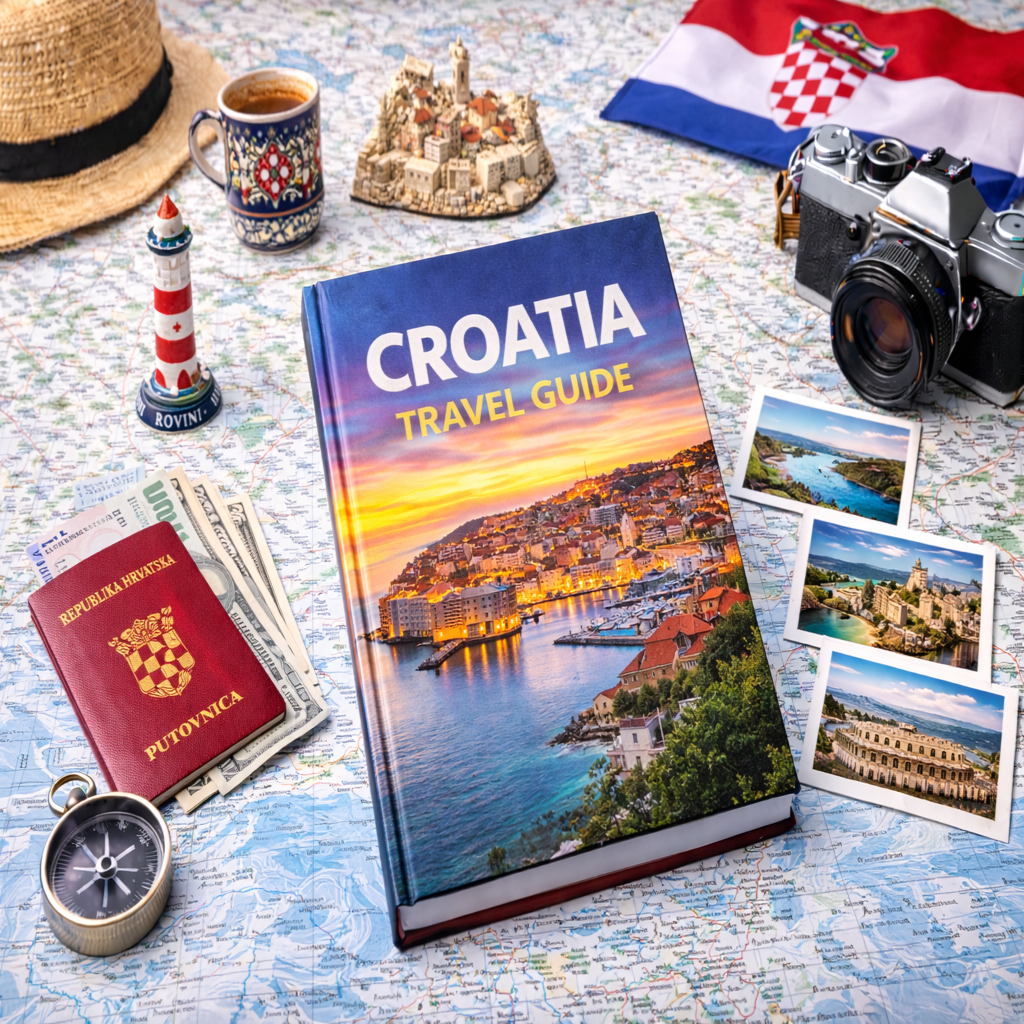
Croatia is one of those rare destinations that delivers exactly what it promises — and then quietly delivers considerably more. You arrive for the Adriatic, that impossibly blue sea lapping against ancient stone walls and pine-forested islands, and you stay for everything else: the walled medieval city of Dubrovnik glowing amber in the late afternoon light, the waterfalls of Plitvice Lakes cascading through emerald forest, the Roman emperor’s palace in Split that an entire city has grown up inside, the lavender fields and vineyard-terraced hillsides of Hvar, the truffle forests and Istrian hill towns of the northwest, the paprika-scented Slavonian plains of the interior.
For a country roughly the size of West Virginia, Croatia contains a staggering diversity of landscapes, cultures, and experiences. Its coastline — 1,777 km of mainland shore plus over 1,000 islands, islets, and reefs — is one of the most dramatic and beautiful in Europe. Its cities carry the layered weight of Roman, Venetian, Austro-Hungarian, and Yugoslav history in their architecture and character. Its food and wine traditions, rooted in both Mediterranean and Central European influences, are among the most underrated and rewarding in the continent.
Croatia joined the European Union in 2013 and adopted the euro in 2023, bringing it fully into the mainstream of European travel. Its infrastructure is excellent, its people speak English with remarkable fluency and warmth, and its tourism industry is sufficiently developed to be convenient without having sacrificed the authenticity that makes the country genuinely special. This is a destination that has arrived — and the best time to go, for those who want it before the crowds define the experience entirely, is now.
This Croatia travel guide for first timers covers everything you need: the best time to visit, how to get around, where to go, what to eat, where to stay, and the practical and cultural knowledge that will help you experience one of Europe’s most beautiful and rewarding destinations at its very finest.
Why Croatia Should Be on Every First-Time Traveler’s European List
Croatia’s appeal is both immediate and deep. The immediate appeal is obvious — few countries in Europe can match the combination of a pristine, crystalline sea, medieval walled cities, and a Mediterranean climate that makes outdoor life a daily pleasure from May through October. But the depth of Croatia’s appeal takes longer to appreciate and is ultimately what turns first-time visitors into devoted returnees.
The country has been at the crossroads of civilizations for three millennia. Illyrians, Greeks, Romans, Byzantines, Venetians, Ottomans, Habsburgs, and 20th-century Yugoslavia have all left their mark on Croatia’s cities, landscape, culture, and cuisine. The result is a country of extraordinary cultural layering — where a Roman emperor’s mausoleum becomes a cathedral, where Venetian Gothic palaces line a harbor that was medieval Europe’s most powerful naval base, and where the memory of more recent and painful history coexists with a fierce, proud embrace of national identity and European belonging.
Croatia is also a country of extraordinary natural wealth. Eight national parks protect its finest landscapes — from the karst waterfalls of Plitvice and Krka to the sea caves and submarine meadows of Kornati and Mljet. Its Adriatic waters, among the cleanest in the Mediterranean basin, are a paradise for sailors, divers, swimmers, and anyone who has ever watched sunlight moving through clear water and felt something fundamental shift inside them.
And then there is the warmth of the people — Croats who are justifiably proud of their country and genuinely pleased when visitors take it seriously enough to go beyond Dubrovnik and Split, to venture into the Dalmatian hinterland or the Istrian interior or the islands of the Kvarner Gulf. That pleasure is infectious, and it makes the experience of traveling through Croatia richer than the landscapes alone could account for.
Best Time to Visit Croatia
Croatia’s tourism is heavily concentrated in the summer months, and understanding the seasonal rhythms of the country is one of the most important parts of planning a first visit.
Spring (April to June) — The Finest Season for Most Travelers
Spring is widely considered the ideal time to visit Croatia, particularly May and early June. The Adriatic is warming but not yet at its summer peak, the national parks are at their most verdantly spectacular (Plitvice Lakes in spring, with its waterfalls fed by snowmelt and its forest in full leaf, is one of Europe’s most beautiful natural spectacles), and the tourist crowds have not yet arrived in their summer intensity. Prices are significantly lower than July and August, accommodation is readily available, and the coastal cities — Dubrovnik, Split, Hvar — can be enjoyed without the crushing density of high season. The sea temperature in May (around 18°C–20°C) is cool for swimming for some visitors but perfect for sailing and kayaking.
Summer (July to August) — Peak Season and Adriatic Perfection
Summer is Croatia’s peak season and for good reason. The Adriatic reaches 26°C–28°C, the islands are at their most lush and fragrant with pine and lavender, the days are long and golden, and the entire coast becomes a celebration of the outdoor Mediterranean life that Croatia does better than almost anywhere else in Europe. Dubrovnik, Hvar, Split, and the Dalmatian islands are extraordinary in summer — and extraordinarily crowded. July and August bring millions of visitors, cruise ship passengers, and yachts. Accommodation prices peak, restaurants fill, and the narrow streets of Dubrovnik’s old city can feel genuinely overwhelming at midday. If visiting in summer, book everything months in advance, arrive at attractions early, and embrace the evening hours when the day-trippers have gone and the cities reclaim their magic.
Autumn (September to October) — The Insider’s Season
September and early October are arguably the finest months of all for experienced Croatia travelers. The sea remains warm (24°C–26°C in September), the summer crowds thin dramatically after the first week of September, prices fall substantially, and the country takes on a golden, unhurried autumn character. The grape harvest (berba) in September adds a festive agricultural dimension to travel in wine regions like the Pelješac Peninsula, Hvar, and Istria. The light in autumn Croatia is magnificent — warm, slightly soft, ideal for photography and long outdoor days. Truffle season begins in October in Istria, making it one of the most rewarding times to visit the northwest.
Winter (November to March) — Quiet, Atmospheric, and Mostly Closed
Croatia’s coast goes significantly into hibernation in winter. Many island restaurants, guesthouses, and ferry services reduce dramatically or cease entirely. Dubrovnik and Split retain year-round life but are quiet and relatively affordable. The inland cities — Zagreb, Varaždin, Osijek — are most rewarding in winter, particularly at Christmas when Zagreb’s Christmas market is widely regarded as one of the finest in Europe. The interior national parks remain open and can be extraordinarily beautiful — Plitvice Lakes in snow is one of Croatia’s most dramatic sights, though access can be challenging. Winter is for the adventurous and the Zagreb-focused traveler, not for a first-time coastal Croatia experience.
How to Get to Croatia
Croatia is well connected to the rest of Europe and increasingly accessible from further afield.
By Air: Croatia has several international airports. Split Airport (SPU) and Dubrovnik Airport (DBV) are the main gateways for coastal travelers, with extensive European connections from April through October. Zagreb Airport (ZAG) is the main year-round hub, with the widest range of international connections. Zadar Airport (ZAD) and Pula Airport (PUY) handle significant low-cost carrier traffic from the UK and northern Europe. Croatia Airlines is the national carrier; Ryanair, easyJet, Eurowings, and Wizz Air all operate extensive routes. From London, flights to Split or Dubrovnik take approximately 2.5–3 hours. From New York, connecting flights via major European hubs take around 12–14 hours total.
Getting from Split Airport to the City: A shuttle bus connects Split Airport to the city center (Prokurative square) in approximately 30 minutes for around €7. Taxis and Uber cost approximately €25–€35.
Getting from Dubrovnik Airport to the City: An Atlas shuttle bus runs between Dubrovnik Airport and Pile Gate (the main entrance to the old city) in approximately 25–35 minutes for around €8. Taxis cost approximately €30–€40.
By Ferry from Italy: Regular Jadrolinija and SNAV ferries connect the Italian Adriatic ports of Ancona, Pescara, and Bari to Split and Dubrovnik, offering a scenic and atmospheric way to arrive in Croatia. The overnight Ancona–Split crossing (around 10 hours) is particularly popular and allows for an excellent introduction to the Adriatic.
By Car from Slovenia, Austria, or Hungary: Croatia is easily driveable from Central Europe. The A1 motorway from Zagreb to Split and the connections from the Slovenian and Hungarian borders are excellent. Driving your own or a rental car is one of the finest ways to explore Croatia’s interior, Istria, and the Dalmatian hinterland.
Getting Around Croatia
Croatia’s elongated coastal geography — a long, narrow strip of coast and islands running from Istria in the northwest to Dubrovnik in the southeast — shapes its transport options significantly.
Ferries (Jadrolinija and Krilo): Ferries are the lifeblood of Croatian coastal travel and one of the most enjoyable ways to move through the country. Jadrolinija operates the main car ferry routes between the mainland and islands — Split to Brač, Hvar, Vis, and Korčula; Zadar to the Zadar archipelago; Dubrovnik to Mljet and the Elafiti Islands. Krilo and TP Line operate faster catamaran services on key routes. Book car ferry spaces well in advance in summer — queues can be extremely long. Passenger-only tickets are generally available on the day.
Domestic Buses: Croatia’s bus network is excellent and covers the entire coast reliably. Flixbus, FlixBus Croatia, and regional operators connect Zagreb, Split, Zadar, Šibenik, Dubrovnik, and all major towns. The Split–Dubrovnik coastal bus journey (approximately 4–4.5 hours) passes through some of the most spectacular coastal scenery in Europe, including the brief transit through Bosnia and Herzegovina at Neum — bring your passport. Buses are comfortable, punctual, and significantly cheaper than flights.
Car Rental: A rental car is the single most liberating way to explore Croatia. It is essential for Istria, the Dalmatian hinterland, Plitvice Lakes, and any destination not served by regular public transport. Roads are excellent, traffic outside the coastal peak season is manageable, and the freedom to stop at a hilltop village or a hidden beach on a whim transforms the quality of the experience. Parking in the old cities of Dubrovnik and Split is challenging — park outside and walk in.
Domestic Flights: Croatia Airlines operates domestic routes between Zagreb, Split, Dubrovnik, and Zadar. Quick and convenient for covering the full length of the country, though prices can be higher than the bus for short notice bookings.
Sailing and Private Boats: Croatia is one of the world’s premier sailing destinations, and charter yachts, catamarans, and skippered boat tours are available from virtually every marina. A week-long sailing charter from Split through the Dalmatian islands — Brač, Hvar, Vis, Korčula — is one of the most extraordinary travel experiences in Europe. Even a half-day private boat tour from Hvar or Vis to the Blue Cave and surrounding islands provides unforgettable access to the coast’s most beautiful corners.
Zagreb Public Transport: Zagreb has an excellent tram network (ZET) covering all major neighborhoods. Single tram tickets cost approximately €0.53 on the tram (or €0.80 at a kiosk). The city is also very walkable — the historic Upper Town (Gornji Grad) and Lower Town (Donji Grad) are compact and rewarding on foot.
Top Destinations in Croatia for First-Time Visitors
1. Dubrovnik — The Pearl of the Adriatic
Dubrovnik is one of the most perfectly preserved medieval walled cities in the world and Croatia’s most iconic destination. Its limestone-paved streets, Baroque churches, Renaissance fountains, and orange-tiled rooftops, enclosed within walls up to 6 meters thick and 25 meters high, represent one of the finest urban ensembles in Europe. The city’s extraordinary history as the Republic of Ragusa — an independent maritime state that rivaled Venice for centuries — is present in every stone.
Walking the 2 km circuit of the city walls is the essential Dubrovnik experience — a panoramic loop above the old city’s rooftops, with the Adriatic glittering blue on one side and the terracotta and white limestone of the medieval city on the other. The Rector’s Palace, Sponza Palace, the Franciscan and Dominican monasteries, and the stunning cable car ascent to Mount Srđ for views over the entire region are all exceptional.
Pro tip: Dubrovnik is at its most magical at dawn and after 8 PM, when the day-trippers and cruise ship passengers have left. Stay at least one night inside or immediately adjacent to the old city to experience this transformation. Visit the walls at opening time (8 AM in summer) before the heat and crowds arrive.
2. Split — A Roman Emperor’s Palace Turned Living City
Split is one of the most remarkable cities in Europe — and one of the most misunderstood. Most visitors treat it as a transit hub for the islands, spending a few hours before catching a ferry. This is a serious mistake. Split is a destination of the highest order, built around and inside the retirement palace of the Roman Emperor Diocletian, constructed in 305 AD. The palace complex — a walled enclosure of approximately 30,000 square meters — was so large and so solidly built that, after the fall of Rome, an entire medieval city grew up within its walls and has continued to develop there ever since.
Today, people live in apartments above Roman columns, restaurants operate in ancient cellars, the emperor’s mausoleum serves as the city’s cathedral, and the Peristyle — Diocletian’s ceremonial courtyard — is a café terrace. Wandering the palace’s warren of streets and passages, where Roman, medieval, and contemporary life are superimposed upon each other, is one of the most extraordinary urban experiences in Europe.
Beyond the palace, Split’s Marjan Hill — a forested peninsula rising above the city with walking and cycling trails, sea views, and a wonderful sense of peaceful retreat from the urban energy below — is outstanding. The city’s food and café culture is excellent, and its position at the center of the Dalmatian coast makes it the ideal base for day trips to Brač, Hvar, and the Krka waterfalls.
3. Plitvice Lakes National Park — Croatia’s Greatest Natural Wonder
Plitvice Lakes is one of the most extraordinary natural landscapes in Europe — a UNESCO World Heritage Site of 16 terraced lakes connected by waterfalls, cascades, and travertine barriers in a forested karst canyon. The colors of the water — ranging from azure and turquoise to emerald and grey-blue depending on the season, weather, and mineral content — are unlike anything else in nature. Wooden boardwalks thread between and across the lakes, and hiking trails wind through the surrounding beech and fir forest.
The park covers 296 square kilometers and is divided into upper and lower sections — a full day is needed to do it justice, and an overnight stay in the area allows for early morning access before the day-trippers arrive. Spring (April–May) and autumn (October) are the finest seasons — summer brings enormous crowds and mandatory timed-entry ticketing that must be booked weeks in advance.
4. Hvar — Lavender, Wine, and the Adriatic’s Most Beautiful Island
Hvar is Croatia’s most celebrated island and, during the summer months, one of the most fashionable destinations in Europe. Hvar Town, set around a harbor flanked by a Venetian arsenal and fortress, with Renaissance loggia, stone palaces, and a cathedral perched above the waterfront, is among the most beautiful small towns on the Adriatic. The fortress of Fortica offers panoramic views over the harbor, the Pakleni Islands archipelago, and the open Adriatic beyond.
But Hvar is far more than Hvar Town’s bar scene and superyacht harbor. The island’s interior is a landscape of lavender fields, vineyards, olive groves, and stone-walled villages that feels entirely removed from the coastal tourism world. The village of Stari Grad — one of the oldest continuously inhabited towns in Europe, founded by Greek colonists in 385 BC, and a UNESCO World Heritage Site for its ancient agricultural landscape — is deeply beautiful and almost entirely overlooked by the party crowds.
5. Pula — Roman Amphitheater and Istrian Culture
Pula, at the tip of the Istrian Peninsula, is home to one of the finest and best-preserved Roman amphitheaters in the world — a first-century elliptical arena that could seat 20,000 spectators and still hosts concerts and events today. The city’s Roman heritage extends well beyond the amphitheater: the Temple of Augustus, the Triumphal Arch of the Sergii, and the ancient city walls all speak to Pula’s significance as a major Roman colony.
Istria more broadly is one of Croatia’s most rewarding and undervisited regions — a peninsula with strong Italian cultural and culinary influence (it was part of Italy until 1947), dramatic hilltop medieval towns (Motovun, Grožnjan, Oprtalj, Roč), exceptional truffles (both white and black), excellent wines from the indigenous Malvazija and Teran grape varieties, and a sophisticated food culture that many argue is the finest in Croatia.
6. Korčula — Marco Polo’s Island and Dalmatian Perfection
Korčula is one of the most beautiful and satisfying islands in the Adriatic — a long, forested island with a walled medieval town at its eastern tip that rivals Dubrovnik in architectural beauty but receives a fraction of the visitors. The old town, built on a small peninsula and planned in a herringbone street pattern to deflect the bura wind, is extraordinarily well preserved — a tightly packed ensemble of Gothic and Renaissance palaces, the Cathedral of St. Mark, and narrow stone alleys leading to sudden sea views in every direction.
Korčula is also home to the Moreška sword dance, a centuries-old theatrical battle performance unique to the island, and to the wines of Pošip and Grk — two indigenous white grape varieties from the island’s vineyards that are among Croatia’s finest.
7. Zadar — Sunsets, Sea Organs, and a Hidden Gem
Zadar is Croatia’s most underrated city — and increasingly, its most interesting. A Roman and Venetian city on a compact peninsula jutting into the Zadar channel, it has an outstanding concentration of Roman ruins, Byzantine churches, and Venetian Gothic architecture, yet receives far fewer visitors than Split or Dubrovnik. Alfred Hitchcock allegedly called the Zadar sunset “the most beautiful in the world,” and while the claim is unprovable, the sunsets seen from the western waterfront — amplified by the sound of the Sea Organ (a public art installation of 35 pipes built into the promenade steps, played by the motion of the waves) — are undeniably extraordinary.
Zadar is also the best base for exploring the Zadar archipelago and the Kornati National Park — a labyrinth of 89 islands, islets, and reefs with almost no permanent population, outstanding sailing waters, and some of the clearest sea in the Adriatic.
8. Krka National Park — Waterfalls You Can Swim In
Krka National Park, centered on the Krka River and its spectacular series of waterfalls between Knin and Šibenik, is one of Croatia’s most popular natural attractions — and one of its most joyful. Unlike Plitvice, where swimming in the lakes is prohibited, Krka has historically allowed swimming at the base of the Skradinski Buk waterfall system — one of the great pleasures in Croatian nature. Note that swimming access at certain points has been restricted in recent years for environmental reasons; check current regulations before visiting. The nearby town of Šibenik, with its magnificent UNESCO-listed Cathedral of St. James — the first Renaissance cathedral built entirely in stone without any wooden structures — is an outstanding complement to a Krka visit.
9. Rovinj — Istria’s Most Romantic Town
Rovinj is the most immediately charming town on the Istrian coast — a jumble of pastel-painted Venetian houses climbing steeply to the Baroque Church of St. Euphemia at the top of a peninsula, its bell tower visible for miles across the Adriatic. The old town’s warren of steep, cobblestone alleys, artists’ studios, and small galeries make it one of Croatia’s most photographed destinations. The surrounding waters are clear and swimmable, and the Rovinj archipelago of small islands — particularly St. Andrew (Sv. Andrija) and the Red Island — is excellent for a half-day boat trip.
10. Zagreb — The Capital That Surprises Everyone
Zagreb is the most underestimated destination in Croatia, consistently overlooked by first-timers in favor of the coast. This is a significant mistake. Croatia’s capital is a genuinely excellent Central European city — compact, walkable, culturally rich, and blessed with a café and restaurant culture that is among the finest in the region.
The Upper Town (Gornji Grad) — with its medieval streets, the 13th-century Cathedral of the Assumption, St. Mark’s Church with its distinctive tiled roof displaying the coats of arms of Croatia and Zagreb, and the Lotrščak Tower — sits above the Austro-Hungarian elegance of the Lower Town (Donji Grad), with its broad boulevards, Mirogoj Cemetery (one of the most beautiful burial grounds in Europe), and an outstanding cluster of museums including the Museum of Contemporary Art, the Museum of Arts and Crafts, and the endearingly eccentric Museum of Broken Relationships. Zagreb’s Christmas market is widely voted the best in Europe.
What to Eat in Croatia: A First-Timer’s Food Guide
Croatian cuisine is a tale of two culinary worlds — the Mediterranean coast and the Central European interior — with a sophisticated Istrian food culture occupying its own distinguished middle ground. Together they make Croatia one of Europe’s most rewarding food destinations, though one that is frequently underestimated.
Fresh Adriatic Seafood: The centerpiece of coastal Croatian cuisine is the extraordinary quality of its Adriatic catch. Grilled fish — branzino (sea bass), orada (gilt-head bream), dentice (dentex), and John Dory — cooked simply over wood coals and dressed only with olive oil, garlic, and herbs, is as fine an expression of Mediterranean seafood cooking as you will find anywhere. Crni rižot (black risotto, made with cuttlefish ink), brudet (a spiced fisherman’s stew), and buzara (shellfish — clams, scampi, or mussels — in a white wine, garlic, and breadcrumb sauce) are essential coastal dishes.
Peka: One of Croatia’s most beloved cooking traditions — meat (lamb, veal, or octopus) and vegetables slow-cooked under a peka, a domed cast-iron lid covered with glowing embers. The result is extraordinarily tender, deeply flavored, and perfumed with olive oil, wine, and herbs. Peka requires advance ordering (usually 24 hours) at the restaurants that serve it, and the wait is completely and utterly worth it.
Istrian Truffles: Istria produces both black and white truffles of world-class quality, and the region’s cuisine revolves around them to an extraordinary degree in season (white truffles from September to January; black truffles year-round). Truffle pasta — fuži (Istrian pasta rolls) or pljukanci (hand-rolled pasta) tossed with fresh truffle shavings and butter — is the definitive Istrian dish. The Zigante tartufi truffle shop in Livade is a pilgrimage destination for food lovers.
Pasticada: Dalmatia’s most celebrated meat dish — beef slowly braised in a sweet-sour sauce of wine, prunes, and spices, served with gnocchi. It is a dish of great depth and complexity that takes an entire day to prepare properly, and finding it at a traditional Dalmatian restaurant is a genuine privilege.
Štrukli: Zagreb and the Zagorje region’s most iconic dish — thin pastry dough filled with fresh cottage cheese, either boiled or baked, with a sour cream topping. It exists in sweet and savory versions and is deeply comforting, homely, and entirely specific to this part of Croatia. The restaurant Stari Fijaker in Zagreb serves an outstanding version.
Lamb from the Islands: The lamb of Pag, Brač, and Cres — raised on the islands’ sparse, salt-sprinkled vegetation of sage, rosemary, and aromatic herbs — is some of the finest in Europe. Roasted whole over an open fire or in a peka, it has a depth of flavor that is unlike any mainland lamb. Paški sir — Pag island cheese, made from the milk of these same herb-fed sheep — is Croatia’s most celebrated cheese and an outstanding accompaniment to a glass of Pošip white.
Wine: Croatia is a wine country of considerable and growing international reputation. Plavac Mali — the indigenous red grape of the Dalmatian coast and islands, particularly from the steep slopes of the Pelješac Peninsula — produces powerful, concentrated reds comparable in quality to the best Zinfandels (to which it is genetically related). Malvazija Istarska is the Istrian white grape par excellence — aromatic, full-bodied, and outstanding with seafood. Pošip from Korčula, Grk from Lumbarda, and Debit from Zadar are all indigenous whites of great quality and character.
Craft Beer and Rakija: Croatia’s craft beer scene has developed impressively in Zagreb and coastal cities in recent years. And no food or cultural journey through Croatia is complete without encountering rakija — the fruit brandy (made from grapes, plums, figs, pears, or herbs) that is the social lubricant of Croatian hospitality. A glass of domaća rakija (homemade rakija) offered by a host or restaurant is both a cultural gesture and, frequently, a genuinely excellent spirit.
Where to Stay in Croatia
Dubrovnik: Staying inside the old city walls or in the immediately adjacent neighborhoods of Lapad and Ploče puts you at the heart of the experience. The old city has a small but growing selection of boutique hotels and apartments in historic buildings — spectacular in character but expensive and often noisy at night in summer. Lapad offers good mid-range hotels with easy bus access to the old city. Book 4–6 months in advance for summer.
Split: The old city (inside or immediately adjacent to Diocletian’s Palace) is the outstanding place to stay. A growing number of boutique guesthouses and apartments within the palace walls offer extraordinary character. The Meštrović Gallery neighborhood and Spinut are good mid-range alternatives within walking or short bus distance of the center.
Hvar: Hvar Town has the widest range of accommodation from boutique hotels to private rooms in stone houses. Stari Grad is a quieter, more authentic alternative base on the same island. For luxury, several outstanding villa and hotel properties are scattered across the island — book extremely early for peak summer.
Istria (Rovinj, Pula, Motovun): Rovinj’s old town has beautiful boutique accommodation in its narrow streets. Pula offers good mid-range options. Inland agriturismo (farm stays) in the Istrian hills — offering home-produced wine, olive oil, and truffle dishes — are one of the most rewarding accommodation experiences in Croatia.
Zagreb: The historic Upper and Lower Town neighborhoods are ideal. Zagreb has a growing range of excellent boutique hotels, well-run hostels, and apartments. Prices are very reasonable by Western European standards.
Islands (Brač, Vis, Korčula, Mljet): Private rooms (sobe) and apartments rented from local families remain the most authentic and affordable way to stay on the islands. Book well in advance for July and August.
Croatia Travel Tips for First Timers
- Book Plitvice Lakes well in advance. Timed entry tickets for Plitvice are mandatory in summer and sell out weeks ahead. Do not arrive without a booking and expect to enter. Check the national park website and book as early as possible.
- Book ferry car spaces early. If traveling with a car, Jadrolinija car ferry spaces on popular routes (Split–Hvar, Split–Vis) fill far in advance in summer. Passenger-only tickets are generally available but car spaces are limited.
- Dubrovnik is best at dawn and dusk. The city is genuinely overwhelming at midday in summer. Arrive at the walls at 8 AM, retreat to your accommodation during the hottest midday hours, and return to the old city in the evening when it transforms back into something magical.
- Carry euros and cards. Croatia adopted the euro in January 2023, replacing the kuna. Cards are widely accepted in tourist areas, but smaller restaurants, markets, and island establishments may prefer cash.
- Respect the sea. Croatia’s Adriatic is extraordinarily clear but not without hazard. Sea urchins are common on rocky shores — water shoes are strongly recommended. Respect red flag beach warnings, which indicate dangerous currents.
- Learn a few Croatian phrases. Hvala (thank you, pronounced “hvah-lah”), molim (please/you’re welcome), dobar dan (good day), and Koliko košta? (How much does it cost?) are warmly appreciated. Croats are immensely proud of their language and genuinely delighted when visitors make the effort.
- The Pelješac Peninsula is essential for wine lovers. The drive along the Pelješac Peninsula between Ston (famous for its medieval salt pans and the world’s best oysters) and Orebić, stopping at wine estates to taste Plavac Mali, is one of Croatia’s finest half-day experiences and almost entirely overlooked by first-timers.
- Island-hop between Split and Dubrovnik. Rather than taking the direct coastal bus, consider island-hopping your way south — Split to Hvar, Hvar to Korčula, Korčula to Dubrovnik via Mljet. It takes longer but is one of the great slow-travel routes in Europe.
- Go beyond the old cities. Dubrovnik and Split are exceptional, but Croatia reveals its full character in the places between — Vis, Lastovo, Mljet, the Dalmatian hinterland, the Zagora villages, and the Velebit mountain range above the Kvarner Gulf. The Croatia that most visitors never reach is often the most rewarding.
- Avoid peak Dubrovnik in July and August if possible. Dubrovnik in the absolute peak of summer — with up to 12,000 cruise ship passengers arriving daily in addition to hotel guests — can feel genuinely overwhelmed. June, September, or May offer a far more rewarding and manageable experience of the same extraordinary city.
Suggested 10-Day Croatia Itinerary for First Timers
Days 1–2: Dubrovnik
Fly into Dubrovnik. Day 1 afternoon: walk the city walls (arrive early or in the evening). Evening stroll through the Stradun and dinner in the old city. Day 2: Rector’s Palace and Dominican Monastery in the morning. Cable car to Mount Srđ in the afternoon for panoramic views. Day trip to the Elafiti Islands by local ferry or boat tour.
Day 3: Korčula
Take the morning Krilo catamaran from Dubrovnik to Korčula Town (2.5 hours). Afternoon exploring the old town, Cathedral of St. Mark, and the waterfront. Wine tasting at a local Pošip producer. Overnight in Korčula.
Days 4–5: Hvar
Ferry from Korčula to Hvar Town. Day 4: explore Hvar Town — the fortress, the Venetian loggia, the Arsenal. Boat trip to the Pakleni Islands for swimming. Day 5: rent a scooter or hire a driver to explore the island’s interior — lavender fields, Stari Grad plain, Vrboska village. Return to Hvar Town for the evening.
Days 6–7: Split
Ferry from Hvar to Split. Day 6: afternoon and evening in Diocletian’s Palace — get genuinely lost in the ancient streets. Dinner in the Vestibule or Peristyle square. Day 7: morning at the Croatian National Museum of Archaeology and the Meštrović Gallery. Afternoon hike on Marjan Hill. Day trip option: Krka National Park waterfalls (1 hour by bus or car).
Days 8–9: Plitvice Lakes and Zadar
Bus from Split to Plitvice Lakes (3 hours). Full day exploring the upper and lower lakes (pre-booked timed entry essential). Overnight near the park. Next morning, continue to Zadar (2 hours by bus). Afternoon in Zadar’s old city — Roman Forum, Church of St. Donatus, Sea Organ. Sunset from the western waterfront.
Day 10: Departure
Morning at the Zadar market. Fly from Zadar Airport home, or continue to Zagreb (2.5 hours by bus) for a final evening and onward international connections.
Croatia on a Budget: Is It Possible?
Croatia has become significantly more expensive over the past decade, particularly in the main tourist destinations of Dubrovnik, Hvar, and Split in peak season. However, it remains comfortably affordable by Western European standards, and the gap between peak-season resort prices and shoulder-season or lesser-known destination prices is substantial.
Eating at a konoba (traditional Croatian tavern) rather than a tourist-facing restaurant cuts costs significantly — a grilled fish lunch at a local konoba costs €15–€20 compared to €30–€40 at a harbor-facing restaurant. A pizza in Croatia remains remarkably affordable and generally excellent. Markets and bakeries provide outstanding value for breakfast and snacks. A burek — flaky phyllo pastry filled with cheese, meat, or spinach — from a pekara (bakery) costs €1–€2 and is one of the great cheap breakfasts in the Balkans.
Accommodation costs are heavily dependent on season. In July and August, Dubrovnik and Hvar prices rival Paris. In May, June, September, and October, the same or better accommodation can be found at half the price. Staying in private sobe (rooms) or apartments rented from local families, rather than hotels, cuts accommodation costs by 30–50% while providing a more authentic experience.
A comfortable daily budget of €80–€100 per person in shoulder season covers a mid-range guesthouse or apartment, excellent konoba meals, transport, and activities. In peak summer at major destinations, €130–€160 is more realistic. Budget travelers in the shoulder season who stay in hostels and eat from local restaurants can experience Croatia very well for €50–€70 per day.
Final Thoughts: Croatia Will Recalibrate Your Sense of Beauty
There is a moment that happens to almost everyone in Croatia — usually on a ferry deck at sunset, or at dawn on the walls of Dubrovnik, or floating in clear water off an island whose name you have already forgotten but whose color you will remember forever — when you understand that the Adriatic is not simply beautiful in the way that many beautiful places are beautiful. It is beautiful in a way that feels somehow necessary, as if this specific combination of light, water, stone, and pine is something the world needed to exist.
Croatia is a country that has been through a great deal in its recent history — the independence war of the 1990s, the long economic transition, the complex reckonings with its wartime past — and has arrived at something that feels like earned pride and quiet confidence. The people who were fiercest in their defense of this country’s culture and sovereignty are also among its warmest and most generous hosts. That combination of pride and welcome is one of the most attractive qualities a destination can possess.
Go in spring or autumn if you can. Go to Korčula and Vis as well as Dubrovnik and Hvar. Drive into the Dalmatian hinterland on a Tuesday morning, find a konoba with a wood-fired peka and a carafe of local wine, and stay longer than you planned. Let the Adriatic work its particular magic on you and accept, as virtually every visitor eventually does, that one trip will not be enough.
We hope this Croatia travel guide for first timers has given you the inspiration and practical foundation to plan a trip you will cherish. For more destination guides, island-by-island deep-dives, and travel inspiration, keep exploring GlobeTrailGuide — your trusted companion for smarter, deeper travel.
GlobeTrailGuide.com | Travel Smarter. Explore Deeper.