Italy has a city problem — or rather, Italian tourism has a city problem. Every year, tens of millions of visitors funnel themselves through Rome, Florence, Venice, and Milan, queuing for the same monuments, eating at the same tourist-facing restaurants, and experiencing a version of Italy that, for all its genuine magnificence, represents only the most obvious and most crowded layer of what is arguably the most beautiful and most culturally varied country in Europe.
The Italy that most of these visitors never reach — the Italy of the hilltop villages, the medieval borghi, the clifftop fishing communities, the fortified towns rising from volcanic rock above ancient lakes — is in many respects the more extraordinary one. It is the Italy that Italians themselves are most proud of, that the I Borghi più belli d’Italia (The Most Beautiful Villages in Italy) association was created to celebrate and protect, and that rewards the traveler willing to rent a car, leave the autostrada, and follow a provincial road into the hills with experiences of beauty, history, food, and human warmth that no amount of queuing at the Uffizi can replicate.
This guide covers the most beautiful villages in Italy — not an exhaustive catalogue of the country’s thousands of extraordinary small towns, but a carefully curated selection of the finest across the country’s diverse regions. Each village has been chosen for a specific combination of qualities: architectural beauty, historical significance, extraordinary natural setting, outstanding local food and wine culture, and that indefinable quality of atmosphere — of place — that makes certain small Italian communities feel like the distilled essence of everything that makes the country extraordinary.
Italy’s villages are not a consolation prize for travelers who cannot get tickets to the Colosseum. They are the destination.
1. Civita di Bagnoregio, Lazio — The Dying City
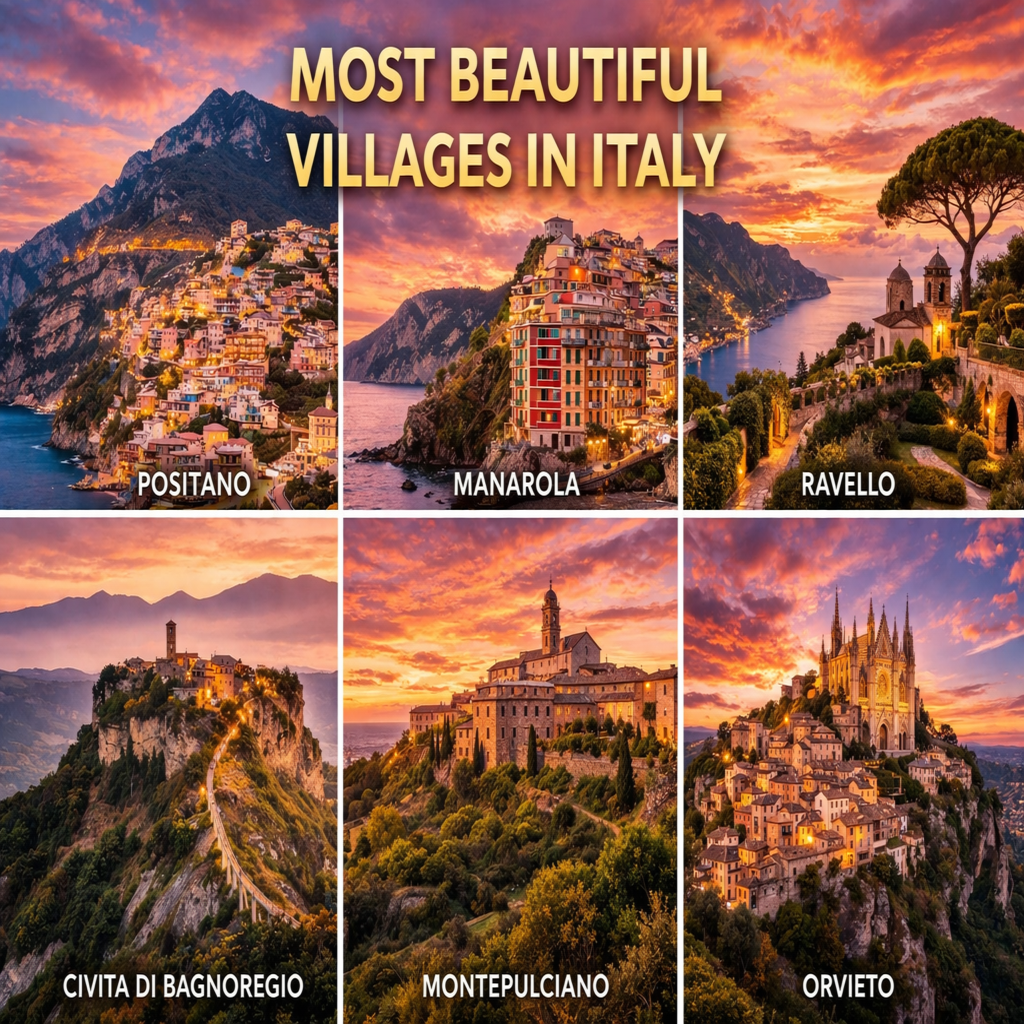
Civita di Bagnoregio is the most dramatically situated village in Italy and one of the most extraordinary small human settlements in the world — a medieval town perched on an isolated tufa rock butte above the Valle dei Calanchi (Valley of the Badlands), connected to the modern town of Bagnoregio by a single pedestrian footbridge and slowly, inexorably eroding into the valley below. Its nickname — La città che muore, the dying city — reflects the geological reality that the tufa rock on which it stands is crumbling away, taking buildings and streets with it over centuries, and that the community’s permanent population has dwindled to single figures.
What remains is one of the most hauntingly beautiful places in Central Italy. The Etruscan-founded, medieval-built town of Romanesque churches, tufa-stone houses, and narrow streets culminating in the small Piazza San Donato — with its church, its café, and its extraordinary panoramic views over the eroded clay badlands below — creates an atmosphere of concentrated beauty and melancholy that is unlike anything else in Lazio. The view of Civita from the footbridge, particularly in the early morning mist or at golden hour when the tufa glows amber, is one of the most photographed and most justifiably celebrated in Italy.
The village is best visited on weekday mornings in spring or autumn — weekends bring significant day-tripper numbers from Rome (2 hours by car), and the small size of the village (barely 1 hectare) means that crowds change its character fundamentally.
Getting there: Drive from Rome (approximately 2 hours) via Viterbo, or from Orvieto (30 minutes). There is no public transport directly to Civita — a car is essential.
Don’t miss: The view from the footbridge at dawn, the Piazza San Donato and the Church of San Donato, the tufa cave cellars beneath the village, the panorama from the village edge over the Valle dei Calanchi.
Best time to visit: April to June and September to October, arriving before 9 AM on weekdays.
2. Positano, Campania — The Vertical Village
Positano is the most iconic and most immediately beautiful village on the Amalfi Coast — a cascade of pastel-painted houses, bougainvillea-draped terraces, ceramic-tiled domes, and narrow stairway streets tumbling precipitously from the clifftop road to the small beach and harbor below. It is simultaneously one of the most photographed places in Italy and one of the most genuinely, stubbornly beautiful — a village whose visual perfection, somehow, resists the dilution of familiarity.
John Steinbeck wrote about Positano in 1953 that it was a dream place that isn’t quite real when you are there and becomes beckoningly real after you have gone. Seven decades later, the observation remains accurate. Positano’s specific quality — the way it hangs above the sea, the way the light moves across its colored facades in the long afternoon hours, the smell of lemon and sea and bougainvillea, the sound of the fishing boats on the small beach — produces a beauty that photographs capture only partially and memory intensifies.
The village is small enough to explore entirely on foot — which is the only option, given that its streets are vertical staircases rather than roads. The Church of Santa Maria Assunta, with its distinctive majolica-tiled dome visible from the sea, houses an extraordinary 13th-century Byzantine icon. The beaches — the main Spiaggia Grande and the smaller Fornillo beach around the western headland — are as beautiful as any in the Campanian coast. And the local food culture — sfogliatelle, linguine alle vongole, fresh grilled fish, the limoncello made from the giant sfusato lemons grown on the cliff terraces above — is excellent.
The Amalfi Drive (SS163) connecting Positano with Amalfi and Ravello is one of the finest coastal roads in Europe — narrow, vertiginous, and spectacular in every direction.
Getting there: By car along the SS163 coastal road (parking is extremely limited and expensive in summer — arrive very early or take the SITA bus). By ferry from Naples or Amalfi. By SITA bus from Sorrento (45 minutes).
Don’t miss: The view from the clifftop road above the village at dawn, the Church of Santa Maria Assunta, Fornillo beach in the late afternoon, linguine alle vongole at a harbor restaurant, the boat trip to the Grotta dello Smeraldo.
Best time to visit: May to June and September to October. July and August are beautiful but extremely crowded.
3. Alberobello, Puglia — The Trullo Village
Alberobello is unique in Italy and, architecturally, unique in the world — a village in the Valle d’Itria of Puglia whose historic center is composed almost entirely of trulli: the extraordinary conical-roofed stone buildings that evolved from prehistoric dry-stone construction techniques and that gave the Valle d’Itria its distinctive, fairy-tale landscape. The Rione Monti neighborhood, with over 1,000 trulli on a single hillside, is a UNESCO World Heritage Site and one of the most architecturally distinctive settlements in Europe.
The trulli are built from local limestone without mortar — each cone of flat stones corbeled inward to a central pinnacle — and their whitewashed walls and grey conical roofs produce a visual effect that is simultaneously ancient and otherworldly. Walking through the Rione Monti’s narrow streets, past trullo after trullo converted into shops, restaurants, guesthouses, and the extraordinary Trullo Sovrano (the only trullo built on two floors), is one of the most genuinely unusual architectural experiences in Italy.
The broader Valle d’Itria — accessible by car from Alberobello — is one of the most beautiful agricultural landscapes in southern Italy, its red earth dotted with trulli farmhouses, olive groves, dry-stone walls, and the whitewashed hill towns of Locorotondo, Cisternino, and Martina Franca. The wines of the valley — particularly the indigenous Verdeca white and the Primitivo di Manduria red — are excellent and almost unknown outside the region.
Getting there: Train from Bari (1.5 hours) or Taranto. By car from Bari (1.5 hours) or along the scenic Valle d’Itria country roads.
Don’t miss: Rione Monti at dawn before the tourist shops open, the Trullo Sovrano interior, dinner in a trullo restaurant, the drive through the Valle d’Itria to Locorotondo and Cisternino, Primitivo di Manduria wine tasting.
Best time to visit: April to June and September to October.
4. Manarola, Liguria — The Cinque Terre’s Most Beautiful Village
The five villages of the Cinque Terre — Monterosso al Mare, Vernazza, Corniglia, Manarola, and Riomaggiore — are among the most famous and most visited small communities in Italy, and for good reason. Their combination of colorful houses stacked vertically on rocky promontories above the Ligurian Sea, terraced vineyards climbing the cliff faces above, and the extraordinary coastal hiking trails connecting them creates one of the most visually stunning coastlines in the Mediterranean.
Of the five, Manarola is widely considered the most beautiful. The classic view of Manarola — its tower of multicolored houses rising above the rocky harbor, reflected in the clear water below — is one of the most iconic images in Italian travel photography and genuinely more beautiful in person than in photographs. The harbor, where local fishermen haul their boats onto the rocks each evening, is a scene of extraordinary pictorial quality. The Via dell’Amore (Love Path) connecting Manarola with Riomaggiore — a clifftop walkway recently reopened after years of restoration — is one of the most romantic short walks in Italy.
The Cinque Terre’s local wine culture — Sciacchetrà, the extraordinary sweet wine made from partially dried Bosco, Albarola, and Vermentino grapes grown on the impossibly steep terraced vineyards — is one of the most labor-intensive and most characterful wine traditions in Italy. A small glass at a Manarola wine bar, watching the sun set over the Ligurian Sea, is one of the great small pleasures of Italian travel.
Getting there: Train from La Spezia (10 minutes) or Genoa (1.5 hours) — the train is by far the most convenient option. A Cinque Terre Card (€7.50–€18 depending on duration) covers the hiking trails and park entry.
Don’t miss: The harbor view at sunset from the Via dei Pesci walkway, the classic Manarola viewpoint, the Via dell’Amore to Riomaggiore, Sciacchetrà wine at a local enoteca, anchovies and focaccia from a village shop, the evening when the day-trippers have left.
Best time to visit: May and September to October — July and August are beautiful but extremely crowded on the trails.
5. Montepulciano, Tuscany — The Noble Wine Town
Montepulciano is the most architecturally distinguished of the Tuscan hill towns — a citta in miniature rather than merely a village, its perfectly preserved Renaissance and medieval street plan rising from the Val di Chiana below in a sequence of palaces, churches, towers, and piazzas that constitutes one of the finest small urban ensembles in Tuscany. And it produces, in the Vino Nobile di Montepulciano, one of the greatest red wines in Italy.
The town’s main street — the Corso, winding steeply upward from the town gates to the summit Piazza Grande — passes through the full architectural history of Montepulciano’s Renaissance golden age. The Palazzo Nobili-Tarugi, the Palazzo Contucci (one of the finest Renaissance palaces in the region, with a wine cellar directly beneath it where Vino Nobile can be tasted), and the extraordinary Tempio di San Biagio — a domed Renaissance church by Antonio da Sangallo the Elder, set alone in the fields below the town, considered one of the finest Renaissance buildings in Tuscany — are all outstanding.
The Vino Nobile di Montepulciano — made from the Prugnolo Gentile (a local clone of Sangiovese) and aged for a minimum of two years in oak — is available for tasting in dozens of cantinas throughout the town, many housed in medieval cellars of extraordinary atmospheric quality. The food of the Val di Chiana — the famous Chianina beef (the finest in Italy, used for the authentic bistecca alla Fiorentina), pecorino cheese, pici (thick hand-rolled pasta with wild boar ragu), and the rich, slow-cooked preparations of Tuscan peasant cuisine — is outstanding.
Getting there: By car from Siena (1 hour) or Florence (1.5 hours). Limited bus connections from Chiusi-Chianciano Terme train station (30 minutes).
Don’t miss: The Piazza Grande and the Cathedral of Santa Maria Assunta, wine tasting in a Palazzo Contucci cellar, the Tempio di San Biagio at sunset, pici al ragù di cinghiale at a traditional osteria, the Cantina de’ Ricci (the largest underground wine cellar in Montepulciano).
Best time to visit: April to June and September to October. The Bravio delle Botti (barrel race) in August is a remarkable medieval festival.
6. Ravello, Campania — The City of Music Above the Amalfi Coast
Ravello is not — contrary to the impression given by most Amalfi Coast travel guides — primarily a beach destination. It is a mountain village, perched on a spur of the Lattari Mountains 350 meters above the sea, with views down the coast that extend 40 km in both directions and constitute some of the finest in Italy. It is a village of extraordinary refinement and cultural distinction — the preferred retreat of Wagner, D.H. Lawrence, Virginia Woolf, Gore Vidal (who lived here for decades), and generations of artists drawn by the quality of the light, the silence, and the panoramic views.
The Villa Cimbrone, whose Terrace of Infinity — a clifftop belvedere lined with classical busts and open to a direct view down the sheer mountain face to the sea and coast far below — has been called the most beautiful viewpoint in Italy, is one of the most romantically conceived gardens in Europe. The Villa Rufolo, whose gardens inspired Wagner to set the Flower Garden scene of Parsifal here, provides the spectacular outdoor setting for the Ravello Festival — an annual classical music celebration held in summer, with concerts performed on a cliff-edge stage with the sea as backdrop.
The Ravello Cathedral, founded in 1086 and housing an extraordinary pulpit of mosaic inlay work (1272) and the Museo del Duomo with its collection of medieval bronze doors and decorative art, is outstanding. And the food — the restaurant scene in Ravello is the finest on the Amalfi Coast, with several excellent establishments offering refined Campanian cuisine alongside the views that few restaurant settings in the world can match.
Getting there: By bus from Amalfi (25 minutes, regular SITA bus service). By car from the coastal SS163 road — the road to Ravello climbs from the coast at Castiglione.
Don’t miss: The Terrace of Infinity at Villa Cimbrone (arrive at opening), the Villa Rufolo gardens and festival stage, the Cathedral pulpit mosaics, a long dinner with Amalfi Coast views, the walk to the village of Scala and back through the mountain terraces.
Best time to visit: April to June and September to October. The Ravello Festival runs July to August.
7. Orvieto, Umbria — The Masterpiece on the Rock
Orvieto occupies one of the most extraordinary sites of any city in Italy — a perfectly flat-topped butte of volcanic tufa rising 325 meters above the Paglia River valley in southern Umbria, its vertical cliff faces dropping away on all sides, the medieval town on its summit connected to the modern city below by a funicular that has been operating since 1888. The town has been inhabited since at least the Bronze Age and was one of the most important Etruscan cities before becoming a significant medieval city and papal residence.
The Duomo di Orvieto — the Cathedral of the Assumption of the Virgin, whose facade is one of the most extraordinary pieces of decorative architecture in Italy, covered in mosaics, bas-reliefs, bronze doors, and Gothic pinnacles that took 300 years to complete — is the most magnificent building in Umbria and one of the finest Gothic cathedrals in the country. The Cappella di San Brizio within the cathedral, with its extraordinary cycle of Last Judgment frescoes by Luca Signorelli (completed 1502), was the primary inspiration for Michelangelo’s Sistine Chapel ceiling and is one of the great masterworks of Italian Renaissance painting.
The underground city of Orvieto — an extraordinary network of caves, cisterns, tunnels, and Etruscan-era chambers excavated into the tufa over millennia beneath the town — is accessible on guided tours and provides a completely different and equally fascinating perspective on the city’s layered history.
Getting there: Train from Rome (1.5 hours on the direct Intercity or regional service) or Florence (2 hours). The funicular from Orvieto Scalo station to the historic center takes 3 minutes.
Don’t miss: The Cathedral facade at midday when the mosaics catch the sun, the Cappella di San Brizio frescoes (book in advance), an underground city tour, the Pozzo di San Patrizio (the extraordinary double-helix well built in 1527), Orvieto Classico white wine from a local cantina, wild boar pasta at a traditional osteria.
Best time to visit: April to June and September to November.
8. Pitigliano, Tuscany — The Little Jerusalem
Pitigliano is the most dramatically sited village in Tuscany — and one of the most dramatic in Italy — perched on a narrow ridge of volcanic tufa above the confluence of three river gorges in the Maremma region of southern Tuscany. Seen from the approach road, the village appears to grow directly from the tufa ridge, its medieval buildings and their foundations so completely continuous with the rock below that the distinction between natural formation and human construction blurs entirely.
The Jewish heritage of Pitigliano — which earned it the nickname “La Piccola Gerusalemme” (Little Jerusalem) for the size and cultural significance of its medieval and Renaissance Jewish community — is deeply embedded in the village’s historic character. The restored synagogue (one of the finest in Tuscany), the Jewish museum, the kosher wine production (Pitigliano’s white wine has historical significance for the local Jewish community’s passover observance), and the network of underground passages and caves used by the community over centuries, constitute a heritage of considerable historical significance and cultural depth.
The surrounding Maremma Toscana — a landscape of volcanic tufa formations, Etruscan tombs, ancient vie cave (sunken roads carved through the tufa by the Etruscans, some up to 20 meters deep), thermal springs, and the extraordinary neighboring villages of Sorano and Sovana — is one of the most beautiful and most overlooked regional landscapes in Tuscany.
Getting there: By car from Rome (2.5 hours) or from Orbetello on the Tyrrhenian coast (1 hour). No convenient train connection — a car is essential.
Don’t miss: The view of the village from the approach road (photograph from the east for the best perspective), the synagogue and Jewish museum, the vie cave Etruscan sunken roads (particularly the Via Cava di San Giuseppe near the village), the neighboring village of Sovana and its Etruscan necropolis, Pitigliano white wine at a local cantina.
Best time to visit: April to June and September to October.
9. Borghetto sul Mincio, Lombardy — Northern Italy’s Hidden Gem
Borghetto sul Mincio is one of northern Italy’s most beautiful and least known villages — a tiny medieval hamlet of stone watermills on the Mincio River, its buildings and mill wheels rising directly from the river in a scene of extraordinary pictorial quality that has remained essentially unchanged for centuries. It is part of the comune of Valeggio sul Mincio in the Veneto, sitting on the border between Lombardy and the Veneto, and it is a destination that even many Italians do not know.
The village is most famous for its tortellini — the fresh pasta that has been made here for centuries and is celebrated annually in the Festa del Nodo d’Amore (Festival of the Love Knot) in June, when the longest table in the world (approximately 1 km) is set along the medieval bridge above the river and thousands of visitors eat tortellini in brodo together. The legend of Borghetto’s tortellini connects it to a love story — the pasta shape supposedly inspired by the navel of a local noblewoman glimpsed through a keyhole — a characteristically Italian combination of food origin myth and romantic narrative.
The watermills, the medieval bridge, the restored fortifications of the Visconti dam, and the extraordinary reflections of the stone buildings in the Mincio’s clear water produce a quality of peaceful, unhurried beauty that is specifically northern Italian — different in character from the dramatic hilltop villages of Tuscany or the coastal settlements of the Amalfi and Ligurian coasts, but equally rewarding in its way.
Getting there: By car from Verona (20 minutes) or Mantua (30 minutes). Limited bus connections from Valeggio sul Mincio village.
Don’t miss: The watermill reflections in the Mincio at dawn or dusk, the Visconti bridge and dam fortifications, tortellini in brodo at a riverside restaurant, the Sigurtà Garden Park nearby (one of the finest garden parks in Italy, particularly spectacular during the tulip season in March and April).
Best time to visit: April to May (tulip season at Sigurtà) and September to October.
10. Santo Stefano di Sessanio, Abruzzo — The Medici Mountain Village
Santo Stefano di Sessanio is one of the finest and most atmospheric medieval villages in central Italy — a perfectly preserved mountain hamlet at 1,251 meters in the Gran Sasso d’Italia massif of Abruzzo, its stone buildings so completely integrated with the grey limestone of the mountain landscape that the village seems to have grown from the rock rather than been built upon it. It was a possession of the Medici family of Florence for over a century, and the wealth and architectural refinement they brought to this remote mountain community is still visible in the quality of its buildings and fortifications.
The Sextantio Albergo Diffuso — a pioneering concept in sustainable rural tourism, in which abandoned village houses have been restored and converted into hotel rooms and communal spaces while preserving the authentic materials and character of the medieval village — has made Santo Stefano di Sessanio internationally known among travelers interested in architecture, design, and sustainable tourism. Staying in the village overnight, when the day visitors have left and the mountain silence returns, is one of the most atmospheric accommodation experiences in Italy.
The Gran Sasso d’Italia National Park surrounding the village offers some of the finest hiking, wildlife watching (the Apennine wolf, the Marsican brown bear, the Abruzzo chamois, and the golden eagle are all present), and mountain landscapes in peninsular Italy — largely unknown to international travelers and extraordinarily beautiful.
Getting there: By car from L’Aquila (45 minutes) or from Rome (2.5 hours via the A24 autostrada). No public transport serves the village directly — a car is essential.
Don’t miss: The village at dawn and dusk when the day-trippers have gone, the restored Torre Medicea (Medici tower), a stay at the Sextantio Albergo Diffuso, arrosticini (Abruzzese lamb skewers grilled over charcoal — the definitive food of the region) from a local restaurant, hiking in the Gran Sasso d’Italia National Park.
Best time to visit: June to September for hiking; December to March for snow and Christmas atmosphere.
11. Atrani, Campania — The Amalfi Coast’s Smallest and Most Authentic Village
Atrani is the smallest municipality in Italy by area and, for that reason and several others, the most authentically Amalfi Coast of the coastal villages — a tiny fishing village immediately east of Amalfi, separated from its more famous neighbor by a single headland, that lacks the tourist infrastructure of Positano or Amalfi proper and retains a quality of genuine, unhurried village life that the more visited communities have largely lost to the tourism economy.
The village is barely 400 meters wide — a single piazza, the Piazza Umberto I (one of the finest small squares in the south of Italy, opening directly onto the sea through an arch), a handful of streets, a small beach, the 10th-century Church of San Salvatore de’ Birecto (where the Doges of the Amalfi Republic were crowned), and the surrounding cliff faces of the Dragone Valley. It is entirely walkable in twenty minutes — and then worth walking again more slowly.
The beach — small, pebbly, shadowed by the clifftops, and populated primarily by local families and a small number of in-the-know visitors — is one of the finest and most intimate on the Amalfi Coast. Eating at one of the two or three restaurants on or near the piazza — fresh pasta with local clams, grilled fish, sfogliatelle for dessert — with the sea visible between the buildings and the sounds of the village around you, is the ideal Amalfi Coast dining experience that the more famous villages rarely provide at anything like this quality of authentic simplicity.
Getting there: By SITA bus from Amalfi (10 minutes) or on foot from Amalfi along the coastal path (15 minutes). Parking is almost nonexistent — arrive by bus.
Don’t miss: Piazza Umberto I opening to the sea, the Church of San Salvatore de’ Birecto, the small beach, a simple lunch of fresh pasta and grilled fish at a local restaurant, the coastal walk to Amalfi and back.
Best time to visit: May to June and September to October.
12. Spello, Umbria — The Flower Village of Roman Umbria
Spello is one of the most satisfying and least visited of the Umbrian hill towns — a perfectly preserved Roman and medieval village on the western flank of Monte Subasio, its pink and cream stone streets, ancient Roman gates, and extraordinary floral tradition making it one of the most beautiful and most quietly rewarding communities in central Italy.
The Roman heritage of Spello is exceptional — the Porta Venere (Gate of Venus), with its two flanking cylindrical towers, and the Porta Consolare, both dating from the 1st century BC, are among the finest surviving examples of Roman civic architecture in Umbria, and the village’s Roman walls and street plan are still legible beneath their medieval overlay. The Collegiata di Santa Maria Maggiore contains the Baglioni Chapel — frescoed by Pinturicchio in 1501 in a cycle of extraordinary quality and freshness that is, for most visitors, a genuine and complete surprise.
The Infiorata — Spello’s famous flower festival held on Corpus Christi (usually in June), when the entire village creates elaborate carpet pictures of flowers covering the main streets — is one of the most spectacular and labor-intensive folk art traditions in Italy and one of the finest regional festivals in Umbria. The surrounding olive oil production (Spello’s DOP extra virgin olive oil is among the finest in Umbria) and the excellent local wine and black truffle culture of the Monte Subasio zone make the village outstanding for food tourism.
Getting there: Train from Perugia (20 minutes) or Assisi (10 minutes, 2 km walk from the station to the village). By car from Perugia (30 minutes) or Assisi (10 minutes).
Don’t miss: The Pinturicchio frescoes in the Baglioni Chapel (genuinely unmissable), the Roman gates, a walk along the ancient walls, the Infiorata flower festival (book accommodation months in advance), Umbrian black truffle pasta at a local osteria, local DOP olive oil tasting.
Best time to visit: April to June (Infiorata in June is exceptional) and September to October.
13. Tropea, Calabria — The Clifftop Village Above the Turquoise Sea
Tropea is the most dramatically beautiful coastal village in Calabria — a clifftop town of Baroque churches, 16th-century palaces, and narrow streets perched 60 meters above a stretch of Tyrrhenian coast whose turquoise and emerald water is among the clearest in the Mediterranean. It has been inhabited since antiquity — according to local tradition, by Hercules himself — and the quality of its beaches, the warmth of its waters, and the beauty of its clifftop position make it one of the finest coastal towns in southern Italy.
The beach below the cliff — accessible by stairs cut into the rock face — is exceptional: fine white sand, crystalline water that turns from turquoise in the shallows to deep blue further out, and the dramatic backdrop of the clifftop village above. The Santa Maria dell’Isola — a Norman monastery built on an isolated sea stack, connected to the mainland by a narrow isthmus and rising dramatically from the sea against the backdrop of the Aeolian Islands visible on clear days — is the defining image of Tropea and one of the most photographed scenes in Calabria.
Tropea is famous throughout Italy for its cipolla rossa — red onions of exceptional sweetness, cultivated in the area for centuries, eaten raw in salads, used in jams, and celebrated in an annual festival. The local food culture of Calabria — nduja (the fiery spreadable pork salumi unique to the region), swordfish prepared in a dozen ways, peperoncino in everything — is one of the most distinctive and most underrated in Italy.
Getting there: Train from Lamezia Terme (45 minutes, with connections from Rome and Milan) or by car from Lamezia Terme airport (1 hour).
Don’t miss: The Santa Maria dell’Isola at sunset, the beach below the cliff at midday, the Baroque churches and palaces of the old town, red onion jam and nduja from a local producer, swordfish carpaccio at a clifftop restaurant, the Aeolian Islands ferry day trip from nearby Vibo Valentia Marina.
Best time to visit: June and September — the sea is warm, the crowds are manageable, and the light is magnificent.
How to Plan a Village-Focused Italy Trip
Rent a car. This is the single most important practical decision in planning a village-focused Italian trip. The vast majority of Italy’s most beautiful villages are either inaccessible by public transport or accessible only by infrequent and time-consuming connections. A rental car transforms the experience — allowing arrival at dawn before the day-trippers, the freedom to stop at an unmarked roadside view, and the ability to reach the secondary villages and landscapes that complete the regional picture. Collect the car from a city airport and return it to a different city to build a one-way regional itinerary.
Stay in the villages overnight. The most important advice for experiencing Italian villages at their finest. The day-tripper version of Positano, Alberobello, or Civita di Bagnoregio — arriving by tour bus at 10 AM and leaving at 4 PM — is incomparably inferior to the overnight visitor’s version. The villages after dark, when the tour groups have left and the community’s authentic life resumes, are the villages worth experiencing. Book guesthouses, agriturismi (farm stays), and small boutique hotels within or immediately adjacent to the villages.
Combine regions intelligently. Italy’s regions are distinct enough in their village character that combining two or three creates an experience of genuine variety. A southern Tuscany and Umbria circuit (Montepulciano, Pitigliano, Orvieto, Spello) covers magnificent hilltop territory across two of Italy’s finest regions. A Campania and Calabria coastal circuit (Positano, Ravello, Atrani, Tropea) covers the finest southern coastal villages. A northern circuit (Borghetto sul Mincio, Cinque Terre, and the Piedmont wine villages) offers completely different northern Italian character.
Eat locally and specifically. Every village in this guide has specific local food traditions — the tortellini of Borghetto sul Mincio, the Sciacchetrà of the Cinque Terre, the Vino Nobile of Montepulciano, the nduja of Tropea, the red onions of Tropea, the truffles of Spello and Pitigliano. Seeking out these specific local products and the restaurants and producers that make them best constitutes the finest food itinerary available in Italian village travel.
Travel in shoulder season. The distinction between crowded and uncrowded at Italy’s most visited villages — Positano, Manarola, Alberobello — is extreme. May, June, September, and October offer the combination of good weather, manageable visitor numbers, and the authentic village rhythm that July and August cannot provide.
Final Thoughts: The Villages Are Where Italy Keeps Its Soul
Italy’s cities are magnificent. Rome is eternal. Florence contains more great art per square meter than anywhere else on Earth. Venice is the most beautiful impossible city in the world. But the Italy that most reveals the country’s essential character — the deep agricultural civilization, the extraordinary relationship between landscape and food and community, the specific beauty of human settlement in extraordinary natural settings — is the Italy of the villages.
The hilltop towns rising from volcanic rock, the fishing villages hanging above turquoise seas, the medieval borghi where the street plan has not changed in 700 years and the same families have been making the same wine in the same cantina for generations — this is the Italy that the country’s own residents love most fiercely and that the traveler who ventures beyond the main cities invariably finds most deeply affecting.
It requires a car and a willingness to leave the familiar itinerary behind. It requires arriving early and staying late and spending the night in places where the only sounds after 9 PM are distant dogs and the wind. It requires accepting that the finest meal of the trip will be served in a room with eight tables and a handwritten menu and a proprietor who is also the cook and whose grandmother’s recipe for the pasta sauce has not materially changed in living memory.
It requires, in other words, exactly the quality of attention and openness that the best travel has always required. And it rewards that quality of attention with an experience of Italy — its beauty, its food, its human warmth, its specific and irreplaceable relationship with the land it occupies — that no amount of queuing for the Uffizi can provide.
The villages are where Italy keeps its soul. Go find it.
We hope this guide to the most beautiful villages in Italy has given you the inspiration and practical foundation to plan an Italian adventure beyond the obvious. For more regional Italy guides, village itineraries, food and wine deep-dives, and travel inspiration across the full extraordinary breadth of the country, keep exploring GlobeTrailGuide — your trusted companion for smarter, deeper travel.
GlobeTrailGuide.com | Travel Smarter. Explore Deeper.