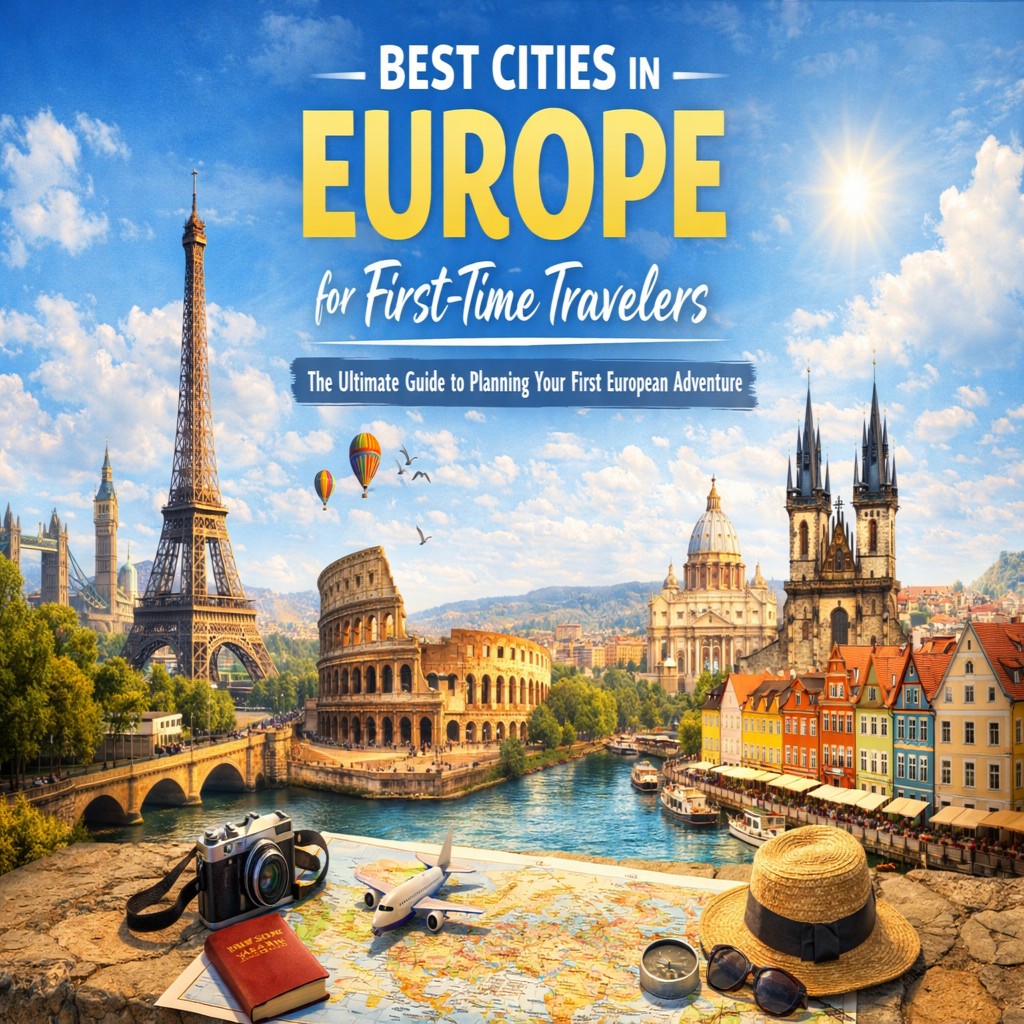
Europe is where most people’s love affair with travel begins. There is a reason for that. Nowhere else on Earth concentrates such an extraordinary diversity of history, culture, architecture, food, and human experience within such a manageable geographical area. You can eat a croissant in Paris at breakfast, be in Amsterdam by lunch, and watch the sun set over the Rhine from a German castle by evening. The continent is a mosaic of civilizations layered one upon another across three thousand years, and almost everywhere you look — from the cobblestone alleys of Lisbon’s Alfama to the grand boulevards of Vienna to the canal-threaded backstreets of Venice — that layering produces something that stops you in your tracks.
But Europe’s richness is also its challenge for the first-time traveler. With over fifty countries, hundreds of great cities, and an almost overwhelming abundance of things to see and do, deciding where to go first is genuinely difficult. Should you go for the iconic — Paris, Rome, London? The underrated — Porto, Ljubljana, Tallinn? The culturally overwhelming — Istanbul, Athens, Prague? The naturally spectacular — Dubrovnik, Bergen, Interlaken?
This guide cuts through the paralysis of choice. We have identified the best cities in Europe for first-time travelers — destinations that reward newcomers with world-class attractions, manageable geography, excellent infrastructure, and the kind of beauty and depth that creates lifelong travel obsessions. Whether you have ten days or three weeks, whether your priority is art, history, food, nightlife, nature, or simply wandering without a plan, this guide will help you build a first European adventure worth remembering for the rest of your life.
How We Chose These Cities
The cities in this guide were selected on five criteria: world-class attractions that genuinely justify the journey, walkability and manageable scale for first-time visitors, strong transport connections that make them easy to reach and use as a base, a food and café culture that rewards exploration beyond the tourist zones, and a depth of character that goes beyond the postcard image. Every city on this list will reward a first-time visitor with experiences that go far beyond what they expected — and send them home already planning a return.
1. Paris, France — The City That Invented the Idea of the Great City
No city on Earth has shaped the world’s imagination of what urban life can be more completely than Paris. It is the most visited city in the world and has held that title with complete justification for generations. Its museums, boulevards, bridges, cafés, and gardens constitute one of the greatest concentrations of human beauty and intellectual achievement ever assembled in a single place.
For first-time European travelers, Paris is both the obvious choice and genuinely the right one. The Louvre — the world’s largest art museum, home to the Mona Lisa, the Venus de Milo, and tens of thousands of other masterworks — could occupy an entire week and still not be fully absorbed. The Musée d’Orsay, housed in a magnificent Belle Époque railway station, contains the world’s finest collection of Impressionist art. The Eiffel Tower, seen for the first time in person, is one of those rare experiences where the reality genuinely exceeds the expectation. And Notre-Dame Cathedral, recently reopened after its devastating 2019 fire, is one of the most historically significant and architecturally magnificent buildings in human history.
But Paris rewards the traveler who goes beyond the monuments. The neighborhoods — the intellectual Left Bank, the aristocratic Marais, the bohemian Montmartre, the vibrant Canal Saint-Martin — each have their own character and their own pleasures. The city’s café culture, its extraordinary pâtisseries, its wine bars and bistros, its bookshops and galleries and fashion houses make daily life in Paris a continuous aesthetic experience.
Best for: First-time Europe visitors who want the full, iconic European city experience. Art lovers, food obsessives, romantics, and anyone who has ever been moved by the idea of the City of Light.
Don’t miss: The Louvre at opening time, Sainte-Chapelle’s stained glass, a sunset from the Pont des Arts, a croissant from a neighborhood boulangerie, fado at a Left Bank café.
Best time to visit: April to June and September to October.
2. Rome, Italy — Where Every Street Is a History Lesson
Rome is a living museum of extraordinary scale and depth — a city where you can stand on the same ground where Julius Caesar was assassinated, where early Christians hid in underground catacombs, where Renaissance popes commissioned the greatest artists of their age, and where contemporary Romans eat lunch on a Tuesday. No city on Earth has been continuously inhabited for as long, or has accumulated as many layers of civilization in a single place.
The Colosseum, the Roman Forum, the Pantheon, the Vatican Museums, the Sistine Chapel, the Trevi Fountain, Piazza Navona — the concentration of world-class monuments within walking distance of each other in central Rome is simply without parallel anywhere in the world. The Vatican alone — St. Peter’s Basilica, the Vatican Museums, the Sistine Chapel — could occupy two full days and still leave things unseen.
But Rome’s greatest pleasure is the one that cannot be put on an itinerary: the simple experience of walking its streets without a destination, of turning a corner and finding a fountain that would be the highlight of any other city, of sitting at a sidewalk café with a glass of prosecco and watching the most theatrical city in the world perform its daily drama.
Best for: History lovers, architecture enthusiasts, food travelers, and anyone who wants the most concentrated hit of human civilization available in a single city.
Don’t miss: The Colosseum and Roman Forum at opening time, the Vatican Museums with a pre-booked ticket, the Borghese Gallery (book weeks in advance), cacio e pepe at a neighborhood trattoria, the Trastevere neighborhood at night.
Best time to visit: April to June and September to October.
3. Barcelona, Spain — Architecture, Beach, and the Art of Living Brilliantly
Barcelona is the city that most consistently exceeds first-time visitors’ expectations. They arrive for the Sagrada Família and La Rambla and leave having fallen in love with a city of extraordinary architectural brilliance, extraordinary food, an extraordinary beach, and an energy and joie de vivre that is entirely, specifically Catalan.
Antoni Gaudí’s architectural legacy alone would make Barcelona one of Europe’s essential destinations. The Sagrada Família — still under construction after 140 years and expected to be fully completed in the late 2020s — is one of the most audacious and moving buildings in the world. Park Güell, Casa Batlló, and Casa Milà (La Pedrera) are further expressions of a creative vision so singular and so fully realized that they constitute a category of their own in the history of architecture.
Beyond Gaudí, Barcelona is a city of outstanding neighborhoods — the Gothic Quarter’s medieval labyrinth, the Modernista elegance of the Eixample, the bohemian Gràcia, the regenerated waterfront of Barceloneta and Poblenou. Its food markets (La Boqueria, the Mercat de Santa Caterina) are extraordinary. Its restaurant scene, shaped by the legacy of Ferran Adrià and elBulli, is among the most creative in the world. And its beach — 4.5 km of golden sand within the city limits — makes it the only major European capital with a genuinely swimmable urban coastline.
Best for: Architecture lovers, beach travelers, food and nightlife enthusiasts, and first-time visitors who want the full Mediterranean city experience in a single destination.
Don’t miss: Sagrada Família (pre-booked ticket essential), Park Güell, the Gothic Quarter, La Boqueria market, pintxos at a Gràcia bar, sunset from Bunkers del Carmel.
Best time to visit: May to June and September to October.
4. Amsterdam, The Netherlands — Canals, Culture, and the Art of Cycling Through Beauty
Amsterdam is one of the most immediately lovable cities in Europe — a place that charms almost every visitor within the first hour of arrival with its extraordinary network of 17th-century canal houses, its bicycle-filled bridges, its world-class museums, and the specific quality of light that filters through North Sea cloud cover and bounces off canal water to create an atmosphere that Dutch painters spent centuries trying to capture.
The Anne Frank House — where Anne Frank and her family hid from Nazi persecution for two years before their discovery and deportation — is one of the most profoundly moving and important museum experiences in Europe. The Rijksmuseum, with its incomparable collection of Dutch Golden Age painting including Rembrandt’s Night Watch and Vermeer’s The Milkmaid, is among the finest art museums in the world. The Van Gogh Museum, housing the world’s largest collection of Van Gogh’s paintings and drawings, is essential.
But Amsterdam is as much about the experience of the city itself as its specific attractions. Renting a bicycle and cycling the canal belt, stopping at a brown café (bruine kroeg) for a glass of Jenever (Dutch gin) and a bitterbal (deep-fried beef ragout ball), browsing the Jordaan neighborhood’s galleries and vintage shops, and taking a canal boat through the 17th-century UNESCO World Heritage ring of waterways — these are the pleasures that make Amsterdam one of Europe’s most rewarding and repeatedly revisitable cities.
Best for: Culture lovers, cyclists, art enthusiasts, and first-time European visitors who want a compact, walkable city with world-class museums and extraordinary everyday beauty.
Don’t miss: Anne Frank House (book months in advance), the Rijksmuseum, a canal bike ride through the Jordaan, the Albert Cuypmarkt, stroopwafels and raw herring from street vendors.
Best time to visit: April to May (tulip season) and September to October.
5. Prague, Czech Republic — The Fairy-Tale City That Defies Belief
Prague is one of the most architecturally spectacular cities in the world — a medieval, Baroque, and Art Nouveau ensemble of extraordinary completeness and beauty, largely spared the destruction of two world wars, that produces in first-time visitors a consistent and predictable reaction: disbelief that a city this beautiful actually exists.
The Old Town Square, with its Astronomical Clock (which has been marking the hours with mechanical figures since 1410), its Gothic Týn Church, and its Baroque St. Nicholas Church, is one of the finest public squares in Europe. Charles Bridge — a 14th-century stone bridge lined with Baroque sculptures crossing the Vltava River toward the castle hill — is one of the most dramatic and romantic walks in European travel. Prague Castle, looming above the city on its rocky promontory, is the largest ancient castle in the world and contains within its walls a cathedral, a royal palace, a Baroque garden, and a Golden Lane of tiny houses that once housed the castle’s guards and alchemists.
Prague is also outstanding value by Western European standards. A glass of excellent Czech Pilsner in a traditional pivnice (beer hall) costs less than €2. A full lunch of svíčková (beef sirloin in cream sauce) with bread dumplings costs €7–€10. The city’s hotels and guesthouses are priced considerably below equivalent accommodation in Paris, Amsterdam, or Rome.
Best for: Architecture enthusiasts, history lovers, budget-conscious first-time European visitors, and anyone who has ever wanted to walk through a fairy tale.
Don’t miss: Charles Bridge at dawn, Old Town Square Astronomical Clock, Prague Castle and St. Vitus Cathedral, a Czech beer at U Fleků brewery, the Josefov Jewish Quarter.
Best time to visit: April to June and September to November.
6. Lisbon, Portugal — Europe’s Most Captivating and Soulful Capital
Lisbon is the city that most surprises first-time visitors in recent European travel. They arrive knowing it is beautiful — they have seen the photographs of the azulejo-tiled facades and the yellow trams rattling through the Alfama — and they leave having been unexpectedly and deeply moved by a city of extraordinary character, warmth, and depth.
Set across seven hills above the broad Tagus estuary, Lisbon is a city of constant views — of the river, of the red rooftops of the Alfama, of the suspension bridge that resembles San Francisco’s Golden Gate, of Atlantic light moving across a sky that is bluer and cleaner than the Mediterranean. The Jerónimos Monastery in Belém, from whose shores Vasco da Gama set sail in 1497, is one of the finest examples of the Manueline architectural style — Portugal’s own elaborately maritime Gothic — in existence. The National Tile Museum, the Museu Gulbenkian, and the MAAT contemporary art museum are all world-class.
But Lisbon’s greatest pleasure, like Rome’s, cannot be scheduled. It is the experience of riding Tram 28 through the Alfama at dusk, the smell of grilled sardines drifting from a restaurant window, the sound of fado — that music of exquisite, bittersweet longing — heard live in a small Mouraria house on a Thursday night. It is a city that gets inside you, and it is increasingly recognized as one of the greatest cities in Europe.
Best for: Culture lovers, food travelers, fado enthusiasts, architecture aficionados, and first-time European visitors who want something slightly off the very beaten path but fully world-class.
Don’t miss: Alfama neighborhood and São Jorge Castle, Jerónimos Monastery and Belém Tower, the National Tile Museum, a pastéis de nata at Pastéis de Belém, fado live in Mouraria.
Best time to visit: April to June and September to October.
7. Vienna, Austria — Imperial Grandeur and the Art of Living Well
Vienna is the city that most makes first-time visitors feel as though they have stepped into a different and more formally magnificent version of civilization. The capital of the Habsburg Empire for six centuries, it accumulated a concentration of palaces, opera houses, museums, and ring-road boulevards that remains overwhelming in its grandeur and largely unchanged in its essential character from the late 19th century.
The Kunsthistorisches Museum — one of the world’s great art museums, its collection assembled by the Habsburgs over centuries — and the Belvedere Palace, home to Gustav Klimt’s The Kiss, are both essential. Schönbrunn Palace, the Habsburg summer residence with its 1,441 rooms and extraordinary formal gardens, is a UNESCO World Heritage Site of breathtaking scale. The Vienna State Opera is one of the finest in the world, and tickets at various price points — including standing room tickets for as little as €4 — make this one of the great affordable luxury experiences in European travel.
Vienna is also extraordinary for its Kaffeehauskultur — the coffee house tradition that is itself a UNESCO Intangible Cultural Heritage. Sitting in Café Central, Café Landtmann, or Café Schwarzenberg for a melange (Vienna’s version of a café au lait) and a slice of Sachertorte, watching Viennese life perform its elegantly unhurried daily ritual, is one of the great pleasures of European travel.
Best for: Classical music lovers, art enthusiasts, history travelers, food and café culture devotees, and anyone who wants to understand what European imperial civilization at its peak looked and felt like.
Don’t miss: Kunsthistorisches Museum, Belvedere Palace and The Kiss, Schönbrunn Palace, a performance at the Vienna State Opera, Naschmarkt, a melange and Sachertorte at Café Central.
Best time to visit: April to June and September to October. December for the Christmas markets.
8. Edinburgh, Scotland — Ancient, Wild, and Deeply Atmospheric
Edinburgh is the most dramatically situated city in Europe — a medieval Old Town of volcanic rock, Gothic spires, and dark wynds (narrow alleyways) growing organically from the Castle Rock, with the elegant Georgian New Town laid out in perfect neoclassical symmetry below. It is a city of extraordinary physical beauty, fierce intellectual tradition, and a cultural vitality that produced the Scottish Enlightenment in the 18th century and the world’s largest arts festival in the 20th.
Edinburgh Castle, perched on its extinct volcanic plug above the city, is one of Europe’s most dramatic fortresses — home to the Scottish Crown Jewels, the Stone of Destiny, and views over the city and the Firth of Forth that are simply unparalleled. The Royal Mile — the medieval spine of the Old City running from the Castle to the Palace of Holyroodhouse — is lined with closes (medieval alleyways) that open into hidden courtyards and unexpected vistas at every turn. Arthur’s Seat, the ancient volcano in Holyrood Park that rises to 251 meters within the city limits, provides a summit hike with 360-degree views over Edinburgh and the surrounding landscape.
The Edinburgh Festival in August — encompassing the Fringe, the International Festival, the Book Festival, and the Military Tattoo simultaneously — is one of the most extraordinary cultural events in the world, transforming the city into a month-long celebration of theatre, comedy, music, and ideas. And Scotland’s national drink — whisky, particularly the smoky, complex single malts of Islay and Speyside — can be explored in depth at Edinburgh’s excellent whisky bars and the Scotch Whisky Experience.
Best for: History and literature lovers, whisky enthusiasts, outdoor walkers, festival-goers, and first-time visitors who want a European city with a wild, ancient, and distinctly non-Mediterranean character.
Don’t miss: Edinburgh Castle, the Royal Mile closes, Arthur’s Seat hike, the National Museum of Scotland (free), a dram at The Bow Bar, haggis at The Witchery.
Best time to visit: May to September. August for the Festival (book accommodation a year in advance).
9. Budapest, Hungary — Grand, Romantic, and Gloriously Underrated
Budapest is consistently described by travelers who have been as one of Europe’s most underrated capitals — and consistently named by those who have not been as somewhere they always mean to get to. This gap between reputation and reality is Budapest’s defining characteristic, and closing it is one of European travel’s most rewarding experiences.
The city sits astride the Danube — Buda on the western hills, Pest on the flat eastern plain — connected by a series of magnificent bridges of which the Chain Bridge is the most iconic. The Hungarian Parliament Building, stretching 268 meters along the Pest riverbank and reflected in the Danube below, is one of the most beautiful government buildings in the world. Buda Castle, rising above the river on its limestone plateau, houses the Hungarian National Gallery and offers panoramic views over Pest and the river that are among the finest in Central Europe.
Budapest’s thermal bath culture — a legacy of Ottoman occupation in the 16th and 17th centuries — is one of Europe’s most distinctive and enjoyable travel experiences. The Széchenyi and Gellért thermal baths, both extraordinarily beautiful buildings housing pools of naturally heated mineral water, are the finest examples. Ruin bars — atmospheric drinking establishments occupying derelict buildings in the old Jewish Quarter, most famously Szimpla Kert — are one of Budapest’s most original contributions to European nightlife culture. And Hungarian cuisine — goulash, lángos (deep-fried dough with sour cream and cheese), halászlé (fisherman’s soup), and the extraordinary Gerbeaud cakes — is deeply satisfying and consistently underestimated.
Best for: Architecture enthusiasts, thermal bath lovers, nightlife seekers, food and wine travelers, and budget-conscious first-time visitors who want a grand European capital at significantly lower prices than the Western European equivalents.
Don’t miss: Hungarian Parliament Building, Buda Castle and Fisherman’s Bastion, Széchenyi thermal bath, a ruin bar evening in the Jewish Quarter, goulash at a traditional étterem, a sunset cruise on the Danube.
Best time to visit: April to June and September to October.
10. Athens, Greece — The Cradle of Western Civilization
Athens is the city that started it all — the birthplace of democracy, philosophy, drama, and the Olympic Games, a place where the accumulated achievements of Western civilization can be traced back to specific buildings, specific hills, and specific human beings whose ideas still shape the world you live in. For a first-time European traveler with any interest in history, Athens is not optional. It is foundational.
The Acropolis — the sacred rock rising 156 meters above the city, crowned by the Parthenon, the Erechtheion, and the Temple of Athena Nike — is one of the most profound and awe-inspiring sites in human experience. The Acropolis Museum, opened in 2009 and housing the sculptures and artifacts found on and around the rock, is one of the finest purpose-built museum experiences in the world. The Ancient Agora — the heart of ancient Athenian civic and commercial life, where Socrates taught and the first democratic debates took place — is a deeply moving and historically extraordinary site.
Modern Athens, long overlooked in favor of the ancient city, has transformed dramatically over the past fifteen years into a genuinely exciting contemporary destination. The Monastiraki and Psiri neighborhoods offer outstanding street food, craft cocktail bars, and a creative energy that rivals any European capital. The Athens street art scene, centered on Exarchia and Kerameikos, is among the finest in the world. And Greek cuisine — far more diverse and sophisticated than its international reputation suggests — is having a well-deserved global moment.
Best for: History lovers, archaeology enthusiasts, philosophy readers, food travelers, and first-time European visitors who want to experience the literal foundations of Western civilization.
Don’t miss: The Acropolis at opening time, the Acropolis Museum, the Ancient Agora, souvlaki and loukoumades in Monastiraki, a sunset from Filopappou Hill, the Athens Central Market.
Best time to visit: April to June and September to November.
11. Florence, Italy — The Renaissance in a Single City
Florence is the city that created the modern world — or at least the visual and intellectual framework that the modern world built itself upon. In the 14th, 15th, and 16th centuries, a remarkable concentration of artists, architects, scientists, philosophers, and patrons in this small Tuscan city produced an outpouring of human creativity that we now call the Renaissance, and whose physical legacy — in museums, churches, palaces, and streets — is more completely preserved here than anywhere else on Earth.
The Uffizi Gallery is where the Renaissance lives most completely. Room after room of Botticelli, Leonardo, Michelangelo, Raphael, Titian, and Caravaggio constitute the most concentrated collection of Renaissance masterpieces in the world, culminating in Botticelli’s Birth of Venus and Primavera — two paintings of such beauty and historical significance that standing before them is a genuinely transformative experience. Michelangelo’s David, in the Galleria dell’Accademia, is the defining sculpture of the Renaissance and one of the most perfect human achievements in any artistic medium.
Beyond the museums, Florence is a city of extraordinary everyday beauty — its narrow medieval streets, the Ponte Vecchio’s gold and silver shops above the Arno, the terracotta dome of the Florence Cathedral (Brunelleschi’s masterwork, the largest brick dome in the world, completed in 1436) visible from almost everywhere in the city, and the sweeping panorama from Piazzale Michelangelo at sunset over the entire Arno valley — all contribute to an experience that is, quite simply, one of the finest in Europe.
Best for: Art lovers, Renaissance history enthusiasts, architecture admirers, food and wine travelers, and anyone who wants to understand what the peak of Western artistic achievement looks and feels like in person.
Don’t miss: The Uffizi Gallery (pre-book), Michelangelo’s David at the Accademia, the Florence Cathedral and Brunelleschi’s Dome, Ponte Vecchio, bistecca alla Fiorentina at a Oltrarno trattoria, sunset from Piazzale Michelangelo.
Best time to visit: April to June and September to October.
12. Porto, Portugal — Raw, Beautiful, and Unforgettable
Porto is the city that most consistently converts skeptics into devotees. Travelers who arrive thinking of it as Lisbon’s lesser sibling leave having experienced something altogether more visceral, more raw, and in some ways more deeply affecting — a city of extraordinary character, built into steep hillsides above the Douro River, its facades a magnificent chaos of azulejo tiles, crumbling plasterwork, ornate ironwork, and laundry lines, its people fiercely proud and genuinely warm, its food and wine among the finest in Europe.
The Ribeira district, a UNESCO World Heritage Site, tumbles down to the Douro waterfront in a cascade of color and texture that is unlike any urban landscape in Europe. The Dom Luís I Bridge, crossing the river between Porto and Vila Nova de Gaia, is one of the great iron bridges of the 19th century and best crossed on foot for the views over the river and the city. The port wine lodges of Gaia offer tours and tastings of the fortified wine that made Porto famous — and the aged tawnies of Taylor’s and Graham’s are world-class expressions of a unique winemaking tradition.
The Livraria Lello — one of the world’s most beautiful bookshops, with its sweeping neo-Gothic staircase and ornate carved interior — is a pilgrimage destination for book lovers. The São Bento railway station’s vast azulejo panels depicting Portuguese history are a masterpiece of public decorative art. And the city’s food scene — the francesinha, the tripas à moda do Porto, the bacalhau com natas, and the extraordinary seafood of the Matosinhos district — is among the most rewarding in Portugal.
Best for: Architecture lovers, food and wine travelers, photography enthusiasts, and first-time visitors who want a deeply authentic and characterful European city that still feels genuinely undiscovered.
Don’t miss: Ribeira waterfront, Dom Luís I Bridge at sunset, port wine tasting in Vila Nova de Gaia, Livraria Lello, São Bento station azulejos, a francesinha at a classic Porto tasca.
Best time to visit: April to June and September to October.
13. Dubrovnik, Croatia — The Most Beautiful Walled City in the World
Dubrovnik is the kind of city that makes people question whether it is real. The medieval walled city — its limestone streets, Baroque fountains, Renaissance palaces, and orange-tiled rooftops contained within walls up to 25 meters high and six meters thick — is one of the most perfectly preserved urban ensembles in the world, and its setting above the Adriatic, with the deep blue sea visible at every turn, produces a beauty that seems almost designed to be experienced rather than simply seen.
Walking the 2 km circuit of the city walls — a panoramic loop above the old city’s rooftops on one side and the Adriatic on the other — is the essential Dubrovnik experience and arguably the finest urban walk in Europe. The Rector’s Palace, Sponza Palace, the Franciscan Monastery with its 14th-century pharmacy (the third oldest in the world), the Church of St. Blaise, and the city’s main artery, the marble-paved Stradun, are all outstanding. The cable car to Mount Srđ provides a bird’s-eye view over the entire old city, the islands, and the coast that is simply overwhelming.
Dubrovnik’s status as a Game of Thrones filming location (it served as King’s Landing) has brought an additional layer of recognition to a city that needed no help in that department. Visit in May, June, September, or October to experience it without the overwhelming peak-season crowds.
Best for: Architecture lovers, Mediterranean beach travelers, Game of Thrones enthusiasts, history buffs, and first-time visitors who want the single most visually perfect city in Europe.
Don’t miss: The city walls at dawn, Stradun at dusk, the Rector’s Palace, the cable car to Mount Srđ, a day trip to the Elafiti Islands, a swim in the Adriatic from the city’s rocky bathing areas.
Best time to visit: May to June and September to October.
14. Berlin, Germany — History, Art, and the Most Exciting City in Europe
Berlin is the most complex and the most exciting city in Europe — a metropolis that was divided by a wall for 28 years, devastated by war, rebuilt from rubble, and has spent the decades since reunification becoming one of the world’s most creative, culturally diverse, and intellectually serious cities. It is not conventionally beautiful in the way of Prague or Dubrovnik, but it is endlessly fascinating, constantly surprising, and permanently interesting in a way that few cities can match.
The historical weight of Berlin is immense and must be engaged with directly. The Memorial to the Murdered Jews of Europe — 2,711 concrete stelae of varying heights covering an entire city block, designed by Peter Eisenman — is one of the most powerful commemorative spaces in the world. The German History Museum, the Topography of Terror (documenting the Nazi security apparatus from the site of its former headquarters), and the DDR Museum (East German everyday life under communism) are all essential. Checkpoint Charlie, the Berlin Wall Memorial on Bernauer Strasse, and the East Side Gallery — a 1.3 km section of the original wall covered in murals — are equally important.
But Berlin in the present tense is equally extraordinary. Museum Island, a UNESCO World Heritage complex of five world-class museums on an island in the Spree, is one of the finest museum concentrations in Europe. The Pergamon Museum houses the reconstructed Pergamon Altar and the Ishtar Gate of Babylon. The city’s street art, nightlife, food markets (Markthalle Neun, Boxhagener Platz), and independent creative culture make it one of the most stimulating cities in the world to spend time in.
Best for: History lovers, contemporary art and culture enthusiasts, nightlife seekers, food and market travelers, and first-time visitors who want a European city of extraordinary depth and complexity.
Don’t miss: Memorial to the Murdered Jews of Europe, Berlin Wall Memorial, Museum Island and the Pergamon, the East Side Gallery, Markthalle Neun on Thursday evenings, currywurst from a street stand.
Best time to visit: May to September. December for the Christmas markets.
15. Bruges, Belgium — The Middle Ages Perfectly Preserved
Bruges is the most completely preserved medieval city in Northern Europe — a UNESCO World Heritage ensemble of Gothic churches, merchant’s houses, winding canals, and cobblestone squares that has changed so little in its essential character since the 15th century that walking its streets feels like passing through a portal into another era entirely.
The Markt — the central square with its towering Belfry (89 meters, 366 steps, and a carillon of 47 bells) — is the heart of medieval Bruges. The Burg square, adjacent to the Markt, contains some of the finest Gothic and Renaissance civic architecture in Northern Europe. The Groeningemuseum houses one of the world’s finest collections of Flemish Primitive painting — Jan van Eyck, Hans Memling, and Gerard David — work of extraordinary quality, intimacy, and emotional power that is inseparable from the city that produced it.
The canals — earning Bruges its reputation as the Venice of the North — are best experienced by boat and by walking the quieter canal-side streets away from the main tourist areas. And the food: Belgian chocolate (Bruges has more chocolate shops per square kilometer than almost any city in Europe), Belgian waffles (both the crispy Liège variety and the lighter Brussels type), moules-frites, and an extraordinary range of Belgian ales — Trappist, Saison, Gueuze, and Witbier — make the city a genuine destination for anyone who takes food and drink seriously.
Best for: Medieval history lovers, art enthusiasts (particularly Flemish Primitive painting), chocolate and beer devotees, and first-time visitors who want the most perfectly preserved pre-modern European city available.
Don’t miss: The Belfry and Markt square, the Groeningemuseum, a canal boat tour, the Begijnhof in early morning, Belgian chocolate at The Chocolate Line, a glass of Trappist ale at De Garre.
Best time to visit: April to June and September to November.
How to Plan Your First European Trip: Practical Advice
Start with two or three cities, not eight. The most common mistake of first-time European travelers is trying to see too much in too little time. A well-paced trip of two to three cities with adequate time in each — three to four days minimum per major city — will be far more rewarding than a whirlwind tour that leaves you exhausted and with little more than a collection of rushed photographs.
Use trains between nearby cities. Europe’s rail network is one of its greatest assets. Paris to Amsterdam takes 3.5 hours by Thalys; Paris to London takes 2.5 hours by Eurostar; Florence to Rome takes 1.5 hours by Frecciarossa; Prague to Vienna takes 4 hours by Railjet. Booking in advance yields excellent prices and the journey itself is frequently one of the most pleasant parts of the trip. The Eurail Pass offers good value for multi-country trips of longer duration.
Book major attractions in advance. The Louvre, the Uffizi, the Vatican Museums, the Anne Frank House, Edinburgh Castle, and the Acropolis all benefit enormously from pre-booked tickets. In peak season, arriving without a reservation at several of these can mean a wait of two to four hours or missing entry entirely.
Stay in the right neighborhood. Accommodation location matters enormously in European cities. Staying within or immediately adjacent to the historic center puts the best of each city within walking distance and significantly reduces transport costs and complexity. Research neighborhoods carefully and prioritize proximity to the main sights over hotel amenities.
Travel in shoulder season if possible. April to June and September to October offer the best combination of good weather, manageable crowds, and reasonable prices in most European destinations. July and August bring the peak of both visitors and prices, particularly in southern Europe. Winter travel to northern European cities (Berlin, Amsterdam, Edinburgh) is underrated — colder but atmospheric, uncrowded, and significantly cheaper.
Get a travel card or multi-city transport pass. Most European cities have day or multi-day public transport passes that offer unlimited travel and save money over individual ticket purchases. Many cities also offer museum passes (Paris Museum Pass, Athens City Pass, Amsterdam City Card) that combine transport and museum entry at significant savings.
Walk as much as possible. The greatest discoveries in European cities are made on foot, between the planned attractions, in the streets and alleyways that no guidebook fully covers. Build unscheduled walking time into every day — the best moments of almost every European trip happen when the itinerary is abandoned and the city is simply allowed to reveal itself.
Best European City Combinations for First-Time Travelers
Some cities pair naturally for a first European trip, either because of geographical proximity, excellent rail connections, or complementary characters that together provide a richer overall experience.
Paris and Amsterdam (4–5 days each): Connected by 3.5-hour Thalys train. Two of Europe’s greatest cities with complementary characters — Paris’s formal grandeur and culinary sophistication alongside Amsterdam’s canal-house charm and Golden Age art.
Rome and Florence (4 days Rome, 2–3 days Florence): Connected by 1.5-hour Frecciarossa. The two most concentrated expressions of Western artistic and historical achievement within easy reach of each other. Add Naples and Pompeii as a day trip from Rome for extraordinary additional depth.
Barcelona and Lisbon (3–4 days each): Two of Europe’s most vibrant and enjoyable cities, connected by a short flight or an epic overnight train journey. Complementary Mediterranean and Atlantic personalities with outstanding food and architecture.
Prague and Vienna (3 days Prague, 3 days Vienna): Connected by 4-hour Railjet. Two of Central Europe’s most spectacular capitals with contrasting characters — Prague’s fairy-tale Gothic and Baroque alongside Vienna’s imperial grandeur and Kaffeehauskultur.
Edinburgh and London (3 days Edinburgh, 3 days London): Connected by 4.5-hour LNER train or 1.5-hour flight. Two of the English-speaking world’s greatest cities, each utterly distinct in character, offering the finest introduction to British and Scottish culture.
Dubrovnik and Split with Islands (3–4 days Dubrovnik, 2–3 days Split): Connected by 4-hour coastal bus or Krilo catamaran via islands. The finest Adriatic itinerary, combining two of Croatia’s greatest cities with island-hopping through Hvar, Korčula, and Vis.
Budget Guide: What to Expect Across Europe’s Best Cities
European city costs vary enormously by destination and season. Here is a general framework for first-time travelers.
Most Affordable: Prague, Budapest, Athens, Porto, and Lisbon offer outstanding value by Western European standards. A comfortable daily budget of €70–€90 per person covers good mid-range accommodation, excellent restaurant meals, transport, and attractions.
Mid-Range: Barcelona, Rome, Florence, Edinburgh, Bruges, and Berlin fall into a comfortable middle range. A daily budget of €100–€130 per person covers well-located accommodation, good restaurant dining, and major attractions.
Premium: Paris, Amsterdam, Vienna, and London are among Europe’s more expensive cities. A comfortable daily budget of €130–€170 per person is realistic for mid-range accommodation, meals at good restaurants, and regular attraction entry.
Money-saving tips across all cities: Eat lunch rather than dinner at restaurants (set lunch menus offer extraordinary value throughout Europe), use public transport passes, visit free museums (many European cities offer free museum days or have outstanding free permanent collections), book accommodation and attraction tickets well in advance, and avoid restaurants immediately adjacent to the most famous landmarks.
Final Thoughts: Europe Is Not a Destination. It Is a Beginning.
The first European trip rarely satisfies the curiosity it was meant to address. Instead, it opens a door into a world of extraordinary complexity and beauty that most travelers spend decades happily exploring without exhausting. The cities in this guide are not endpoints — they are starting points. They are the places that teach you what Europe is capable of, what human civilization has produced over three millennia in this particular corner of the world, and what you most want to return to and go deeper into.
The traveler who sees the Parthenon for the first time and feels genuinely moved by standing where democracy was invented will come back for Olympia, Delphi, and Santorini. The traveler who discovers fado in a Lisbon back street will come back for the Alentejo, the Douro Valley, and the Azores. The traveler who gets lost for an afternoon in Prague’s Josefov Quarter and emerges with a completely different understanding of Central European history will come back for Krakow, Budapest, and Sarajevo. That is how Europe works. It begins with the obvious and rewards you with the inexhaustible.
Start somewhere on this list. Go slowly. Walk more than you planned. Eat everything. Talk to people. Sit in cafés without checking your phone. Let the cities surprise you beyond what the photographs prepared you for. And accept — as every first-time traveler to Europe eventually and gratefully does — that you are going to need to come back.
We hope this guide to the best cities in Europe for first-time travelers has given you the inspiration and practical foundation to plan the adventure of a lifetime. For individual city guides, regional deep-dives, and travel inspiration for every destination in this list and far beyond, keep exploring GlobeTrailGuide — your trusted companion for smarter, deeper travel.
GlobeTrailGuide.com | Travel Smarter. Explore Deeper.