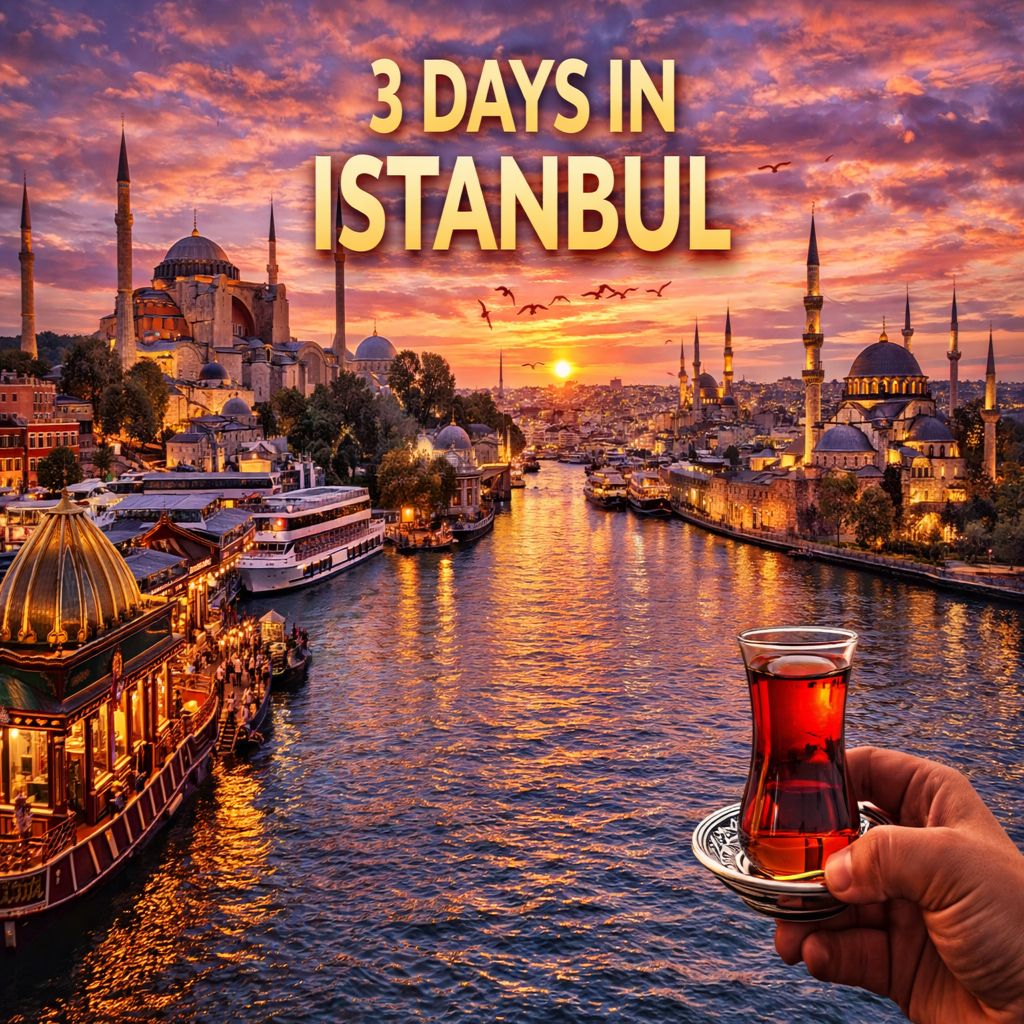
Three days in Istanbul is not enough. This needs to be stated honestly and immediately, before the itinerary begins, because Istanbul is the kind of city that makes every visitor acutely aware of how much they are not seeing — the neighborhoods not reached, the mosques not entered, the ferry not taken to the Asian shore at dusk, the meyhane not found in the backstreets of Beyoğlu where the raki flows and the meze arrives in waves and the evening extends beyond any reasonable hour. Three days in Istanbul is an introduction to one of the world’s great cities, a provocation to return, and — if planned and executed well — one of the most extraordinary seventy-two hours available to any traveler anywhere on the planet.
Istanbul is unique in the specific and literal sense: it is the only city in the world that sits on two continents, straddling the Bosphorus Strait that divides Europe from Asia, and this geographical reality is the starting point for understanding a place that has spent three thousand years at the intersection of everything. Greek colony, Roman capital, Byzantine seat of empire for over a millennium, Ottoman imperial center for another six centuries — Istanbul (or Constantinople, or Byzantium, depending on your historical frame of reference) has been, at various points in its history, the most important city in the world. The physical evidence of all of these civilizations is still present, layered upon each other in the most concentrated and dramatic architectural and archaeological palimpsest in human history.
But Istanbul is not merely a historical city. It is a living, heaving, magnificently alive metropolis of 15 million people — a city of traffic and ferries and street cats and street food and the call to prayer echoing from hundreds of minarets simultaneously and the smell of roasting chestnuts and simit bread and sea and diesel and spice. It is one of the great food cities of the world. It has neighborhoods of extraordinary contemporary creativity and neighborhoods of unchanged 19th-century Ottoman character. It is simultaneously the most ancient and the most vigorously present city you are likely to encounter, and three days in it will leave you disoriented, overwhelmed, fed beyond capacity, and entirely unwilling to leave.
This itinerary makes the most of those three days. It covers the essential historical monuments while leaving enough space for the slower, less structured pleasures — the neighborhood walks, the ferry crossings, the long lunches, the late evenings — that distinguish a genuinely experienced Istanbul visit from a monument-ticking exercise. It covers both the European and Asian sides of the city. It eats and drinks extremely well. And it ends, as all the best Istanbul experiences do, with the Bosphorus glittering below and the minaret-studded skyline above and the certainty that you are already planning to come back.
Before You Arrive: Essential Istanbul Practicalities
Getting There and Into the City
Istanbul has two main international airports. Istanbul Airport (IST) — the new airport on the European side, opened in 2019 and now one of the largest in the world — handles the majority of international traffic. From the airport, the Istanbul Airport Metro (M11) connects to Gayrettepe station in approximately 40 minutes, with connections to the wider metro network. The Havaist bus service connects to Taksim Square (45–60 minutes, approximately 100 TL). Taxis charge approximately 300–400 TL to the historic center — agree a price before departure or ensure the meter runs.
Sabiha Gökçen Airport (SAW) on the Asian side handles significant low-cost carrier traffic. The Havabus connects to Taksim Square in approximately 60–90 minutes depending on traffic. An Uber or taxi to the European side via the Bosphorus bridges costs approximately 400–600 TL.
The Istanbulkart
The Istanbulkart is the rechargeable transit card covering all metro, tram, bus, ferry, and funicular journeys in Istanbul. Available at airport machines and metro stations for a small deposit, it is the essential tool for independent navigation of the city and provides significant savings over single-journey tickets. Buy one immediately on arrival and load it with credit.
The Tram T1 Line
The historic tram line T1 runs from Kabataş on the Bosphorus shore, through Karaköy, across the Galata Bridge, and along the main tourist axis of the historic peninsula through Eminönü, Beyazıt, and on to Bağcılar. It connects virtually every major historical attraction on the European side and is the most useful single transit line for first-time visitors. Board at any stop with your Istanbulkart.
Currency and Tipping
Turkey uses the Turkish Lira (TL). Cash is widely used in the historic markets, smaller restaurants, and street food vendors. Cards are accepted at most hotels and larger restaurants. Tipping is customary — 10–15% at restaurants, rounding up for taxis and small services.
Safety
Istanbul is generally a safe city for tourists exercising normal urban awareness. The main concerns are pickpocketing in crowded tourist areas (Grand Bazaar, Eminönü, and the T1 tram line are the most targeted) and, for solo female travelers, unwanted attention in certain neighborhoods late at night. The historic peninsula, Beyoğlu, Karaköy, and Kadıköy on the Asian side are all well-regarded for visitor safety.
Day One: The Ottoman Empire’s Greatest Stage
The first day is dedicated to the historic peninsula — Sultanahmet and its immediate surroundings — where the greatest concentration of world-class monuments in Istanbul is compressed into a walkable area of extraordinary historical intensity. The objective is not to rush through the monuments but to experience them properly, with sufficient time to be genuinely affected by their scale and beauty.
Morning: Hagia Sophia at Opening Time
Set the alarm. Hagia Sophia opens at 9 AM (it closes on Fridays during Friday prayer, reopening in the afternoon) and the difference between experiencing it at 9 AM and 11 AM is the difference between awe and endurance.
The Hagia Sophia — completed in 537 AD by the Emperor Justinian, who reportedly declared “Solomon, I have surpassed thee” on seeing the finished building — is one of the most extraordinary architectural achievements in human history. For nearly a thousand years it was the largest enclosed space in the world, its 31-meter central dome seemingly floating above the nave on a ring of forty windows that flood the interior with light in a way that 6th-century observers described as miraculous — the dome appearing to hang from heaven by a golden chain. It served as the cathedral of Byzantine Christianity for 916 years, became the greatest mosque of the Ottoman Empire in 1453, was converted to a museum in 1934, and was reconverted to a functioning mosque in 2020 — each of these transitions leaving physical traces that are still legible in the building’s extraordinary layered interior.
The mosaics — partially covered for the mosque conversion but still partially visible — are among the finest examples of Byzantine art in the world. The enormous calligraphic medallions bearing the names of Allah, Muhammad, and the early caliphs, hanging in the nave, represent the Ottoman layer of the building’s history with equal grandeur. The gallery level, reached by a ramp from the northwest corner, provides close-up access to the finest preserved mosaics and the finest overview of the main dome.
Dress modestly (cover shoulders and knees; head covering for women available at the entrance), remove shoes at the inner doorway, and — if you arrive early enough — find a spot in the nave and simply stand there for fifteen minutes without taking photographs. The building rewards stillness and silence in a way that very few spaces in the world can.
Entry is free as a functioning mosque. Book the gallery timed entry online to guarantee access.
Mid-Morning: The Blue Mosque and the Hippodrome
The Sultan Ahmed Mosque — universally known as the Blue Mosque for the 20,000 hand-painted İznik tiles covering its interior — sits directly opposite the Hagia Sophia across the Sultanahmet park, its six minarets (controversial at the time of its construction in 1616 as no mosque outside Mecca had previously had six) creating the most recognizable skyline in Istanbul.
The interior — its four enormous elephant-foot pillars supporting the central dome, the galleries of İznik tiles in cobalt, turquoise, and white, the 260 windows admitting a cool, filtered light — is extraordinarily beautiful and, unlike the Hagia Sophia, is experienced at its most moving when the mosque is actively in use, the smell of incense and the sound of prayer filling the space. Visit between prayer times — times are posted at the entrance — and observe the same dress code as at the Hagia Sophia. Entry is free.
The Hippodrome — the ancient Byzantine chariot racing track that ran between the two mosques — is now the pedestrianized At Meydanı (Horse Square), but three monuments from its original decoration survive in situ: the Egyptian Obelisk of Thutmose III (erected here in 390 AD, brought from Luxor), the Serpentine Column (originally from Delphi, the oldest Greek monument in Istanbul, dating from 479 BC), and the Column of Constantine. These three objects, standing casually in an open square, carry between them over 2,500 years of history — a typical Istanbul moment of monumental casualness.
Lunch: Traditional Turkish at a Sultanahmet Lokanta
Avoid the tourist-facing restaurants immediately surrounding the Hagia Sophia and Blue Mosque — their prices are elevated and their quality is mediocre. Walk five minutes in any direction into the residential back streets of Sultanahmet and find a traditional lokanta (Turkish canteen restaurant) where office workers and local residents eat. A plate of mercimek çorbası (red lentil soup, the most beloved soup in Turkish cuisine), a portion of slow-cooked lamb güveç (clay pot stew), fresh bread, and a glass of ayran (cold salted yogurt drink) costs approximately 150–250 TL and is exactly what is needed after a morning of monumental intensity.
Afternoon: Topkapi Palace — The Heart of the Ottoman Empire
The Topkapi Sarayı was the administrative and residential center of the Ottoman Empire for nearly 400 years — the palace from which thirty-six sultans ruled a territory extending from Vienna to the Persian Gulf, from the Caspian Sea to the Atlantic coast of Morocco. It is not a single building but a complex of courts, pavilions, kitchens, barracks, mosques, and libraries spread over 700,000 square meters on the promontory above the confluence of the Bosphorus and the Golden Horn — the finest strategic site in Istanbul and, arguably, in the world.
The complex divides into four courts of increasing exclusivity. The Second Court contains the enormous imperial kitchens (now housing one of the world’s finest collections of Chinese and Ottoman ceramics) and the Divan-i Hümayun (Imperial Council Chamber). The Third Court — the inner sanctum, accessible only to those with specific permission in the imperial era — contains the Throne Room and the extraordinary Treasury, whose collection includes the 86-carat Spoonmaker’s Diamond (the fifth largest in the world), the Topkapi Dagger, and the Throne of Shah Ismail. The Fourth Court’s garden pavilions, including the magnificent Baghdad Kiosk, offer the finest views of the Bosphorus from any building in Istanbul.
The Harem — the separate residential complex housing the sultan’s household, his wives, concubines, and the eunuchs who administered it — is accessible on a separate timed ticket and is one of the most fascinating and architecturally extraordinary parts of the complex. The suite of rooms developed by Mimar Sinan for Suleiman the Magnificent, the Valide Sultan’s apartments, and the Privy Chamber of Murat III with its İznik tilework are all outstanding.
Practical: Buy a Museum Pass Istanbul (approximately €30, valid for 5 days) before visiting Topkapi — it covers entry to Topkapi, the Hagia Sophia gallery, the Archaeological Museums, and several other major sites, saving significant money and allowing queue-free entry at most. Topkapi’s separate Harem ticket must be purchased on site. Allow a minimum of three hours for the main complex; four to five hours with the Harem.
Late Afternoon: The Basilica Cistern
Five minutes on foot from Topkapi, the Yerebatan Sarnıcı (Basilica Cistern) is the largest surviving Byzantine cistern in Istanbul — an underground cathedral of 336 marble columns supporting vaulted brick ceilings, built by Justinian in the 6th century to supply water to the Great Palace and capable of holding 80,000 cubic meters. The cistern was forgotten after the Byzantine collapse, rediscovered in the 16th century, and is now one of Istanbul’s most evocative and atmospheric monuments.
The floor is covered in shallow water, wooden walkways navigate between the columns, and the lighting is theatrical — dim, with certain columns spot-lit to dramatic effect. Two of the columns rest on upside-down Medusa heads of unknown provenance — one inverted, one sideways — whose asymmetrical positioning has generated centuries of speculation. The entire space is cool, silent, and deeply mysterious.
Entry approximately 250 TL. Book online to avoid queues.
Evening: Sunset From Galata Bridge, Dinner in Karaköy
Walk down from Sultanahmet to the Eminönü waterfront and cross the Galata Bridge on foot at approximately 6:30 PM. The bridge connects the historic peninsula to the Karaköy and Galata neighborhood on the opposite shore of the Golden Horn — a walk of perhaps fifteen minutes that passes fishermen lining both sides of the bridge’s lower deck, the Bosphorus and the Golden Horn converging ahead, and the skyline of Sultanahmet receding behind in the last golden light.
Stop for a midye dolma — mussels stuffed with spiced rice, eaten straight from the shell with a squeeze of lemon, sold from street carts at both ends of the Galata Bridge for approximately 10–15 TL each. Eat four or five. They are one of Istanbul’s finest and most ubiquitous street foods.
Dinner in Karaköy — the neighborhood immediately north of the bridge on the western shore — at one of the excellent contemporary Turkish restaurants that have transformed this formerly industrial quarter into one of Istanbul’s most exciting dining destinations. Lokanta Maya, Karaköy Lokantası, or the excellent meyhanes (Turkish taverns) of the adjacent Galata neighborhood offer modern interpretations of Turkish cuisine alongside an introduction to rakı — the anise-flavored spirit that is Turkey’s national drink, mixed with cold water and ice until it turns milky white, drunk slowly with meze throughout the evening.
Day Two: Beyoğlu, the Grand Bazaar, and Bosphorus at Dusk
Day Two covers the Grand Bazaar and Spice Market in the morning, the Beyoğlu neighborhood and the Galata Tower in the afternoon, and a Bosphorus ferry at sunset — combining the city’s most extraordinary shopping and market experience with its finest contemporary neighborhood and its most iconic natural feature.
Morning: Grand Bazaar at Opening Time
The Kapalıçarşı (Grand Bazaar) is the oldest and largest covered market in the world — 4,000 shops, 61 covered streets, and an estimated 250,000–400,000 visitors daily at peak season, all contained within a domed and vaulted labyrinthine structure that has been continuously operating since its construction in 1455. It is simultaneously one of the most extraordinary architectural spaces in Istanbul and one of the most overwhelming commercial environments in the world.
The key to enjoying the Grand Bazaar is timing. Arrive at opening time (9 AM) on a weekday morning, when the shopkeepers are arranging their goods and the tourist buses have not yet arrived, and the market has an unhurried, slightly domestic quality entirely different from its midday form. Walk without a specific shopping agenda for the first thirty minutes — get productively lost in the deeper covered streets away from the main tourist artery of the İç Bedesten, discover the carpet merchants and the gold dealers and the antique sellers in the inner sections, and let the market reveal its structure gradually.
What to buy — and what to avoid buying — at the Grand Bazaar requires honest guidance. The leather goods, carpets, kilims, İznik-style ceramics, hand-painted objects, and gold and silver jewelry are all available in ranges from mass-produced tourist souvenirs to genuinely excellent quality handcrafted pieces. The difference between them is discernible to an attentive eye. Bargaining is standard — start at 50–60% of the asking price and work toward a mutual agreement with good humor and without aggression. Walking away is a legitimate negotiating tool and frequently produces a revised offer. Do not feel obligated to buy anything you do not genuinely want.
The best purchases in the Grand Bazaar are the most durable and authentic: a hand-woven kilim from a reputable dealer, a piece of genuine Ottoman-era silver, high-quality Turkish cotton textiles, or a set of hand-painted İznik tiles from a ceramics specialist who can explain the production process.
Mid-Morning: Egyptian Spice Bazaar
A ten-minute walk from the Grand Bazaar along the Hasırcılar Caddesi leads to the Mısır Çarşısı — the Egyptian Spice Bazaar, built in 1664 as part of the New Mosque complex and named for the Egyptian customs duties that originally funded it. Smaller, less overwhelming, and more sensory than the Grand Bazaar, the Spice Bazaar is a covered L-shaped market specializing in spices, dried fruits, nuts, Turkish delight (lokum), cheese, olives, and the full range of Turkish pantry ingredients.
The smell — cumin, sumac, dried rose petals, cinnamon, sesame — fills the arcade from one end to the other and constitutes one of Istanbul’s finest sensory experiences. Buy baharat (mixed spice blend), pul biber (Turkish red pepper flakes — indispensable in any kitchen), sumac, and a selection of Turkish delight to take home. The quality varies significantly between stalls — the older, less flashy shops toward the back of the market tend to offer better quality than the tourist-facing stalls at the main entrances.
The Eminönü waterfront immediately outside the Spice Bazaar is one of Istanbul’s most kinetic and pleasurable public spaces — ferries arriving and departing for the Bosphorus and the Asian shore, the smell of balık ekmek (fish sandwiches grilled on rocking boats moored at the quay), the Yeni Cami (New Mosque) rising above the market entrance, and the full panorama of the Golden Horn opening to the north.
Eat a balık ekmek — grilled mackerel fillet in a crusty white roll with onions, salad leaves, and lemon, sold from the famous wooden boats moored at the Galata Bridge end of the Eminönü quay. It costs approximately 80–100 TL and is one of Istanbul’s great street food experiences — simple, fresh, and entirely specific to this quayside.
Afternoon: Galata, İstiklal Caddesi, and Beyoğlu
Cross the Galata Bridge on foot and climb the hill to the Galata Tower — the medieval Genoese stone tower built in 1348 that dominates the skyline of the northern shore. The observation deck at the top (entry approximately 220 TL, book online to skip the queue) provides a 360-degree panorama over the Golden Horn, the Bosphorus, the historic peninsula’s minarets, and the Beyoğlu neighborhoods spreading northward. The view at any time of day is extraordinary; in the late afternoon light, it is magnificent.
From the Galata Tower, walk north up the Galip Dede Caddesi — a street lined with musical instrument shops that has served Istanbul’s musicians for generations — to the lower station of the Tünel funicular (the second-oldest underground railway in the world, opened in 1875, running two stops) and up to İstiklal Caddesi.
İstiklal Caddesi — the 1.4 km pedestrianized main street of Beyoğlu, running from Tünel to Taksim Square — is the most important street in modern Istanbul. Its Art Nouveau and early 20th-century European-style buildings house international boutiques, independent bookshops, patisseries, cinemas, galleries, and an extraordinary density of human activity from mid-morning until well past midnight. The vintage red tram that runs its length is one of Istanbul’s most photographed images.
But the real Beyoğlu is in the side streets — the hans (old commercial courtyards), the passage ways (pasajlar) opening off İstiklal lined with meyhanes and second-hand bookshops, the streets of the Cihangir neighborhood (bohemian, café-dense, the preferred neighborhood of Istanbul’s writers and artists) descending toward the Bosphorus. The Çiçek Pasajı (Flower Passage) and the adjacent Balık Pazarı (Fish Market) are outstanding for afternoon exploration and early evening eating.
Late Afternoon: Bosphorus Ferry
At approximately 5 PM, walk or take a taxi to Kabataş or Beşiktaş on the Bosphorus shore and board a public Şehir Hatları ferry for the crossing to Kadıköy on the Asian side (approximately 25 minutes, covered by Istanbulkart). Stand on the ferry’s open deck. Watch the city — the minarets, the Ottoman palaces on the European shore, the hills of the Asian side ahead, the Bosphorus traffic of tankers and fishing boats and other ferries, the occasional dolphin — pass around you in a panorama of extraordinary beauty. This is the essential Istanbul experience — the city experienced from the water, from the very strait that defines its geographical and historical identity — and it costs the price of a public transit fare.
Evening: Dinner in Kadıköy
Kadıköy — the main residential and commercial neighborhood of Istanbul’s Asian shore — is the city’s finest food neighborhood and the one most completely removed from the tourist economy. Its market streets (the Moda and Kadıköy bazaar area, centered on Güneşlibahçe Sokak and Mühürdar Caddesi) are filled with fishmongers, cheese shops, pickle sellers, bakers, and the full range of Turkish gastronomic production at its most authentic and affordable.
Dinner in Kadıköy should be a meyhane experience — the long, convivial Turkish tavern meal that begins with cold meze (haydari thick yogurt with herbs, cacık cucumber and yogurt, patlıcan ezmesi smoked eggplant, stuffed grape leaves, white bean salad, fresh white cheese with honey), continues through warm meze (crispy börek pastry, fried liver, shrimp güveç), advances to a main course of grilled fish or meat, and concludes very slowly, with rakı throughout and no particular regard for the hour. This is the finest and most convivial form of Turkish eating and the one most completely inaccessible to visitors who do not cross the Bosphorus.
Return to the European side by ferry (running until midnight) with the city lights reflected on the water below and the minaret silhouettes above.
Day Three: Ottoman Architecture, Neighborhood Wandering, and a Final Feast
The third day opens out — less monument-focused than the first two, more attuned to the specific pleasures of Istanbul’s neighborhoods, its non-Sultanahmet mosque architecture, and the long, slow, final evening that every great Istanbul visit deserves.
Morning: Süleymaniye Mosque and the Historic Bazaar Quarter
The Süleymaniye Camii — the mosque complex built by the great Ottoman architect Mimar Sinan for Sultan Suleiman the Magnificent between 1550 and 1557 — is, in the view of many architects and historians, the finest building in Istanbul. It lacks the Hagia Sophia’s awe-inspiring scale and the Blue Mosque’s famous silhouette, but surpasses both in the quality of its architectural thinking — the extraordinary mastery of structural logic and aesthetic harmony that makes Sinan’s work the highest expression of Ottoman mosque architecture.
The mosque sits on a terrace above the Golden Horn in the university quarter of Beyazıt, surrounded by its original külliye (complex) of medrese, hospital, caravanserai, and the tombs of Suleiman and his beloved wife Hürrem Sultan. The interior — its four massive columns and the perfect proportions of its central dome creating a space of luminous, serene beauty — is most affecting in the early morning when the light through its 138 windows is at its purest. Entry is free; the same dress code applies as at the Blue Mosque.
From the Süleymaniye, descend through the historic bazaar quarter — the book bazaar of Sahaflar Çarşısı (the oldest book market in Istanbul, operating since Byzantine times), the Beyazıt Mosque square, and the neighborhoods of Vefa and Zeyrek, where the oldest surviving Byzantine churches outside Sultanahmet stand in their repurposed forms (the Zeyrek Camii, built as the Monastery of the Pantokrator in the 12th century, is extraordinary and rarely visited).
Mid-Morning: Breakfast at a Vefa or Zeyrek Kahvaltı
Istanbul’s kahvaltı (breakfast) culture is one of the finest in the world — a multi-plate spread of white cheese (beyaz peynir), kaşar cheese, butter, honey, clotted cream (kaymak), olives, sliced tomatoes and cucumbers, sucuk (spiced sausage), eggs prepared to order, fresh bread, and çay (Turkish black tea in tulip-shaped glasses) that constitutes one of the most satisfying and most specifically Turkish food experiences available. In the Vefa and Balat neighborhoods north of the bazaar quarter, small lokanta cafés and traditional kahvaltı houses serve this spread for 150–250 TL per person — substantially cheaper and more authentic than the tourist-facing breakfast restaurants of Sultanahmet.
Late Morning: Balat and Fener — The Byzantine Shore
Balat and Fener are two adjacent waterfront neighborhoods on the Golden Horn’s western shore that constitute the most historically layered and most visually rewarding neighborhood walk in Istanbul. Balat was the Jewish quarter of Constantinople — home to the city’s Sephardic Jewish community from the 15th century, when they were welcomed by the Ottomans following their expulsion from Spain — and its colorful wooden houses, crumbling Byzantine walls, and the Ahrida Synagogue (the oldest synagogue in Istanbul, founded by immigrants from Ohrid in the 15th century) are extraordinary. Fener, adjacent to Balat, is the Greek Orthodox Patriarchate neighborhood — the Ecumenical Patriarchate of Constantinople, the spiritual center of Eastern Orthodoxy, is still located in the Fener Church of St. George.
Walk through both neighborhoods slowly, following the hillside streets that climb from the Golden Horn waterfront, pausing at the Chora Church (now the Kariye Camii museum — its 14th-century Byzantine mosaic and fresco cycle is the finest in Istanbul after the Hagia Sophia and arguably the most beautiful in the world; book timed entry well in advance at muze.gen.tr) and the views over the Golden Horn from the neighborhood’s upper streets.
Lunch: A Proper Istanbul Pide
Pide — the Turkish flatbread boat, baked in a wood-fired fırın (oven) and topped with minced meat (kıymalı), cheese (kaşarlı), or mixed toppings (karışık), its edges folded up and the whole thing delivered to the table sizzling from the oven — is one of the finest and most satisfying Turkish foods and one of the most authentically local. A traditional pide salon in the Fatih or Fener area, where the oven is visible from the table and the pide arrives within minutes of ordering, provides one of Istanbul’s finest value meals for approximately 150–200 TL.
Afternoon: Çukurcuma, Cihangir, and the Art of Being in Istanbul
The afternoon of the third day should be the least structured and the most indulgent. The Çukurcuma neighborhood — a hilly district between İstiklal Caddesi and the Bosphorus shore, known for its extraordinary concentration of antique shops, vintage dealers, and design galleries — is one of Istanbul’s finest destinations for slow, purposeless afternoon exploration. Orhan Pamuk set his novel The Museum of Innocence in Çukurcuma, and the actual Masumiyet Müzesi (Museum of Innocence) — a museum in a townhouse based on objects from the novel, one of the most conceptually original museum experiences in Istanbul — is located here and is outstanding.
From Çukurcuma, the adjacent Cihangir neighborhood — its cafés and bookshops and slightly bohemian, art-world character making it the neighborhood where Istanbul’s writers and journalists and artists have always congregated — provides the ideal afternoon café stop. Sit at a window table in a Cihangir café with a glass of Turkish çay, watch the neighborhood go about its afternoon, and appreciate the specific quality of being in a city of fifteen million people that nevertheless feels, in certain pockets, entirely human and intimate in scale.
Sunset: Mikla Restaurant or Pierre Loti Café
For a final sunset, two options of entirely different character:
Mikla Restaurant on the rooftop of the Marmara Pera hotel in Beyoğlu (book in advance — miklarestaurant.com) provides one of the finest views over Istanbul from any restaurant in the city — the historic peninsula’s minarets and domes to the south, the Bosphorus to the east, the Golden Horn below — alongside some of the most sophisticated contemporary Turkish cuisine available anywhere. A sunset cocktail at the rooftop bar, even without staying for dinner, is one of Istanbul’s finest experiences.
Pierre Loti Café — a hilltop Ottoman café above the Eyüp neighborhood at the head of the Golden Horn, accessible by cable car from the Eyüp waterfront — provides a completely different and equally extraordinary view, more intimate and more historically resonant, looking down the Golden Horn toward the minarets of Sultanahmet with the afternoon light on the water below. Named for the French novelist who frequented it in the late 19th century, it is a place of specific, old-fashioned Istanbul atmosphere that the rooftop cocktail bars cannot replicate.
Final Evening: A Meyhane Feast in Beyoğlu
The final evening in Istanbul should be long. Find a meyhane in the Beyoğlu backstreets — Nevizade Sokak, the street of meyhanes running off İstiklal Caddesi, is the most concentrated and most atmospheric option, though the quality varies and booking a specific highly-regarded meyhane in advance is worthwhile — and commit to the full ritual: cold meze, warm meze, grilled fish, rakı throughout, and no particular hurry.
Order the following: tarama (fish roe whipped with olive oil and lemon), arnavut ciğeri (fried Albanian-style liver with red onion and sumac), midye dolma (stuffed mussels), white beans in tomato sauce, a cheese and herb börek, and then whatever grilled fish — levrek (sea bass), çipura (sea bream), palamut (bonito, in season from September to November) — the waiter recommends as the finest catch of the day. Drink rakı with cold water in the traditional two-glass system (one for rakı, one for water, adding each to the other in whatever ratio pleases you). Eat slowly. Talk at length. Watch the meyhane fill up and grow louder around you as the evening deepens.
This is Istanbul at its most perfectly itself — its specific combination of pleasure and conviviality and historical weight and extraordinary food and the sound of multiple languages and the smell of the sea coming through an open window and the minarets visible in the distance through the darkness. It is the best possible last thing to do in a city that has been offering this specific quality of pleasure, in various forms, for three thousand years.
Three Days in Istanbul: Practical Summary
Booking in advance: Topkapi Harem (on site but limited numbers), Chora Church/Kariye Camii (muze.gen.tr), Hagia Sophia gallery level (online), Mikla Restaurant (essential for sunset dinner). The Istanbul Museum Pass (approximately €30) covers most major paid monuments and is worthwhile for a three-day visit.
Getting around: The Istanbulkart covers tram T1, metro, buses, ferries, and funiculars. Taxis and Uber for longer journeys or late nights. Walking is the finest mode of transport for the historic peninsula, Beyoğlu, Karaköy, Galata, Balat, and Fener.
What to eat and not miss: Simit (sesame-crusted bread ring, from any street cart, 10–15 TL — eat one every morning), balık ekmek at Eminönü, midye dolma from a waterfront cart, Turkish breakfast (kahvaltı) at a neighborhood lokanta, pide from a wood-fired fırın, a full meyhane feast with rakı, Turkish çay in a tulip glass at every possible opportunity.
Best neighborhoods beyond Sultanahmet: Karaköy and Galata, Balat and Fener, Kadıköy (Asian side), Çukurcuma and Cihangir, Beyoğlu backstreets.
The single most important advice: Take the ferry. Cross the Bosphorus on a public Şehir Hatları boat, stand on the open deck, and watch the city from the water. This is how Istanbul has always been best understood — not from its streets, which are overwhelming, but from the strait that holds its two halves apart and together simultaneously. The ferry crossing to Kadıköy in the late afternoon, with the European skyline receding and the Asian shore approaching and the Bosphorus going about its ancient business around you, is the moment Istanbul reveals itself most completely.
Three days is not enough. But these three days will be extraordinary.
We hope this Istanbul itinerary has given you the inspiration and practical foundation to plan an unforgettable visit to one of the world’s greatest cities. For more Turkey guides, Cappadocia itineraries, Aegean coast travel inspiration, and deep-dive destination content, keep exploring GlobeTrailGuide — your trusted companion for smarter, deeper travel.
GlobeTrailGuide.com | Travel Smarter. Explore Deeper.