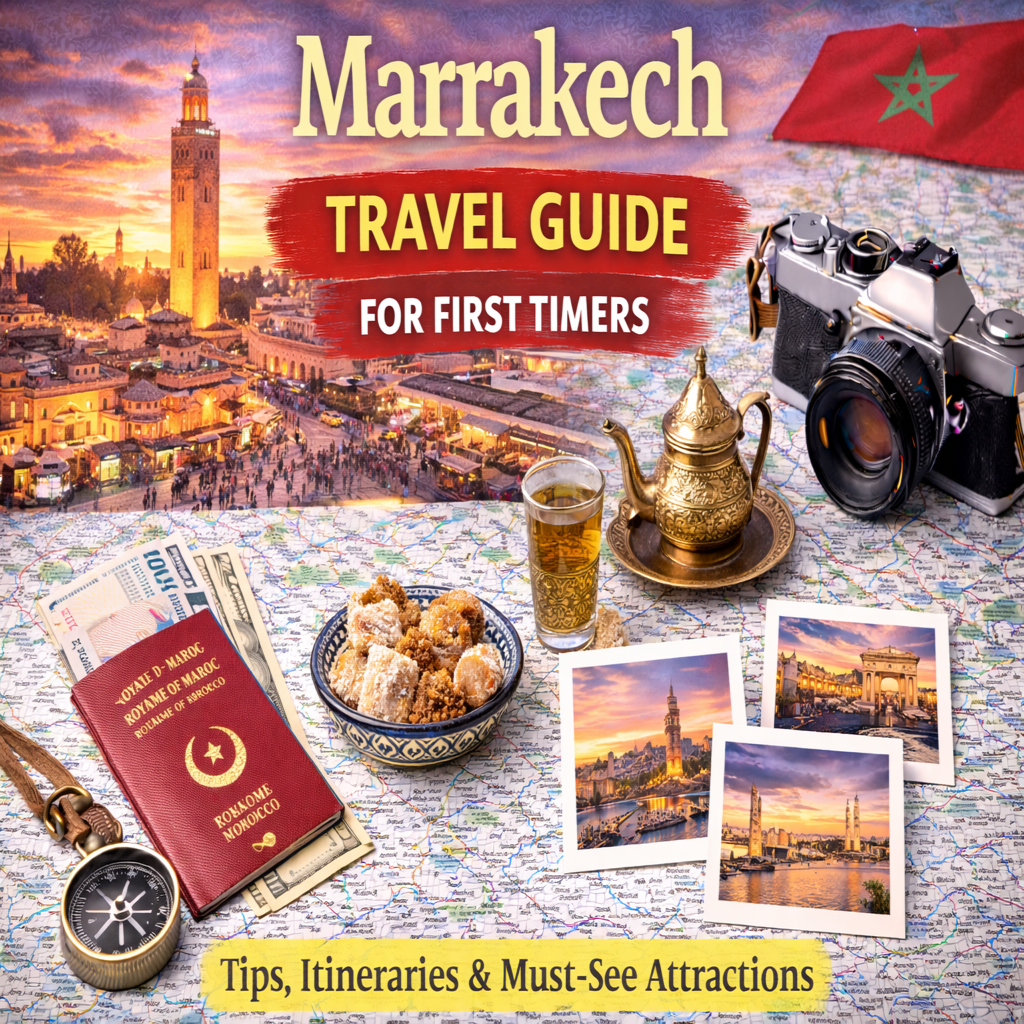
Marrakech does not arrive gradually. It hits you all at once — the heat, the color, the noise, the smell of cumin and rose water drifting from the souks, the call to prayer rolling across a skyline of terracotta rooftops and swaying palms. From the moment you step through the gates of the medina, the ancient walled city at its heart, Marrakech demands your full attention and rewards it completely. There is nowhere quite like it on Earth.
For first-time visitors, Marrakech is a city of beautiful disorientation. Its medieval street plan was deliberately designed to confuse outsiders — a defensive strategy that has the unintended consequence of making every wrong turn a discovery. A dead-end alley opens into a hidden courtyard. A doorway that looks like a wall leads into a palace. A market that seems to sell only leather suddenly gives way to a spice merchant’s cave of saffron, ras el hanout, and dried rose petals. Getting lost here is not an inconvenience. It is the point.
This Marrakech travel guide for first timers covers everything you need: when to visit, how to get around, what to see, where to eat, which neighborhoods to explore, and the practical knowledge that separates a stressful first visit from a transformative one. The Red City — named for the rose-hued pisé walls that glow amber in the late afternoon light — is one of Africa’s most extraordinary destinations, and this guide will help you experience it at its very best.
Why Marrakech Should Be on Every First-Time Traveler’s List
Marrakech occupies a singular position in the world of travel. It is close enough to Europe to reach in three hours from most major cities, yet culturally, sensory and historically, it feels like a completely different world. The medina, a UNESCO World Heritage Site since 1985, is one of the best-preserved medieval Islamic cities in existence. Its souks, riads, mosques, madrasas, and palaces have changed remarkably little in their essential character over the past five centuries.
But Marrakech is not a museum piece. It is a living, breathing, intensely energetic city of nearly one million people, with a sophisticated hospitality industry, a world-class food scene that blends Berber, Arab, Andalusian, and French influences, and a creative culture — in design, fashion, art, and music — that has made it one of the most talked-about destinations in the world for two decades running.
The city also sits at the gateway to some of Morocco’s most spectacular landscapes. The High Atlas Mountains rise dramatically just an hour’s drive from the medina, the Saharan dunes of Merzouga are a day’s journey away, and the coastal city of Essaouira is just three hours by road. Marrakech is a destination in itself and an outstanding base for exploring one of the most geographically and culturally diverse countries in the world.
Best Time to Visit Marrakech
Marrakech sits at the edge of the Sahara’s influence, giving it a semi-arid climate with very hot summers and mild winters. Timing your visit well makes a significant difference to the experience.
Spring (March to May) — The Ideal Season
Spring is broadly considered the best time to visit Marrakech. Temperatures are warm and very pleasant — ranging from 18°C to 28°C (64°F–82°F) — the city’s gardens and surrounding countryside are green and blooming, and the light has a softness that makes the medina’s pink walls glow beautifully. The roses of the Dadès Valley, a short drive east, are in spectacular bloom in April and May. Crowds are present but manageable, and the evenings are perfect for outdoor dining in riad courtyards.
Summer (June to August) — Extreme Heat
Summer in Marrakech is genuinely very hot, with temperatures regularly exceeding 40°C (104°F) and occasionally pushing higher. It is not an impossible time to visit — the city’s riads and museums are cool, and locals and experienced visitors adapt by moving slowly, taking long midday breaks, and doing serious sightseeing only in the early morning and after sunset. However, for most first-time visitors, the heat makes summer the least comfortable season. If you must visit in summer, accommodation with a pool is essential.
Autumn (September to November) — An Excellent Choice
Autumn is arguably as good as spring and increasingly popular with experienced travelers. By September the worst of the summer heat has broken, temperatures return to the pleasant 25°C–32°C range, and the city is alive with local activity after the summer slowdown. October and November bring cooler, very comfortable conditions ideal for long days of exploring the souks and making day trips into the mountains. The light in autumn is magnificent — warm and golden — and the crowds are thinner than in spring.
Winter (December to February) — Cool, Atmospheric, and Affordable
Winter in Marrakech is mild by North African standards but can feel cold, particularly at night, when temperatures drop to 5°C–10°C (41°F–50°F). Days are often bright and sunny with temperatures climbing to 18°C–20°C, making daytime sightseeing very pleasant. The medina is at its least crowded, riad prices fall substantially, and the snow-capped High Atlas visible on the horizon adds a dramatic backdrop to the city’s skyline. December and January are among the most atmospheric months to experience Marrakech at its most local and unhurried.
How to Get to Marrakech
Marrakech Menara Airport (RAK) is the main point of entry and sits just 6 km from the medina — one of the most conveniently located airports of any major tourist destination in the world.
Taxi from the Airport: The most straightforward option. Official petit taxis (small red metered cabs) are available outside arrivals and take around 15–20 minutes to reach the medina. Agree on a price before departure or insist on the meter — the fare to the medina should be approximately 80–120 MAD (Moroccan dirhams). Grand taxis (larger shared cabs) are also available and slightly cheaper for the journey.
Airport Bus (Bus 19): A public bus service runs between the airport and Djemaa el-Fna square in the medina center. It is cheap (approximately 30 MAD) and runs regularly, though it takes longer than a taxi and can be crowded with luggage.
Pre-arranged Transfer: Many riads offer airport pickup services, either directly or through recommended drivers. This is often the most stress-free option for first-time visitors, particularly if arriving at night. Arrange in advance and agree on the price beforehand.
Marrakech is also well connected to other Moroccan cities by the ONCF national rail network. The train from Casablanca takes around 3 hours and from Rabat around 4.5 hours. From Tangier, a high-speed Al Boraq train connects to Casablanca, from where you transfer to Marrakech. Long-distance buses (CTM and Supratours) connect Marrakech to cities not served by rail, including Agadir, Essaouira, and the south.
Getting Around Marrakech
Marrakech divides naturally into two distinct zones: the ancient medina (old city), where most of the historical attractions, riads, and souks are concentrated, and the Ville Nouvelle (new city), particularly the Guéliz and Hivernage neighborhoods, where modern hotels, restaurants, and shops are located.
Walking: The medina is best — and really only properly — explored on foot. Its narrow derbs (alleyways) are inaccessible to vehicles and impossible to fully appreciate from a car window. Wear comfortable shoes, download an offline map (Google Maps works reasonably well but has gaps in the medina’s deepest alleys), and embrace the inevitable moments of navigational confusion as part of the experience.
Petit Taxis: Small red taxis operate within the city and are the standard way to move between the medina and Guéliz. They are metered, affordable, and plentiful. Always ensure the meter is running or agree on a fixed price before departure. The fare between the medina and Guéliz is typically 20–40 MAD.
Calèches (Horse-Drawn Carriages): A romantic and quintessentially Marrakchi way to travel between neighborhoods or take a slow circuit around the medina walls. Agree on the price in advance — a full circuit of the ramparts takes around 45 minutes and costs approximately 150–200 MAD.
Bikes and Scooters: Cycling within the medina is impractical, but bicycle rental is available for exploring the Palmeraie (palm grove) on the city’s outskirts or the road to the Menara Gardens. Several guesthouses also offer scooter rental for more independent exploration.
Ride Apps: Careem (now owned by Uber) operates in Marrakech and offers a more predictable pricing experience than negotiating with individual taxi drivers. Useful for journeys to and from the airport and between the medina and Guéliz.
Top Attractions in Marrakech for First-Time Visitors
Marrakech rewards wandering above almost any other travel activity, but there are specific sites that no first-time visitor should miss.
1. Djemaa el-Fna Square
The beating heart of Marrakech and one of the most extraordinary public spaces in the world. By day, Djemaa el-Fna hosts orange juice vendors, henna artists, snake charmers, and acrobats. By evening it transforms into something altogether more theatrical: dozens of food stalls materialize from nowhere, filling the square with smoke and the smell of grilled meats, while storytellers, musicians, gnawa trance performers, and comedians work the crowd. The atmosphere is unlike anything else in the world. UNESCO recognized it as a Masterpiece of the Oral and Intangible Heritage of Humanity in 2001.
Pro tip: Watch the transformation from a rooftop café terrace overlooking the square at sunset — one of the great travel experiences in Africa. The Café de France and Les Terrasses de l’Alhambra both offer excellent vantage points.
2. The Souks of the Medina
The souks of Marrakech are a world unto themselves — a vast, interconnected network of market streets organized broadly by trade. The spice souk, leather souk, textile souk, lantern souk, woodworking souk, and jewelry souk each occupy their own quarter, though the boundaries blur wonderfully as you wander. The dyers’ souk, with its vivid hanks of silk and wool hanging above the alleyways, and the coppersmiths’ quarter, ringing with the sound of hammers on metal, are among the most atmospheric and memorable.
Pro tip: The souks are best explored in the morning when light filters down through the reed latticework overhead and the vendors are at their most relaxed. Agree on a price before committing to any purchase and enjoy the negotiation process as a cultural exchange rather than a confrontation.
3. Bahia Palace
Built in the late 19th century for Si Moussa, grand vizier of the sultan, the Bahia Palace is a masterpiece of Moroccan craftsmanship and architectural ambition. Its 8 hectares of gardens, fountains, and rooms are decorated with intricate zellij tilework, carved cedar ceilings, and painted stucco of extraordinary finesse. The name means “brilliance” in Arabic, and the palace earns it. It offers an unparalleled glimpse into the opulence of pre-colonial Moroccan court life.
4. Saadian Tombs
Discovered only in 1917 after being sealed off for centuries following the fall of the Saadian dynasty, these royal tombs date from the late 16th century and contain the mausolea of Sultan Ahmad al-Mansur and his family. The main chamber, with its forest of carved marble columns and honeycomb cedar ceiling, is one of the finest examples of Moroccan decorative arts in existence. Despite their small size, the tombs are among Marrakech’s most beautiful and historically significant sites.
5. Koutoubia Mosque
The Koutoubia Mosque and its 70-meter minaret are the defining landmark of Marrakech — visible from almost everywhere in the city and the model upon which the Giralda in Seville and the Hassan Tower in Rabat were both based. Non-Muslims cannot enter the mosque itself, but the surrounding gardens are open to all and offer excellent views of the minaret, particularly at sunset when it is illuminated against the sky. The mosque dates from the 12th century and is a masterpiece of Almohad architecture.
6. Majorelle Garden and Yves Saint Laurent Museum
Created by French painter Jacques Majorelle over 40 years from 1923, the Majorelle Garden is one of the most celebrated botanical gardens in the world. Its iconic cobalt blue buildings — a color Majorelle patented and that now bears his name — contrast brilliantly with the deep greens of bamboo groves, cacti, and exotic palms. The garden was purchased and restored by Yves Saint Laurent and Pierre Bergé in 1980. The adjacent Musée Yves Saint Laurent Marrakech, opened in 2017, is a world-class fashion museum worthy of significant time.
Pro tip: Book Majorelle Garden tickets online in advance — it operates at limited capacity and sells out frequently in high season.
7. Medersa Ben Youssef
Once the largest Islamic theological college in North Africa, the Medersa Ben Youssef was founded in the 14th century and rebuilt in magnificent form in 1565. Its central courtyard — with a marble pool reflecting carved stucco walls, zellij tilework, and a soaring cedar gallery above — is one of the most breathtaking architectural spaces in Morocco. The students’ cells around the upper gallery give a poignant sense of the scholarly life that once animated this extraordinary place.
8. El Badi Palace
Once described as one of the wonders of the world, the El Badi Palace was built by Sultan Ahmad al-Mansur in the 1590s to celebrate his victory over the Portuguese. Today it stands in magnificent ruin — stripped of its Italian marble and gold leaf by a later sultan — but its sheer scale (360 rooms arranged around a vast central courtyard with sunken gardens and reflecting pools) and the views from its ramparts over the medina are deeply impressive. Storks nest in its crumbling towers, adding a layer of melancholy beauty to the whole.
9. Hammam Experience
No visit to Marrakech is complete without a traditional hammam. These public bathhouses — a cornerstone of Moroccan social and hygienic life for centuries — offer an experience of deep physical relaxation and cultural immersion. The process involves steam rooms, black soap (savon beldi), a vigorous kessa scrub, and often a rhassoul clay mask. Local hammams in the medina cost a fraction of the price of tourist-oriented spa hammams and offer a more authentic experience — ask your riad for a recommendation.
10. Day Trip to the High Atlas: Imlil and Ourika Valley
The High Atlas Mountains begin just one hour’s drive from Marrakech and offer some of the most dramatic mountain scenery in Africa. Imlil is the most popular base for Atlas trekking, with trails leading through Berber villages and, for the more ambitious, toward the summit of Jebel Toubkal — at 4,167 meters, the highest peak in North Africa. The Ourika Valley, closer to the city, is beautiful and easily accessible, with a traditional Berber market (souk) at Tnine Ourika on Mondays and a series of waterfalls further up the valley.
What to Eat in Marrakech: A First-Timer’s Food Guide
Moroccan cuisine is one of the great culinary traditions of the world — a magnificent fusion of Berber, Arab, Andalusian, and Sub-Saharan African influences, perfumed with spices and slow-cooked to extraordinary depth and complexity. Eating in Marrakech is one of the central pleasures of any visit.
Tagine: Morocco’s most iconic dish — slow-cooked meat, poultry, or fish with vegetables and aromatics in a conical clay pot that acts as both cooking vessel and serving dish. Lamb tagine with prunes and almonds, chicken tagine with preserved lemon and olives, and kefta (spiced meatball) tagine with eggs are all spectacular. A good tagine should simmer for hours — the best ones are tender to the point of falling apart.
Couscous: Friday is couscous day in Morocco, a tradition as deeply embedded as Sunday roast in England. Steamed semolina served with slow-cooked lamb or chicken, root vegetables, and caramelized onions with raisins — couscous done properly in a Marrakchi home or traditional restaurant is revelatory. Many riads serve it on Fridays for guests.
Pastilla (B’stilla): A stunning piece of Moroccan culinary architecture — a flaky warqa pastry pie filled with pigeon (or increasingly chicken), almonds, and eggs, dusted with cinnamon and icing sugar. The combination of sweet and savory sounds unlikely and tastes extraordinary. It is one of the great dishes of the Moroccan imperial kitchen.
Harira: A thick, warming soup of tomatoes, lentils, chickpeas, and herbs that is the traditional dish for breaking the fast during Ramadan and a staple at any time of year. Served with dates and chebakia (honey-soaked sesame pastries), harira is one of Morocco’s most comforting and nourishing dishes. A bowl from a medina stall costs almost nothing.
Mechoui: Whole lamb slow-roasted in a pit oven (tandir) until the meat falls off the bone and the skin crisps. The mechoui stalls in the northern medina near the Mouassine neighborhood are a Marrakech institution — you point to the cut you want, it is weighed and chopped before you, and you eat it with cumin salt and warm bread.
Fresh-Squeezed Orange Juice: The orange juice vendors of Djemaa el-Fna are one of Marrakech’s most photographed sights, and the product is genuinely outstanding — fresh, cold, and extraordinarily cheap (approximately 5–10 MAD per large glass). Morocco’s oranges, particularly from the Souss Valley, are among the best in the world. Drink at least one glass every day.
Moroccan Mint Tea (Atay): The ritualistic preparation and pouring of mint tea — green tea steeped with fresh spearmint and sweetened with considerable sugar — is one of Morocco’s most important social customs. It is poured from height to create a froth and served in ornate glasses. Refusing tea offered by a host or shopkeeper is considered impolite. Embrace it completely.
Street Food at Djemaa el-Fna: The evening food stalls at Djemaa el-Fna are an experience as much as a meal — merguez sausages, grilled lamb chops, snail soup (babouche), fried fish, stuffed spleen sandwiches, and countless other dishes prepared before you in clouds of fragrant smoke. Eat adventurously and negotiate your preferred stall by looking at what is freshest and busiest rather than accepting the first aggressive invitation.
Where to Stay in Marrakech
The type of accommodation you choose in Marrakech is one of the most consequential decisions of your trip. The riad — a traditional Moroccan townhouse built around a central courtyard — is the defining accommodation experience of the city and is highly recommended for any first-time visitor.
Staying in a Riad (Medina): Riads vary from simple guesthouses with a handful of rooms to lavishly restored palaces with plunge pools, rooftop terraces, and full concierge services. Staying inside the medina puts you at the heart of the experience — minutes from the souks, the Djemaa el-Fna, and the major historical sites. Prices range enormously, from €50 per night at a well-run budget riad to €500+ at the city’s most prestigious addresses. This is the recommended choice for first-timers.
Guéliz (Ville Nouvelle): The French-built new city to the west of the medina. More modern, easier to navigate, and with excellent restaurants, galleries, and the Majorelle Garden within walking distance. Standard hotel accommodation (including international chains) is more readily available here. A good choice for travelers who want modern comfort with easy access to the medina by taxi.
Hivernage: An upscale residential neighborhood adjacent to Guéliz, home to many of Marrakech’s larger luxury hotels and the main live music and nightclub venues. Good for travelers prioritizing luxury amenities and nightlife.
Palmeraie: The palm grove on the city’s northern edge, about 20 minutes from the medina, is home to several of Morocco’s most spectacular luxury resort hotels with large pools and extensive grounds. Best for travelers whose primary goal is resort-style relaxation with day trips into the city.
Book riads and popular accommodation 3–4 months in advance for spring visits and December through February holiday periods. The most sought-after riads in the medina sell out far ahead of time.
Marrakech Travel Tips for First Timers
- Embrace getting lost in the medina. It is inevitable and it is wonderful. Carry your riad’s address written in Arabic (your host can provide this) to show taxi drivers or locals when you need to find your way back.
- Agree on prices before committing. Whether in the souks, with taxi drivers, or hiring a guide, establish the price before any transaction begins. This avoids misunderstanding and is simply the normal way business is conducted.
- Dress modestly and respectfully. Marrakech is a Muslim city and while it is accustomed to tourists, dressing conservatively — covered shoulders and knees for both men and women — is respectful and will make you feel more comfortable in conservative parts of the medina. In riads and modern restaurants, normal Western clothing is perfectly appropriate.
- Be firm but polite with persistent vendors. The souks and Djemaa el-Fna involve a level of commercial pressure that can be surprising for first-time visitors. A calm, friendly “la shukran” (no thank you) and continuing to walk without making eye contact is the most effective strategy.
- Hire a licensed guide for the souks. A qualified guide from the official Marrakech tourist office can transform your souk experience — explaining the craft traditions, taking you to workshops and cooperatives, and navigating the most atmospheric areas most visitors never find. It also reduces unwanted attention. Half-day rates are approximately 300–500 MAD.
- Carry small denomination dirhams. Small purchases in the souks, tips, and public toilet fees all require small change. Breaking a 200-dirham note at a market stall can be difficult.
- Drink bottled or filtered water. Tap water in Marrakech is not reliably safe for tourists unaccustomed to it. Bottled water is cheap and widely available. Most reputable riads provide filtered water.
- Photography etiquette matters. Always ask permission before photographing people, particularly women, performers at Djemaa el-Fna, and in hammams or prayer spaces. A small tip (5–10 MAD) is customary when photographing performers at the square.
- The medina is larger than it looks on a map. What appears to be a short walk between two points can take 30–40 minutes through the labyrinthine streets. Build extra time into every plan.
- Ramadan transforms the city. If visiting during Ramadan, be respectful — avoid eating, drinking, or smoking in public during daylight hours. The city takes on a uniquely spiritual atmosphere, and the post-sunset iftar (fast-breaking) meal is a beautiful thing to witness and, if invited, to share.
Suggested 4-Day Marrakech Itinerary for First Timers
Day 1 — Arrival and the Heart of the Medina
Check into your riad and take the afternoon to orient yourself in the medina. Walk to the Koutoubia Mosque and its gardens. As the late afternoon light turns golden, head to Djemaa el-Fna and watch the square come alive. Climb to a rooftop terrace for sunset over the city. Dinner at one of the evening food stalls in the square for the full sensory experience.
Day 2 — Palaces, Tombs, and Souks
Morning at Bahia Palace, followed by the Saadian Tombs nearby. Lunch at a traditional medina restaurant. Afternoon in the souks — allow 3 hours minimum to wander the spice market, dyers’ quarter, leatherwork stalls, and lantern souk. Sunset from the El Badi Palace ramparts. Dinner at a riad restaurant in the medina.
Day 3 — Gardens, Art, and the New City
Morning at Medersa Ben Youssef. Head to the Majorelle Garden mid-morning (pre-booked ticket). Spend an hour at the Musée Yves Saint Laurent adjacent to the garden. Lunch in Guéliz at one of the Ville Nouvelle’s excellent modern Moroccan restaurants. Afternoon hammam experience (ask your riad to recommend a good local one). Rooftop dinner back in the medina.
Day 4 — Day Trip to the High Atlas
Arrange a driver through your riad for a day trip to Imlil or the Ourika Valley. Morning drive through the foothills as the Atlas grows larger ahead of you. Lunch at a Berber village restaurant with mountain views. Afternoon hike or walk through the valley. Return to Marrakech by late afternoon in time for a final evening at Djemaa el-Fna and a farewell dinner.
Marrakech on a Budget: Is It Possible?
Marrakech is one of the most accessible and affordable major tourist destinations in the world, and the gap between budget travel and genuine luxury is remarkably small here. A bowl of harira at a medina stall costs 10–15 MAD. A fresh orange juice at Djemaa el-Fna is 5–10 MAD. A full tagine lunch at a local restaurant costs 60–100 MAD. A night in a well-run budget riad starts from around 300–400 MAD (approximately €30–€40).
Even Marrakech’s most iconic paid attractions — Bahia Palace, Saadian Tombs, Medersa Ben Youssef, El Badi Palace — each cost between 70–100 MAD. The Majorelle Garden is the most expensive at around 150 MAD, but remains exceptional value.
A very comfortable daily budget of €60–€80 per person covers a mid-range riad, all meals at traditional restaurants, transport, and multiple paid attractions. Travelers willing to eat from medina stalls and local canteens can experience Marrakech authentically for considerably less. At the other end of the spectrum, the city’s luxury riads, fine dining restaurants, and spa experiences offer genuine world-class quality at prices still well below comparable European or American luxury.
Final Thoughts: Marrakech Will Stay With You Long After You Leave
Marrakech is the kind of place that lodges itself in the memory with unusual stubbornness. The smell of rose water. The sound of a craftsman hammering copper in a souk alleyway. The moment a hidden riad door opens to reveal a courtyard of orange trees and mosaic fountains. The Atlas mountains appearing above the rooftops at dawn, snow-capped and impossibly close. These are the images that first-time visitors carry home and cannot quite explain to people who have not been.
The city asks something of its visitors — patience, flexibility, a willingness to let go of the urge to control and plan every moment. The medina is disorienting by design, the commercial culture is energetic and sometimes relentless, and the sensory intensity can feel overwhelming in the first hours. Push through that initial disorientation and you will find one of the most rewarding and genuinely transporting travel experiences available anywhere in the world.
Go slowly, eat everything, get lost on purpose, and let the Red City work its particular magic on you. It will.
We hope this Marrakech travel guide for first timers has given you the confidence and inspiration to plan your trip. For more destination guides, itineraries, and travel inspiration, keep exploring GlobeTrailGuide — your trusted companion for smarter, deeper travel.
GlobeTrailGuide.com | Travel Smarter. Explore Deeper.