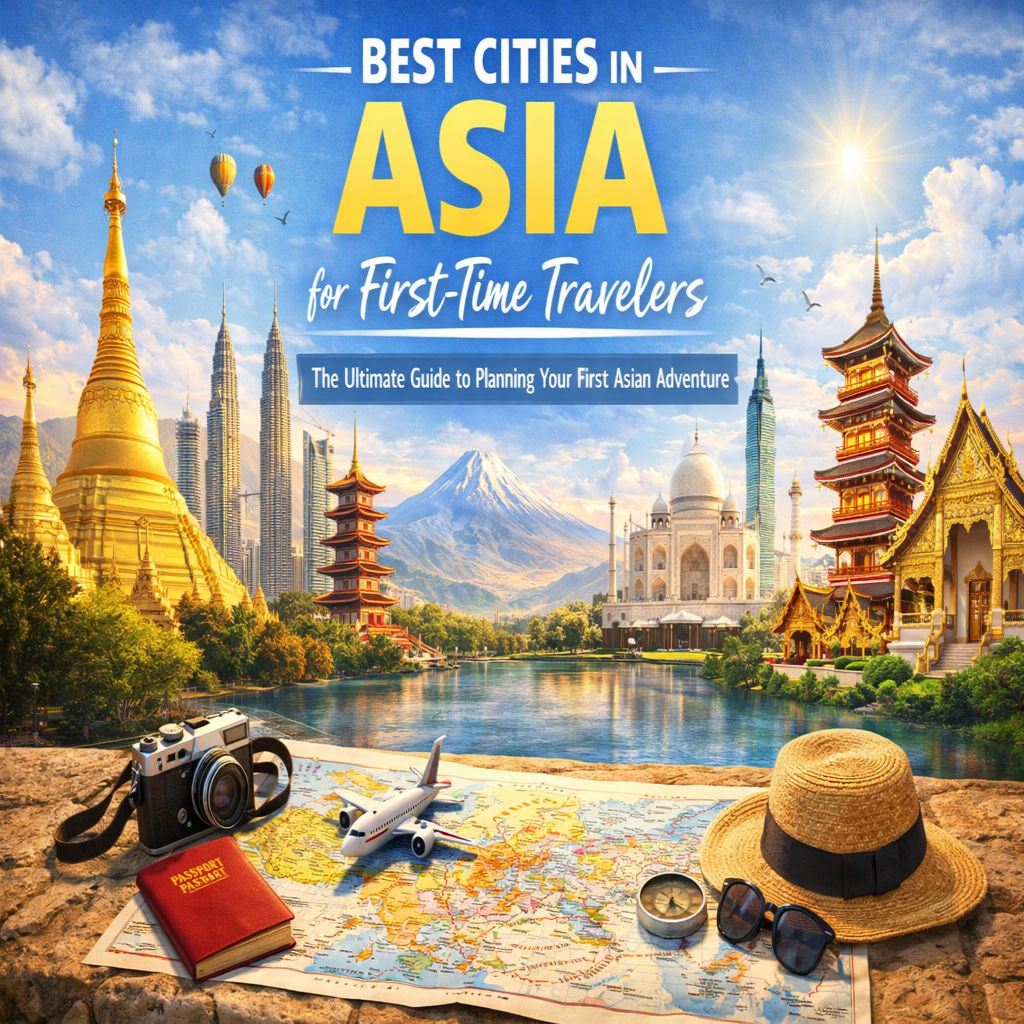
Asia does not ease you in gently. From the moment you land — whether it is the warm, jasmine-scented air of Bangkok wrapping around you as you step out of Suvarnabhumi Airport, or the organized, almost surgical efficiency of Singapore’s Changi greeting you with cool air-conditioned precision, or Tokyo’s vast, luminous sprawl spreading to every horizon as you descend through the clouds — the continent announces itself with a force and intensity that no amount of preparation fully anticipates. Asia is not simply a destination. It is a recalibration of everything you thought you understood about the scale, diversity, and sheer human complexity of the world.
The numbers alone are staggering. Asia is home to 4.7 billion people — nearly 60 percent of the world’s population — spread across 48 countries, dozens of major civilizational traditions, hundreds of distinct languages, and a geographic range that encompasses the world’s highest mountains, its longest rivers, its most productive agricultural plains, and some of its most biodiverse tropical coastlines. Within its borders you will find the world’s oldest continuously inhabited cities, the fastest-growing economies, the most ancient religious traditions still actively practiced, and a contemporary creative culture — in food, design, architecture, fashion, and technology — that is reshaping global civilization in real time.
For the first-time Asian traveler, the challenge is not finding extraordinary things to experience. It is choosing where to begin. This guide does that work for you. We have identified the best cities in Asia for first-time travelers — destinations that offer world-class attractions, manageable infrastructure, remarkable food, and the kind of depth and wonder that creates lifelong Asia obsessions. Whether your priority is ancient temples and imperial history, futuristic urban design, the world’s greatest street food, extraordinary nature on a city’s doorstep, or simply the intoxicating experience of being somewhere entirely unlike anywhere you have ever been, this guide will help you build a first Asian adventure that exceeds every expectation you arrived with.
How We Chose These Cities
The cities in this guide were selected on five criteria: world-class attractions that genuinely justify the journey, sufficient infrastructure and English-language accessibility for first-time visitors, strong international transport connections, a food culture that rewards exploration at every price point, and a depth of character that goes far beyond the surface. Every city on this list will deliver experiences that reshape first-time visitors’ understanding of what cities, cultures, and civilizations can be — and send them home already planning a return.
1. Tokyo, Japan — The City That Redefines What a City Can Be
Tokyo is the city that most consistently produces the same response in first-time visitors: bewilderment that somewhere this large, this complex, and this efficient can simultaneously be so safe, so clean, and so astonishingly, relentlessly excellent at almost everything it does. The world’s largest metropolitan area — home to 37 million people — operates with a precision and consideration for others that feels, to visitors from most parts of the world, like evidence of an entirely different social contract.
The food alone would make Tokyo one of the world’s essential travel destinations. With more Michelin-starred restaurants than any other city on Earth, a convenience store culture so refined that 7-Eleven onigiri constitutes a legitimate meal, ramen shops where a single bowl represents the life’s work of a craftsman, and a fish market tradition that treats ingredient quality as a moral position, Tokyo redefines what it means to eat well in a city. Every neighborhood has its own food personality, its own specialties, its own legendary shops and stalls that locals queue for on weekend mornings.
Beyond food, Tokyo is a city of extraordinary cultural depth and constant sensory revelation. Senso-ji Temple in Asakusa, founded in 628 AD, receives 30 million visitors annually and remains genuinely moving in the early morning mist. The Shibuya Scramble Crossing — the world’s most famous intersection, where up to 3,000 people cross simultaneously — is a perfect metaphor for Tokyo’s organized complexity. Shinjuku’s Golden Gai alleyways, with their dozens of tiny bars seating six people each, represent a model of intimate human-scaled drinking culture found nowhere else. The teamLab digital art installations are among the most innovative immersive experiences in contemporary art. And the neighborhoods — Harajuku’s fashion culture, Akihabara’s electronics and anime world, Yanaka’s preserved Edo-period streets, Daikanyama’s sophisticated boutiques — could each occupy a day of genuinely rewarding exploration.
Best for: First-time Asia visitors who want the most complete and overwhelming urban experience the continent offers. Food obsessives, technology enthusiasts, culture and art lovers, and anyone who has ever wondered what a city would look like if it took excellence seriously as an organizing principle.
Don’t miss: Senso-ji Temple at dawn, Shibuya Scramble Crossing and Sky observation deck, Shinjuku’s Golden Gai, Tsukiji Outer Market breakfast, teamLab Planets or Borderless, the Ghibli Museum (book far in advance).
Best time to visit: March to May (cherry blossom) and September to November (autumn foliage).
2. Bangkok, Thailand — The City That Never Stops Giving
Bangkok is the most exhilarating, chaotic, and generous city in Southeast Asia — a place that operates at a volume and intensity that overwhelms most first-time visitors in the first twelve hours and completely captivates them in the second twelve. It is a city of profound contradictions: solemn golden temples rising above streets choked with tuk-tuks and food carts, Michelin-starred restaurants sharing neighborhoods with forty-baht pad thai stalls that have been cooking the same recipe from the same cart for thirty years, Buddhist monks in saffron robes navigating the same elevated sky-train platforms as office workers in Gucci.
The temples of Bangkok are among the finest in the world. Wat Phra Kaew — the Temple of the Emerald Buddha within the Grand Palace complex — is the most sacred site in Thailand, its gold-encrusted exterior and elaborately painted gallery of murals among the most visually overwhelming religious spaces in Asia. Wat Pho, home to the 46-meter reclining Buddha and the birthplace of traditional Thai massage, is equally magnificent. Wat Arun — the Temple of Dawn — rising from the Chao Phraya riverbank in a spire of porcelain-encrusted prangs, is one of the most dramatically beautiful structures in Southeast Asia, particularly at sunset when its surface catches the last light.
But Bangkok is as much about its living culture as its monuments. The Chatuchak Weekend Market — 15,000 stalls spread across 35 acres — is one of the world’s great market experiences. The street food of Yaowarat (Bangkok’s Chinatown), particularly after dark when the street fills with grills, steamers, and the smell of char kway teow and roasted duck, is a world-class food experience of the highest order. And the city’s rooftop bar scene — with venues like Vertigo and Moon Bar at Banyan Tree offering 360-degree views over the city’s extraordinary nighttime skyline — is among the finest in Asia.
Best for: First-time Southeast Asia visitors, street food enthusiasts, temple lovers, nightlife seekers, and travelers who want the most intense and fully alive urban experience in the region.
Don’t miss: Wat Phra Kaew and the Grand Palace, Wat Pho and traditional Thai massage, Wat Arun at sunset, Yaowarat Chinatown night food market, Chatuchak Weekend Market, a rooftop sundowner.
Best time to visit: November to February (cool and dry season).
3. Singapore — Asia’s Most Polished and Surprising City
Singapore is the city that most surprises first-time visitors who arrive expecting a sterile, regulated stopover and discover a destination of genuine complexity, extraordinary food, world-class design, and a multicultural energy that is entirely its own. The city-state of 5.9 million people has built, in the 60 years since independence, one of the most successful and livable urban environments in human history — and it has done so while preserving and celebrating the Chinese, Malay, Indian, and Peranakan cultural traditions that give it a richness that purely modern cities cannot manufacture.
The food alone justifies Singapore’s place on any Asia itinerary. The hawker centre culture — open-air food halls where dozens of specialist stalls offer single dishes perfected over decades — is one of the world’s great democratic food institutions, and UNESCO recognized it as an Intangible Cultural Heritage in 2020. Lau Pa Sat, Maxwell Food Centre, Chinatown Complex, and Old Airport Road Food Centre are all legendary. Dishes like Hainanese chicken rice, char kway teow, laksa, chili crab, and bak kut teh (pork rib herb soup) represent a food culture of extraordinary diversity and depth.
Gardens by the Bay — the spectacular horticultural park with its 18 Supertrees and two extraordinary climate-controlled conservatories — is one of the most ambitious and successful pieces of urban design in the 21st century. The Marina Bay waterfront at night, with the Marina Bay Sands infinity pool reflected in the bay and the light display over the Supertree Grove, is one of the most dramatic urban spectacles in Asia. The colonial district, Chinatown, Little India, Kampong Glam, and the Peranakan shophouses of Joo Chiat offer neighborhoods of extraordinary cultural character. And Changi Airport — consistently rated the world’s finest airport, with its indoor waterfall, butterfly garden, and rooftop pool — sets the tone for a city that has decided to take the concept of excellence seriously in every domain.
Best for: First-time Asia visitors who want a gentle, accessible, English-speaking introduction to Asian food and culture. Food enthusiasts, design lovers, families, and travelers using Singapore as a hub for wider Southeast Asian exploration.
Don’t miss: Gardens by the Bay at night, Maxwell Food Centre for Hainanese chicken rice, Chinatown and Little India, the Marina Bay Sands SkyPark, Kampong Glam’s Sultan Mosque and Haji Lane, Changi Airport’s Jewel waterfall.
Best time to visit: February to April (drier months, though Singapore is year-round).
4. Kyoto, Japan — The Soul of Japanese Civilization
If Tokyo represents Japan’s future and present, Kyoto represents its past — and what a past it is. The imperial capital of Japan for over a thousand years, from 794 to 1868, Kyoto accumulated during that period a concentration of temples, shrines, imperial palaces, traditional gardens, geisha districts, and tea ceremony culture that makes it the single greatest repository of Japanese civilization in existence. With 17 UNESCO World Heritage Sites, more traditional machiya townhouses than any other city in Japan, and a culinary tradition — kaiseki cuisine — that is one of the most refined and philosophically considered in the world, Kyoto is not merely a travel destination. It is an education.
The Fushimi Inari Taisha — with its thousands of vermilion torii gates winding up the forested hillside of Mount Inari — is one of the most dramatic and photogenic religious sites in Japan. The Arashiyama Bamboo Grove, the silver and golden pavilions (Ginkaku-ji and Kinkaku-ji), Ryoan-ji’s famous dry rock garden (the finest example of karesansui garden design in Japan), Nijo Castle with its nightingale floors, and the geisha district of Gion — where maiko (apprentice geisha) can still be spotted walking to evening engagements on narrow Hanamikoji Street — are all world-class experiences.
Kyoto is also extraordinary for its food. Kaiseki — the multi-course traditional cuisine that evolved from the tea ceremony, with each dish calibrated to the season, the time of day, and the specific beauty of impermanence — is available at various price points from humble teahouses to three-Michelin-star restaurants. Nishiki Market, the narrow covered shopping street known as Kyoto’s kitchen, is outstanding for food exploration. And the tofu culture of Kyoto — centered around Arashiyama and the Philosopher’s Path — is a revelation for anyone who thought they did not particularly like tofu.
Best for: Culture and history lovers, temple and garden enthusiasts, Japanese food devotees, photographers, and any first-time Japan visitor who wants to understand the aesthetic and spiritual foundations of Japanese civilization.
Don’t miss: Fushimi Inari at dawn (before the crowds), the Arashiyama Bamboo Grove, Kinkaku-ji, Gion district at dusk, Nishiki Market, a matcha ceremony at a traditional teahouse.
Best time to visit: March to May (cherry blossom) and October to November (autumn foliage). Book months in advance.
5. Hanoi, Vietnam — Ancient, Chaotic, and Deeply Captivating
Hanoi is the city in Southeast Asia that most rewards the traveler willing to engage with its complexity rather than retreat from it. It is ancient, noisy, intoxicating, maddening, and deeply beautiful in ways that reveal themselves gradually — in the peeling yellow facades of the French Quarter, in the 36 guilds of the Old Quarter with their streets still named for the trades that once dominated them (Silk Street, Paper Street, Tin Street), in the way a bowl of pho at 6 AM from a street vendor beside Hoan Kiem Lake can constitute a perfect, complete experience of a place and a culture.
Hoan Kiem Lake — the jade-green lake at the center of the old city, home to a sacred giant soft-shell turtle of legendary status and the red-painted Huc Bridge leading to Ngoc Son Temple — is the emotional and geographical heart of Hanoi. The Temple of Literature, founded in 1070 and home to Vietnam’s first national university, is a masterpiece of Vietnamese traditional architecture and one of the most serene and historically significant spaces in the country. The Ho Chi Minh Mausoleum, where the Vietnamese revolutionary leader’s embalmed body lies in state, is one of the most politically charged and culturally essential sites in Vietnam.
Hanoi’s food culture is extraordinary — and specifically, distinctly Hanoian in a way that sets it apart from the south. The pho here is cleaner and more refined than Saigon’s richer version, the broth simmered for hours with charred ginger and star anise to a clarity and depth that is its own argument for the city’s greatness. Bun cha — grilled pork patties and noodles with fresh herbs and dipping broth, eaten at plastic stools on a sidewalk — was famously shared by Anthony Bourdain and Barack Obama at a Hanoi restaurant in 2016, briefly making it the most famous lunch in the world.
Best for: History and culture lovers, Vietnamese food enthusiasts, photographers, and first-time Southeast Asia visitors who want a city with genuine depth, complexity, and a powerful sense of its own identity.
Don’t miss: Hoan Kiem Lake at dawn, the Old Quarter’s 36 streets, the Temple of Literature, pho at a street vendor before 8 AM, bun cha at a sidewalk restaurant, a water puppet theatre performance.
Best time to visit: October to April (dry and relatively cool season).
6. Hong Kong — Where East Meets West at Full Throttle
Hong Kong is one of the most extraordinary urban environments in the world — a vertical, high-density, perpetually kinetic city of 7.5 million people compressed onto 1,108 square kilometers of mountainous terrain and islands, where the density and energy of one of the world’s great Chinese cities is fused with the commercial and legal infrastructure of a former British colony into something that is entirely, uniquely its own.
The view from Victoria Peak — the mountain that rises behind Hong Kong Island, reachable by the historic Peak Tram — over the harbor and the Kowloon skyline is arguably the finest city panorama in the world. The density of skyscrapers packed into the narrow strip between Victoria Harbour and the peak, reflected in the harbor waters and animated at night by the Symphony of Lights show, produces a visual spectacle of organized human ambition that has no equal anywhere in Asia.
Hong Kong’s food culture is extraordinary in its breadth and depth. Dim sum — the tradition of small steamed and fried Cantonese dishes served from trolleys in large teahouses, eaten with jasmine tea in a ritual called yum cha — is one of the great communal eating experiences in Asia and reaches its finest expression in Hong Kong. The city’s street food culture, centered on the cooked food centres of Sham Shui Po and the Temple Street Night Market in Kowloon, is equally outstanding. And the range of cuisines — Cantonese, Shanghainese, Sichuan, Vietnamese, Japanese, Indian, and everything in between — makes Hong Kong one of the finest cities in the world for food exploration.
The neighborhoods of Hong Kong reward exploration on foot and by MTR. The Western District and Sheung Wan on Hong Kong Island, with their antique shops, dried seafood stores, and traditional Chinese medicine practitioners; the night markets and electronics shops of Mong Kok in Kowloon; the fishing village turned art space of Sai Kung; and the wild, largely undeveloped country parks that cover 40% of Hong Kong’s territory — all offer dimensions of the city that most visitors never reach.
Best for: Food enthusiasts, urban photography lovers, business travelers, first-time visitors to China who want an accessible and English-speaking introduction to Chinese culture, and anyone who wants to experience vertical urban living at its most spectacular.
Don’t miss: Victoria Peak at dusk, dim sum yum cha at a classic teahouse, Temple Street Night Market, the Star Ferry across Victoria Harbour, Sham Shui Po street food, the MTR to Ngong Ping and the Giant Buddha on Lantau Island.
Best time to visit: October to December (cool, clear, and dry).
7. Istanbul, Turkey — Where Two Continents and Three Empires Collide
Istanbul is the only city in the world that sits on two continents, and that geographical reality is the starting point for understanding a place that has spent three thousand years at the intersection of East and West, Christian and Muslim, ancient and modern, Byzantine and Ottoman and secular Turkish. No city in Asia — or indeed in Europe — carries the weight of quite so much history in quite such a concentrated and physically present way.
The Hagia Sophia, completed in 537 AD and one of the greatest buildings in human history, alone justifies a journey to Istanbul. The Blue Mosque, with its 20,000 hand-painted İznik tiles and six minarets, is one of the most recognizable landmarks in the Islamic world. Topkapi Palace — the administrative heart of the Ottoman Empire for nearly 400 years — and its extraordinary Treasury and Imperial Harem offer an unparalleled window into the most powerful empire in the pre-modern world. The Grand Bazaar, continuously operating since 1461 with over 4,000 shops, is one of the world’s oldest and most atmospheric covered markets.
But Istanbul is as much about the experience of the city itself as its specific monuments. The Bosphorus — the strait separating Europe from Asia — is alive with ferries, tankers, fishing boats, and pleasure craft at every hour, and crossing it on a public ferry for the price of a bus ticket is one of the great inexpensive travel pleasures in the world. The neighborhoods of Beyoğlu, Galata, Karaköy, and Kadıköy (on the Asian side) offer contemporary Istanbul at its most creative and vibrant — excellent restaurants, galleries, coffee shops, and music venues in buildings that carry centuries of Ottoman and Byzantine history in their walls.
Best for: History lovers, architecture enthusiasts, food travelers, and first-time Asia visitors who want a city that offers the deepest possible encounter with the meeting point of Eastern and Western civilizations.
Don’t miss: Hagia Sophia at opening time, the Blue Mosque, Topkapi Palace and Treasury, the Grand Bazaar, a Bosphorus ferry crossing, baklava at Güllüoğlu in Karaköy, sunset from the Galata Tower.
Best time to visit: April to May and September to October.
8. Seoul, South Korea — Ancient Palaces, Modern Energy, and the World’s Best Fried Chicken
Seoul is the city in Asia that most successfully occupies the space between ancient and ultramodern, doing both with equal conviction and without apparent tension. A metropolis of 10 million people — 25 million in the greater metropolitan area — it is one of the most technologically advanced and economically dynamic cities in the world, yet its five great Joseon Dynasty palaces, its Buddhist mountain temples, its centuries-old markets, and the deeply rooted traditions of its food culture ensure that the ancient world is never more than a few minutes’ walk from the present.
Gyeongbokgung Palace — the largest and most magnificent of Seoul’s five Joseon palaces, built in 1395 and framed by the mountains of Bukhansan National Park behind — is one of the finest examples of Korean royal architecture in existence. The National Museum of Korea, adjacent to the palace, is one of the largest and finest in Asia. Bukchon Hanok Village, a neighborhood of 600-year-old traditional Korean houses (hanok) between the palaces, offers one of the most atmospheric and photogenic urban environments in the country.
Seoul’s food culture is extraordinary and relentlessly generous. Korean barbecue — samgyeopsal (pork belly), galbi (short ribs), and bulgogi (marinated beef) grilled at the table over charcoal and eaten with banchan (dozens of small side dishes) and soju — is one of the great communal eating rituals in Asia. The street food of Gwangjang Market — bindaetteok (mung bean pancakes), mayak kimbap (addictive rice rolls), and raw beef yukhoe — has been sustaining Seoulites since 1905. And the fried chicken — Korean style, double-fried to an extraordinary crispness and glazed with soy-garlic or yangnyeom sauce, eaten with beer and pickled radish — is genuinely, objectively, the finest fried chicken in the world.
Best for: History and culture lovers, Korean food enthusiasts (and specifically fried chicken devotees), K-pop and contemporary Korean culture fans, technology enthusiasts, and first-time Asia visitors who want a city that combines ancient depth with dazzling modernity.
Don’t miss: Gyeongbokgung Palace at the changing of the guard, Bukchon Hanok Village, Gwangjang Market street food, Korean barbecue with soju, the DMZ day trip (the most surreal day trip in Asia), Gyeongui Line Forest Park walk.
Best time to visit: April to June (cherry blossom and mild weather) and September to November (autumn foliage).
9. Bali, Indonesia — The Island of the Gods and the World’s Most Spiritual Destination
Bali is not a city in the conventional sense but functions as one for travel planning purposes — a destination so complete, so self-contained, and so densely packed with world-class experiences that it demands a dedicated place in any guide to Asia’s best destinations. The Indonesian island of 4.3 million people has been drawing travelers seeking spiritual depth, natural beauty, and cultural richness since the early 20th century, and its combination of ancient Hindu temple culture, extraordinary rice terrace landscapes, world-class surf, outstanding food, and a genuine spiritual atmosphere found nowhere else in Southeast Asia continues to make it one of the most visited and most beloved destinations in Asia.
Ubud — the cultural and artistic heart of Bali, set in the forested hills of the island’s interior — is the destination within the destination. Its rice terraces (the UNESCO-listed Jatiluwih terraces and the Tegallalang terraces near Ubud are both extraordinary), its temples (Pura Tirta Empul with its sacred spring bathing pools, Pura Besakih on the slopes of Mount Agung), its traditional performing arts (Kecak fire dance, Legong dance, wayang kulit shadow puppet theatre), and its craft villages (Celuk for silver, Batubulan for stone carving, Mas for wood carving) constitute a concentration of cultural experience that is unique in Southeast Asia.
The surf of Bali’s Bukit Peninsula — Uluwatu, Padang Padang, Bingin — is world-class, and the sunsets from Uluwatu Temple, perched on a 70-meter cliff above the Indian Ocean, are among the most dramatic in Asia. The food culture of Bali, particularly in Ubud and Seminyak, has developed over the past decade into one of the most sophisticated and internationally diverse in Southeast Asia — from traditional babi guling (suckling pig) and nasi campur (rice with various accompaniments) to world-class contemporary restaurants that draw chefs from around the globe.
Best for: Spiritual seekers, surfers, yoga and wellness travelers, culture and arts enthusiasts, food lovers, and first-time Asia visitors who want a combination of natural beauty, ancient culture, and deeply relaxed tropical pace of life.
Don’t miss: Tegallalang and Jatiluwih rice terraces, Pura Tirta Empul temple bathing ritual, Kecak fire dance at Uluwatu at sunset, babi guling at Ibu Oka in Ubud, a yoga retreat in Ubud, sunrise at Mount Batur (guided hike).
Best time to visit: April to October (dry season).
10. Mumbai, India — Maximum City and the Subcontinent’s Greatest Stage
Mumbai is the most intense city in Asia — a place of such compressed human energy, ambition, contradiction, and vitality that the experience of it constitutes a kind of education available nowhere else. Home to 21 million people, it is India’s financial capital, the home of Bollywood, the city that contains within its borders some of the world’s most expensive real estate alongside some of its largest informal settlements, and a food culture that ranges from the refined Parsi cuisine of old Bombay to the street food of the chawls to the finest contemporary Indian restaurants in the world.
The Gateway of India — the triumphal arch built to commemorate the 1911 visit of King George V, standing at the harbor’s edge with the dome of the Taj Mahal Palace Hotel behind it — is one of the great arrival experiences in Asia. The Chhatrapati Shivaji Maharaj Terminus (formerly Victoria Terminus), the UNESCO-listed Victorian Gothic railway station designed by F.W. Stevens and completed in 1887, is one of the most spectacular pieces of colonial architecture in Asia. The Dharavi neighborhood — often described as Asia’s largest informal settlement, home to over a million people and a vast informal economy of recycling, leather goods, pottery, and textiles — is one of the most fascinating and misunderstood urban environments in the world.
Mumbai’s street food is extraordinary. Vada pav — the fried potato dumpling in a bread roll that is Mumbai’s unofficial street food — is eaten by millions daily. Pav bhaji — spiced mashed vegetables cooked on a griddle with butter and served with soft bread rolls — is one of the great democratic foods of Indian street culture. The bhel puri and sev puri of Chowpatty Beach, the frankies of Mohammed Ali Road, and the dosas and idlis of Matunga’s Udupi restaurants are all essential eating experiences.
Best for: First-time India visitors who want the country’s most cosmopolitan and accessible entry point, food enthusiasts, Bollywood culture lovers, architecture admirers, and travelers seeking the most intense and alive urban experience in Asia.
Don’t miss: Gateway of India and Taj Mahal Palace Hotel, Chhatrapati Shivaji Terminus, Dharavi neighborhood tour, vada pav and pav bhaji from street vendors, Crawford Market, Marine Drive at sunset, a Bollywood film at a single-screen cinema.
Best time to visit: November to February (cool and dry season).
11. Chiang Mai, Thailand — Northern Thailand’s Cultural Capital
Chiang Mai is the city in Southeast Asia that most perfectly balances authentic cultural depth with comfortable, accessible travel infrastructure — a combination that makes it an outstanding choice for first-time Asia visitors who want genuine cultural immersion without the intensity of Bangkok or the tourist saturation of Bali’s most developed areas.
Founded in 1296 as the capital of the Lanna Kingdom, Chiang Mai’s Old City — still enclosed within its original moat and partial ancient walls — contains over 300 Buddhist temples, more than any other city in Thailand. Wat Phra Singh, Wat Chedi Luang, and Wat Suan Dok are among the finest, with their gilded chedis (stupas), intricate teak woodwork, and the specific quality of early morning incense and monk chanting that constitutes one of the most atmospheric experiences in Southeast Asian travel.
The Night Bazaar and Sunday Walking Street are outstanding for crafts — Chiang Mai is the center of Northern Thai craft tradition, producing silverwork, lacquerware, silk weaving, umbrella making, and carved teak goods of real quality. The Thai Elephant Sanctuary near Chiang Mai — where rescued elephants are cared for in an ethical, no-riding environment — is one of the most moving and popular day trip experiences in Thailand. And the food of Northern Thailand — khao soi (the extraordinary coconut curry noodle soup that is the signature dish of the north), sai oua (herbed pork sausage), nam prik noom (roasted green chili dip) — is entirely distinct from the central Thai cuisine most international visitors know and is among the finest regional food traditions in Southeast Asia.
Best for: First-time Southeast Asia visitors who want cultural depth at a manageable pace, elephant sanctuary visitors, Thai food enthusiasts, trekking and outdoor adventurers, and digital nomads seeking a base with outstanding infrastructure and quality of life.
Don’t miss: Old City temple circuit (Wat Phra Singh, Wat Chedi Luang), a monk chat at a temple, ethical elephant sanctuary experience, Sunday Walking Street, khao soi at Khao Soi Islam or Khao Soi Lung Prakit, sunrise from Doi Suthep temple above the city.
Best time to visit: November to February (cool and clear season).
12. Taipei, Taiwan — Asia’s Most Underrated Food Capital
Taipei is the city in Asia that experienced travelers most often cite as their favorite destination that the rest of the world has not yet fully discovered — a sophisticated, safe, genuinely friendly, and extraordinarily food-obsessed city that combines Chinese cultural depth with Japanese colonial influence, Taiwanese democratic modernity, and a creative energy that produces some of the finest street food, night markets, and contemporary restaurants in the region.
The Taipei 101 — a 508-meter skyscraper modeled on a stack of bamboo segments, with a 660-tonne tuned mass damper visible from an interior observation level — is the city’s most iconic landmark, offering panoramic views over the Taipei Basin and the surrounding mountains. The National Palace Museum houses the world’s largest collection of Chinese imperial artifacts — over 700,000 objects accumulated by Chinese emperors over millennia, brought to Taiwan in 1949 — and is one of the finest museums in Asia.
But Taipei’s greatest glory is its food culture. The night markets — Shilin, Raohe, Ningxia, Tonghua — are among the finest street food destinations in Asia, offering a dizzying variety of dishes that reflect Taiwan’s unique culinary history: beef noodle soup, oyster vermicelli, stinky tofu (which smells alarming and tastes revelatory), scallion pancakes, braised pork rice (lu rou fan), pineapple cake, and the bubble tea that Taiwan invented and the world subsequently adopted. The Din Tai Fung chain, founded in Taipei in 1958, produces xiao long bao (soup dumplings) of such precise, delicate perfection that it has Michelin stars in multiple countries and queues around the block in its Taipei home.
Best for: Food enthusiasts, Chinese history and culture lovers, first-time Asia visitors who want a gentle, safe, English-accessible introduction to East Asian culture, and anyone who wants to discover a world-class Asian city that most of their friends have not yet been to.
Don’t miss: Shilin Night Market, Din Tai Fung xiao long bao (queue early), National Palace Museum, Taipei 101 observation deck, Jiufen mountain village day trip, a day at the Beitou hot spring district.
Best time to visit: October to December and March to May.
13. Siem Reap, Cambodia — Gateway to the World’s Greatest Temple Complex
Siem Reap is the only city on this list that owes its entire existence and identity to a single nearby attraction — but what an attraction it is. Angkor Wat, the 12th-century Khmer temple complex covering 400 square kilometers of northwestern Cambodia, is the largest religious monument in the world and one of the most extraordinary architectural achievements in human history. For first-time visitors to Asia, Angkor is a non-negotiable destination — a place where the full ambition and sophistication of a pre-modern Asian civilization is preserved in stone at a scale that defies comprehension.
Angkor Wat itself — the central temple, its five lotus-bud towers reflected in the moat at sunrise in one of the most iconic images in Asian travel photography — is magnificent. But the wider Angkor complex contains hundreds of temples, many of which surpass Angkor Wat in intimacy and atmosphere. Ta Prohm, where the roots of enormous silk-cotton trees have grown through the stone walls and corridors over centuries (and where Tomb Raider was filmed), is one of the most dramatically atmospheric ruins in the world. Bayon, with its 216 serene stone faces gazing in all directions from its towers, is deeply mysterious and moving. Pre Rup, Banteay Srei (the jewel of Khmer art), and the remote jungle temples of Beng Mealea all reward the visitor who goes beyond the most famous sites.
Siem Reap town itself has developed a sophisticated hospitality infrastructure — excellent boutique hotels, outstanding restaurants serving Khmer cuisine (amok, lok lak, bai sach chrouk), and a creative arts and craft scene that reflects the remarkable resilience of Cambodian culture after the devastation of the Khmer Rouge era. Visiting the Landmine Museum and the Cambodian Cultural Village provides essential context for understanding the country’s complex recent history.
Best for: History and archaeology lovers, photographers, and any first-time Asia visitor who wants to experience the most spectacular pre-modern civilization the continent has to offer in the most accessible possible setting.
Don’t miss: Angkor Wat at sunrise, Ta Prohm temple, Bayon’s stone faces, Banteay Srei temple, Khmer cuisine at a Siem Reap restaurant, a traditional Apsara dance performance, the Landmine Museum.
Best time to visit: November to March (dry season and cooler temperatures).
14. Kuala Lumpur, Malaysia — Asia’s Most Underestimated Cosmopolitan City
Kuala Lumpur is the city in Southeast Asia that most consistently punches above its weight in the international travel imagination — a modern, cosmopolitan, genuinely multicultural metropolis of 1.8 million people (8 million in greater KL) where Malay, Chinese, Indian, and indigenous cultures coexist in a richness that produces one of the most extraordinary and accessible food cultures in the world.
The Petronas Twin Towers — twin 88-story steel and glass skyscrapers connected at the 41st floor by a sky bridge, designed by César Pelli and completed in 1998 — are among the most recognizable structures in Asia and offer one of the finest urban panoramas in the region from their observation deck. Batu Caves — a limestone hill complex 13 km north of the city containing a series of cave temples decorated with vivid Hindu iconography, accessible via 272 rainbow-colored steps — is one of Malaysia’s most visited and visually spectacular sites.
But Kuala Lumpur’s greatest asset is its food. The convergence of Malay, Chinese, and Indian culinary traditions in KL produces a food culture of extraordinary breadth and quality. Nasi lemak (coconut rice with sambal, anchovies, and hard-boiled egg — Malaysia’s national dish) eaten from a banana leaf at a morning hawker stall. Char kway teow wok-fried to a smoky perfection in a Petaling Street kopitiam. Banana leaf curry from a Brickfields Indian restaurant, eaten with the right hand. Laksa, satay, roti canai, dim sum, Hokkien mee — the depth and diversity of KL’s food culture is staggering, and it is available at all hours of the day and night at prices that make it among the best food value in Asia.
Best for: Food enthusiasts, multicultural city lovers, first-time Southeast Asia visitors using KL as a regional hub, and architecture admirers who want a modern Asian city with excellent infrastructure and extraordinary everyday food culture.
Don’t miss: Petronas Twin Towers at sunset, Batu Caves, Jalan Alor night food street, a nasi lemak breakfast at a local kopitiam, the Central Market for crafts, Little India in Brickfields for banana leaf curry.
Best time to visit: May to July and December to February (drier months, though KL is a year-round destination).
How to Plan Your First Asian Trip: Practical Advice
Choose a region and go deep rather than skimming across the continent. Asia is too large and too diverse to experience meaningfully by trying to cover multiple regions in a single trip. A focused itinerary within Southeast Asia, East Asia, or South Asia will deliver a far richer experience than bouncing between Tokyo, Bangkok, Bali, and Mumbai in two weeks. Pick a region, choose two or three cities, and allow sufficient time in each — a minimum of three to four days per major city.
Budget for flights between cities. Domestic and regional flights within Asia are the most practical way to cover distances that would be impractical by land. Budget carriers — AirAsia, Jetstar, Scoot, IndiGo, and Vietjet — offer remarkably affordable fares when booked in advance. Budget the cost of inter-city flights into your overall trip budget from the outset.
Get a local SIM card immediately. In almost every Asian country, a local data SIM is available at the airport for a few dollars and provides fast, cheap mobile data that is essential for navigation, translation, and ride-hailing apps. This single step makes navigating unfamiliar cities dramatically easier and safer. Google Translate’s camera mode, which translates text in real time, is an invaluable tool throughout Asia.
Use Grab across Southeast Asia. Grab — Southeast Asia’s equivalent of Uber — operates in Singapore, Malaysia, Thailand, Vietnam, Cambodia, Indonesia, and the Philippines. It provides transparent pricing, driver accountability, and a digital record of every journey, making it by far the safest and most convenient way to take private transport in cities across the region. Download it before you arrive.
Respect local religious and cultural customs. Dress codes at temples and religious sites are taken seriously throughout Asia — cover shoulders and knees when entering Buddhist temples, Hindu temples, mosques, and Shinto shrines. Remove shoes at the entrance to most places of worship. Ask before photographing people, particularly monks, local market vendors, and in rural communities. These are small courtesies that are noticed and deeply appreciated.
Eat where the locals eat. The finest food in almost every Asian city is found not in tourist-facing restaurants but in hawker centres, night markets, street food stalls, and local coffee shops that have been serving the same dishes to the same neighborhood for decades. Follow the queue. Eat at the stall with the longest line of locals. Point at what looks good. This approach consistently produces the most memorable and authentic food experiences at the lowest possible prices.
Understand the monsoon. Seasonal planning in Asia requires awareness of the monsoon calendar, which varies significantly by region and can profoundly affect the quality of a visit. The broad pattern for most of Southeast Asia is a dry season from November to April and a wet season from May to October, but significant regional variations exist — research the specific weather pattern for your destination rather than relying on general Southeast Asia guidance.
Book popular experiences weeks or months in advance. The Ghibli Museum in Tokyo, Angkor Wat sunrise tours in peak season, the Borghese Gallery equivalent in Kyoto (certain temples limit entry), and luxury ryokan accommodation in Japan all require advance booking that many first-time visitors underestimate. Research what requires pre-booking for your specific destinations and secure those reservations early.
Best Asian City Combinations for First-Time Travelers
Tokyo and Kyoto (5 days Tokyo, 3–4 days Kyoto): Connected by 2.5-hour Shinkansen. The essential Japan combination — the country’s overwhelming present alongside its extraordinary past. Add Nara (day trip from Kyoto for the sacred deer park and Todai-ji temple) for additional depth.
Bangkok and Chiang Mai (3–4 days Bangkok, 3–4 days Chiang Mai): Connected by 1-hour flight or overnight train. The definitive Thailand first-timer itinerary — Bangkok’s chaotic, magnificent urban intensity followed by Chiang Mai’s cultural depth and manageable scale.
Singapore and Bali (3 days Singapore, 5–7 days Bali): Connected by 2.5-hour flight. Singapore’s polished, air-conditioned efficiency as the entry point, followed by Bali’s spiritual, natural, and cultural depth. An outstanding combination of urban and tropical travel.
Hanoi and Ho Chi Minh City with Hoi An (3 days Hanoi, 2 days Hoi An, 3 days Ho Chi Minh City): The essential Vietnam itinerary, covering the country from north to south with Vietnam Airlines or Bamboo Airways connecting the cities affordably and quickly.
Seoul and Tokyo (4 days Seoul, 5 days Tokyo): Connected by 2.5-hour flight. Two of Asia’s most extraordinary and contrasting East Asian cities — Seoul’s ancient palaces and extraordinary food culture alongside Tokyo’s overwhelming urban perfection.
Istanbul and Bangkok (standalone or combined with regional extensions): Both cities serve as excellent gateways for their respective regions — Istanbul for exploring the Middle East, Caucasus, and Central Asia; Bangkok for all of Southeast Asia. Both also function as outstanding standalone destinations of three to five days each.
Budget Guide: What to Expect Across Asia’s Best Cities
Asia’s cities span the full spectrum of travel costs, from some of the world’s most affordable destinations to some of its most expensive.
Most Affordable: Hanoi, Siem Reap, Chiang Mai, and Bali (outside of luxury resort areas) offer extraordinary value — a comfortable daily budget of €30–€50 per person covers good guesthouse or mid-range hotel accommodation, excellent local restaurant meals, transport, and most activities.
Mid-Range: Bangkok, Kuala Lumpur, Taipei, Seoul, and Mumbai fall into a comfortable middle range. A daily budget of €60–€90 per person covers well-located mid-range accommodation, good restaurant dining, and major attractions.
Premium: Tokyo, Singapore, Hong Kong, and Kyoto are among Asia’s more expensive cities, with costs comparable to or exceeding Western European capitals. A comfortable daily budget of €100–€150 per person is realistic for mid-range accommodation, good restaurant meals, and attraction entry. Japan in particular requires careful budgeting — though its extraordinary quality at every price point makes every yen feel well spent.
Money-saving tips across all cities: Eat at hawker centres, night markets, and local canteens rather than tourist-facing restaurants. Use public transport (Asia’s metro and bus systems are almost universally excellent and cheap). Book accommodation and flights as far in advance as possible. Visit free attractions — many of Asia’s finest temples, parks, and neighborhoods cost nothing to explore. Travel in shoulder seasons rather than peak school holidays.
Final Thoughts: Asia Will Change the Way You See the World
There is a particular quality to the disorientation that Asia produces in first-time visitors — a productive, irreversible kind of bewilderment that comes from encountering civilizations of extraordinary depth and complexity that operate on entirely different organizing principles from those you were raised with. You eat a bowl of ramen in Tokyo prepared by a man who has spent thirty years perfecting his broth and you understand something about patience and mastery that no Western institution has quite managed to teach you. You stand before Angkor Wat at dawn and you understand that the civilization that built it was not a precursor to anything — it was a complete, sophisticated, magnificent thing in its own right. You sit at a plastic stool in a Bangkok alley at midnight eating pad see ew for sixty baht and you understand that the relationship between price and quality is a convention, not a law.
Asia rewires you. It expands your understanding of what human beings are capable of, what cities can be, what food can taste like, how ancient and how modern the world simultaneously is. It is impossible to travel seriously in Asia and come back unchanged — and the change, for the vast majority of travelers, is entirely and profoundly for the better.
Start with one city on this list. Go slowly. Eat everything. Get lost. Follow the sound of chanting down an alley at 6 AM. Sit at a rooftop and watch a megalopolis move beneath you. Let the continent’s scale, beauty, and humanity work on you without resistance. And accept, as every first-time Asia traveler eventually and gratefully does, that you are going to need significantly more time than you planned.
We hope this guide to the best cities in Asia for first-time travelers has given you the inspiration and practical foundation to plan the adventure of a lifetime. For individual city guides, regional deep-dives, neighborhood breakdowns, and travel inspiration for every destination in this list and far beyond, keep exploring GlobeTrailGuide — your trusted companion for smarter, deeper travel.
GlobeTrailGuide.com | Travel Smarter. Explore Deeper.