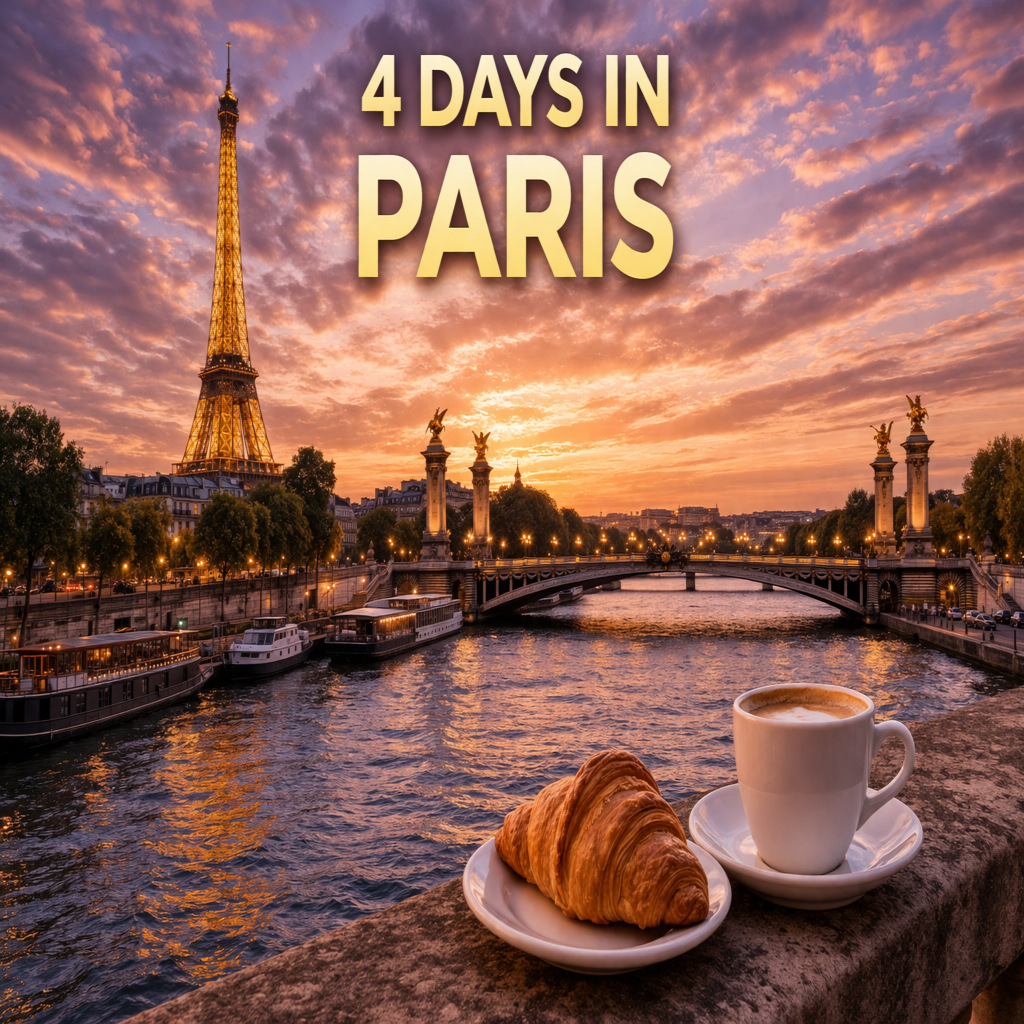
Paris has a reputation problem — not with the city itself, which is magnificent, but with the version of Paris that most first-time visitors experience. The version of excessive queuing, overpriced café terrasses on the tourist boulevards, the Mona Lisa glimpsed over seventeen rows of raised smartphones, the feeling that you are not quite in Paris but in a theme park version of Paris, perfectly replicated but somehow hollow, populated by people who have also come to see the theme park.
This guide exists to help you avoid that version and find the real one.
Four days in Paris is enough time to see the essential monuments properly — and several of them are genuinely, irreversibly magnificent and deserve your full attention — while also doing what most first-time visitors never quite manage: disappearing into the city. Eating at the zinc-countered corner café where nobody speaks English and the plat du jour changes daily and costs €14. Walking into neighborhoods with no particular agenda and discovering that the street you are on is one of the most beautiful streets you have ever walked down. Sitting in the Luxembourg Gardens on a Tuesday afternoon doing nothing at all except watching Parisians doing nothing at all, which is a specific and highly refined art form. Standing on a bridge over the Seine at midnight when the tourists have finally gone and the city is itself again — enormous, luminous, and entirely indifferent to whether or not you are adequately appreciating it.
This four-day Paris itinerary is organized around two principles. The first is that the famous things in Paris are famous for excellent reasons and should be experienced — but strategically, at the right time, with advance booking, and with sufficient time to be genuinely moved rather than merely checked off. The second is that the Paris you will remember most vividly is not the Louvre or the Eiffel Tower — though both are extraordinary — but the unscheduled moments in between: the corner where the light was perfect, the restaurant you stumbled into, the conversation with a stranger, the afternoon when you had nowhere to be and Paris filled the time with the specific, unhurried quality of pleasure it is better at than any other city in the world.
The guide also answers, directly and honestly, the skip question. Not every famous Paris attraction is worth your limited time. Some are overrated, some are oversaturated, and some can be experienced just as well from the outside without paying for the interior. This guide tells you which is which.
Before You Arrive: Essential Paris Practicalities
Getting There and Into the City
Paris has two main airports. Charles de Gaulle Airport (CDG) is the main international hub, 25 km northeast of the city. The RER B train connects CDG directly to the city center (Châtelet-Les Halles, Saint-Michel, Luxembourg) in approximately 35 minutes for approximately €11.80 — the most practical and affordable airport connection. Taxis charge a fixed rate of €55 to the Right Bank and €62 to the Left Bank from CDG. Uber and Le Cab are also available.
Orly Airport (ORY), 14 km south of the city, is connected by the Orlyval automated metro to the RER B line at Antony station (total journey to central Paris approximately 35 minutes) or by bus to various points in the city.
The Paris Metro and Transport
Paris’s Metro network — 16 lines, 302 stations — is the most comprehensive urban rail system in Europe and covers virtually every neighborhood of the city. A Navigo Easy card (rechargeable, purchased for €2 at any Metro station) loads individual tickets (t+ tickets) or carnets (10-ticket books at a significant discount). For a four-day visit with intensive city exploration, the Navigo Semaine (weekly pass, valid Monday to Sunday, approximately €30) provides unlimited travel on Metro, RER within zones 1–5, buses, and Noctilien night buses and represents excellent value. The Paris Visite tourist pass is generally less advantageous — calculate your expected journeys before purchasing.
Walking between Metro stops in central Paris is frequently faster than taking the Metro and always more rewarding. The city’s core — from Montmartre in the north to Montparnasse in the south, from the Marais in the east to the 8th arrondissement in the west — is approximately 4 km across in any direction: entirely walkable given sufficient time and good shoes.
Arrondissements and Orientation
Paris is divided into 20 arrondissements (districts) arranged in a clockwise spiral from the center. The 1st arrondissement contains the Louvre and Île de la Cité; the 4th the Marais and Notre-Dame; the 5th the Latin Quarter; the 6th Saint-Germain-des-Prés; the 7th the Eiffel Tower and Musée d’Orsay; the 8th the Champs-Élysées; the 18th Montmartre. Understanding this structure — and the Seine’s division of the city into the Right Bank (Rive Droite, arrondissements 1, 2, 3, 4, 8, 9, 10, 11, 17, 18, 19, 20) and Left Bank (Rive Gauche, arrondissements 5, 6, 7, 13, 14, 15) — provides the basic mental geography needed to navigate the city effectively.
Booking in Advance
Several Paris attractions require advance booking that many first-time visitors underestimate. The Musée d’Orsay, the Sainte-Chapelle, the Catacombs, and tours of the Palais Garnier all benefit enormously from pre-booked timed entry. The Louvre does not require booking for general entry but benefits from it during peak season. Book these before arriving in Paris — failing to do so means queues of 45–90 minutes at some of the city’s most popular attractions.
What to See — and What to Skip — in Paris
Before the day-by-day itinerary, a direct and honest answer to the guide’s central promise.
See: Musée d’Orsay. The finest Impressionist collection in the world, in one of the most beautiful museum buildings in Europe. Non-negotiable for any visit.
Skip: The Mona Lisa. The painting itself is extraordinary — small, behind glass, 8 meters away, visible over the heads of approximately two hundred other people at any given moment. The experience of seeing it in room 711 of the Louvre’s Denon Wing is one of the most anticlimactic in European art tourism. See the Louvre’s other galleries, which are uncrowded and magnificent. Walk past Room 711 if you wish. Do not plan your day around it.
See: Sainte-Chapelle. The most beautiful Gothic interior in Paris and one of the most beautiful in the world. Vastly undervisited relative to Notre-Dame. Pre-book and arrive at opening.
Skip: The top of the Eiffel Tower. The queue for the summit lift is the longest and most expensive in Paris. The view from the second floor is superior to the summit in most respects (closer to the buildings, better proportioned) and the queue is dramatically shorter. Alternatively, the view of the Eiffel Tower from the Trocadéro esplanade, from the Pont d’Iéna, or from the Champ de Mars is more beautiful than the view from it.
See: The Louvre’s lesser-known wings. The Richelieu Wing’s Dutch and Flemish paintings, the Sully Wing’s French paintings, and the entire Department of Islamic Art (housed in a spectacular new glass-and-gold courtyard) are uncrowded, extraordinary, and entirely missed by the majority of Louvre visitors racing toward the Italian Paintings.
Skip: The Champs-Élysées for shopping or dining. The most overrated street in Paris — magnificent as a ceremonial avenue and worth walking once for the Avenue perspective toward the Arc de Triomphe, but its shops are international chains available in any major city and its restaurants are expensive and mediocre. Shop and eat in Le Marais, Saint-Germain, or the 9th arrondissement instead.
See: The covered passages (passages couverts). The 19th-century glass-roofed shopping arcades of the 2nd arrondissement — Galerie Vivienne, Passage des Panoramas, Passage Jouffroy — are among the most beautiful and most atmospheric spaces in Paris and almost entirely overlooked by first-time visitors.
Skip: A Seine river cruise as your primary evening activity. The Bateaux Mouches and Vedettes du Pont Neuf offer a serviceable overview of the city’s riverside monuments, but the same views — better, slower, and free — are available from any of the Seine’s bridges on foot. Walk the quais from Pont de la Tournelle to Pont des Arts at dusk instead.
See: Père Lachaise Cemetery. Not a morbid suggestion — Père Lachaise is one of the most beautiful and most historically extraordinary open spaces in Paris, its wooded paths winding through the tombs of Chopin, Proust, Oscar Wilde, Edith Piaf, Jim Morrison, Gertrude Stein, and hundreds of other significant cultural figures, in a landscape that is simultaneously a sculpture garden, a museum, and a genuinely moving space of reflection.
Skip: The Moulin Rouge show. Enormously expensive, heavily marketed, and an experience calibrated entirely for tourist consumption. The Pigalle and Montmartre neighborhoods surrounding it are excellent; the show itself is not the most rewarding way to spend €120 per person.
Day One: The Left Bank, Sainte-Chapelle, and Notre-Dame
The first day is anchored on the Île de la Cité and the Left Bank — the oldest parts of Paris, where the city’s medieval, Renaissance, and intellectual history is most concentrated, and where the finest and most consistently rewarding walks in central Paris begin.
Morning: Sainte-Chapelle at Opening Time
Begin at Sainte-Chapelle. Pre-book a 9 AM timed entry at sainte-chapelle.fr and arrive precisely at opening. The Sainte-Chapelle — the royal chapel built by Louis IX between 1242 and 1248 to house the Crown of Thorns — is one of the supreme achievements of Gothic architecture, its upper chapel walls consisting almost entirely of 15 meters of stained glass in 1,113 individual panels depicting 1,113 scenes from the Old and New Testaments. When the morning sun comes through this glass from the east — which it does, directly and dramatically, in the earlier hours of the day — the upper chapel fills with a quality of colored light that is unlike anything else in Paris and among the most beautiful architectural experiences in Europe.
The chapel is small, the visit focused, and the experience complete in 45–60 minutes of proper attention. At 9 AM, before the timed-entry crowds arrive in force, it can feel almost private — which is precisely the condition it deserves.
From Sainte-Chapelle, walk the length of the Île de la Cité toward Notre-Dame de Paris, reopened in December 2024 after the devastating 2019 fire. The cathedral’s exterior — the west facade with its twin towers, the flying buttresses of the apse seen from the Square Jean XXIII garden on the eastern tip of the island, and the Gothic spire restored to Viollet-le-Duc’s original 19th-century design — is as magnificent as it has ever been. The interior restoration has returned the cathedral to a luminosity not seen in decades.
Pre-book a timed entry at notredamedeparis.fr — demand since the reopening has been extraordinary and walk-up access is significantly limited.
Late Morning: The Latin Quarter and the Luxembourg Gardens
Cross to the Left Bank via the Pont au Double and walk south into the 5th arrondissement — the Latin Quarter. The narrow medieval streets around the rue de la Huchette, rue Saint-Séverin, and the Place de la Sorbonne are the oldest in Paris and most rewarding on foot before the tourist lunch crowds fill the restaurant terrasses. The Panthéon — the neoclassical mausoleum housing the remains of Voltaire, Rousseau, Victor Hugo, Émile Zola, Marie Curie, and dozens of other defining figures of French civilization — is excellent and rarely crowded. Entry approximately €13.
Walk west along the Boulevard Saint-Michel to the Jardin du Luxembourg — the Left Bank’s finest park and one of the great public gardens in any city in the world. The formal French garden, the palace (now the French Senate), the octagonal basin where children have sailed toy boats for generations, the orchard of trained fruit trees, the beehives, the chess players in the tree-shadowed corners — the Luxembourg Gardens in mid-morning, with the light on the palace facade and the first café terrasses setting out their chairs, is one of the quintessential Paris experiences.
Sit for twenty minutes. Watch the Parisians do whatever Parisians do in parks on weekday mornings: read, argue on the phone, feed pigeons with considerable lack of enthusiasm, walk small dogs of great dignity. This is Paris as its residents inhabit it, and it is worth every minute of unscheduled time.
Lunch: A Saint-Germain Bistro
The 6th arrondissement — Saint-Germain-des-Prés — is the ideal neighborhood for the first Paris lunch. The famous literary cafés (Café de Flore, Les Deux Magots) are excellent for a coffee and people-watching but overpriced for lunch. Instead, find a traditional bistro on a side street off the Boulevard Saint-Germain — Rue de Buci, Rue de l’Abbaye, or the streets around Place de l’Odéon — where the menu changes daily and the plat du jour (daily special) costs €14–€18.
Onion soup gratinée with its crust of melted cheese, entrecôte with béarnaise and frites, crème brûlée. A carafe of house Côtes du Rhône. The bill for two, with a shared dessert and a pichet of wine, should not exceed €65 and will probably be one of the best meals of the trip.
Afternoon: Musée de Cluny and the Marais
The Musée de Cluny — the National Museum of the Middle Ages, housed in a Gothic mansion built over the ruins of Roman baths — contains the six-panel Lady and the Unicorn tapestry cycle, one of the greatest and most mysterious works of medieval art in existence, its meaning still debated by art historians and its beauty entirely beyond debate. The museum is small, the visit focused at approximately 90 minutes, and the tapestries are seen in conditions of relative calm that the Louvre’s major works rarely allow. Entry approximately €12.
Cross to the Right Bank via Pont Marie and enter the Marais — the 3rd and 4th arrondissements, the most beautiful and most walkable neighborhood in Paris, its medieval and Renaissance street plan intact and its architecture spanning five centuries of urban building. The Place des Vosges — the oldest planned square in Paris, built by Henri IV between 1605 and 1612 and lined with 36 identical red-brick and stone pavilions — is one of the finest public spaces in the city and the heart of the Marais experience.
Walk the Marais streets without a specific agenda: the Rue des Rosiers (the historic Jewish quarter, now gentrified but retaining excellent falafel shops and a few traditional bakeries), the Rue Vieille du Temple, the Place du Marché Sainte-Catherine (a quiet, tree-lined square that most visitors never find), and the courtyards of the private hôtels particuliers whose ornate facades are visible through half-open carriage gates.
Evening: Apéro on the Seine and Dinner in the Marais
At approximately 6:30 PM, buy a bottle of wine and glasses from a Nicolas wine shop or a Franprix supermarket (an excellent Sancerre or a Côtes du Rhône costs €8–€15) and sit on the quai below the Pont de la Tournelle, on the île Saint-Louis side, watching the light leave the Seine and the Notre-Dame towers catch the last gold. This is the Paris apéritif, Left Bank style — enormously civilized, entirely free apart from the wine, and one of the finest early evenings available in the city.
Dinner in the Marais — the neighborhood has both excellent traditional French bistros (Au Bourguignon du Marais for Burgundian cooking, Chez Janou for Provençal) and some of the finest international restaurants in Paris (the Jewish Ashkenazi restaurants of the Rue des Rosiers are outstanding). Book in advance for any restaurant of quality in the Marais — the neighborhood’s small size and high dining density mean the best places fill early.
Day Two: The Louvre, Properly, and the Right Bank
Day Two is organized around the Louvre — which deserves a full morning rather than the two-hour rush that most visitors give it — followed by an afternoon in the Right Bank’s finest neighborhoods and an evening in the 9th arrondissement.
Morning: The Louvre Without the Mona Lisa
Arrive at the Louvre at 9 AM (opening time) with a pre-booked timed entry ticket (louvre.fr) and go immediately — immediately — to the wings and galleries that are not the Italian Paintings. By 9:30 AM, Room 711 with the Mona Lisa will be filling with crowds. By 10 AM it will be impenetrable.
You, instead, are standing in front of Vermeer’s The Lacemaker in the Dutch Paintings galleries of the Richelieu Wing, where there are approximately twelve other people. Or in the Greek Antiquities galleries looking at the Venus de Milo in the early morning light, with a handful of visitors and no one raising a phone above their head. Or in the Department of Islamic Art, which occupies a stunning glass-and-gold-mesh courtyard in the Cour Visconti and houses one of the finest collections of Islamic decorative arts in the world, through which visitors move in a state of relative tranquility.
The Louvre is not one museum but a collection of museums occupying a former royal palace. Its highlights beyond the Italian Paintings include: the Winged Victory of Samothrace (at the top of the Daru staircase — undeniably magnificent and currently very visited, but experienced at its best in the first minutes after opening); Delacroix’s Liberty Leading the People (French Paintings, Denon Wing — one of the most energizing paintings in European art); the Flemish Portraits (Rubens, Van Dyck, Hals — Richelieu Wing, largely uncrowded); the entire ancient Near Eastern collection (Sully Wing, ground floor — almost never crowded and extraordinary); and the Richelieu Wing’s Napoleon III apartments (the most opulent rooms in the museum and entirely overlooked by most visitors).
Spend three hours in the Louvre and see almost nothing of what you planned to see. This is correct. This is how the Louvre works.
Lunch: Covered Passages and the 2nd Arrondissement
Walk north from the Louvre through the Palais Royal gardens — the arcaded 18th-century gardens of the former royal palace, now housing independent galleries and restaurants and the striped columns of Daniel Buren’s contemporary art installation, one of the most pleasant and most underutilized public spaces in central Paris — and into the 2nd arrondissement.
Lunch in the Galerie Vivienne — the most beautiful of the 19th-century glass-roofed covered passages, its mosaic floor and neoclassical decoration creating an atmosphere of extraordinary Belle Époque refinement — at the excellent A Priori Thé salon de thé, which has been serving lunch and tea here since 1980. The covered passage, with its combination of antiquarian bookshops, wine merchants, and the specific filtered quality of light through the glass roof above, is one of the finest settings for a Paris lunch.
After lunch, walk through the adjacent passages: Passage des Panoramas (the oldest covered passage in Paris, opened in 1800), Passage Jouffroy (with its toy shops and stamp dealers and the extraordinary Hôtel Chopin), and Passage Verdeau (the quietest and most authentic). These passages are among the finest and least-visited spaces in Paris and constitute a complete 19th-century urban world in miniature.
Afternoon: Musée Picasso and the Upper Marais
The Musée Picasso Paris — in the extraordinary 17th-century Hôtel Salé in the Upper Marais — houses the world’s largest Picasso collection: over 5,000 works from every period of the artist’s extraordinary production, including the personal collection that passed to the French state in lieu of inheritance taxes after his death in 1973. It is one of the finest single-artist museums in the world and significantly less crowded than its collection quality deserves.
Pre-book at museepicassoparis.fr (approximately €14). Allow 90 minutes to two hours.
From the Musée Picasso, walk north through the upper Marais and into the Canal Saint-Martin neighborhood — the 10th arrondissement’s most fashionable and most genuinely local area, its iron footbridges over the tree-lined canal, its independent shops and cafés, and the specific young-creative-Parisian energy that the Marais itself has lost to gentrification. The Canal Saint-Martin area on a weekday afternoon has the authentic neighborhood character that first-time visitors to Paris often seek and rarely find in the more famous districts.
Evening: The 9th Arrondissement and a Proper Paris Dinner
The 9th arrondissement — the Opéra and Pigalle area, sometimes called South Pigalle or SoPi by those who enjoy unfortunate neighborhood acronyms — is currently the most exciting restaurant neighborhood in Paris. Its combination of traditional bistros, natural wine bars, and the new generation of Paris cooking (young chefs, small rooms, seasonal menus that change daily, the wine list written on a blackboard in chalk) makes it the essential destination for serious Paris dining.
Before dinner, a pre-theatre drink at the Café de la Paix on the Place de l’Opéra — opposite the extraordinary Palais Garnier — is one of the most elegantly excessive café experiences in Paris, its Belle Époque interior a masterwork of Second Empire decoration and its terrace offering one of the finest people-watching positions on the Right Bank. The Palais Garnier itself, even if you do not attend a performance, is worth a visit to the public foyer and the interior tour (palaisgarnier.fr, approximately €14) — its grand staircase and auditorium are among the most extravagant and most beautiful interiors in Paris.
For dinner, the restaurant density in the 9th is such that a reservation at almost any highly-rated establishment will reward — but make one. The Paris reservation system (Google, TheFork, or direct restaurant booking) is well-developed and the best tables in the 9th fill 1–2 weeks in advance on weekends, 3–4 days on weekdays.
Day Three: Musée d’Orsay, the 7th, and Montmartre
Day Three covers the Musée d’Orsay in the morning — allowing the full time it deserves — the 7th arrondissement and Eiffel Tower in the afternoon, and Montmartre in the late afternoon and evening.
Morning: Musée d’Orsay — Allow Four Hours
The Musée d’Orsay is the finest art museum in Paris for the general visitor — not because it surpasses the Louvre in historical depth or institutional importance, but because its collection (Impressionist and Post-Impressionist painting, sculpture, and decorative arts from 1848 to 1914) is the most universally beloved in the history of Western art, its building (the former Gare d’Orsay railway station, converted into a museum in 1986) is one of the most beautiful museum buildings in Europe, and its collections are presented at a human scale that allows genuine contemplation rather than the Louvre’s overwhelming abundance.
The fifth floor — where the core Impressionist collection is displayed — contains Monet’s series paintings (Rouen Cathedral, the Haystacks, the Water Lilies studies), Renoir’s Bal du Moulin de la Galette, Manet’s Olympia and Le Déjeuner sur l’Herbe, Degas’s dance studies, Van Gogh’s bedroom and self-portraits, Cézanne’s Card Players, and Seurat’s The Circus — essentially the complete canon of Impressionist and Post-Impressionist masterwork, displayed in natural light from the converted station’s great glass roof.
The ground floor and middle levels cover the academic, Realist, Symbolist, and Art Nouveau traditions of the same period — Gustave Courbet’s monumental Realist paintings, Rodin’s sculpture (including the marble Gates of Hell studies), and the extraordinary Art Nouveau decorative arts collection are all outstanding and largely uncrowded.
Pre-book a 9 AM timed entry at musee-orsay.fr. The museum is closed on Mondays. Allow a full four hours — less is genuinely insufficient.
Afternoon: The Eiffel Tower and the 7th
Walk across the Seine to the Champ de Mars and approach the Eiffel Tower from the south, where the full perspective of the tower’s extraordinary iron structure — its four legs converging 276 meters above to a single point, the lattice of its ironwork visible in elaborate detail at close range — can be appreciated before joining any queue.
The honest Eiffel Tower advice: if you have pre-booked tickets for the second floor (tour-eiffel.fr — book weeks in advance for peak season), go. The second floor view at approximately 115 meters provides an excellent panorama of the city and the experience of being in the tower’s structure is genuinely worthwhile. If you have not booked, the view of the tower from the Trocadéro esplanade across the Seine — the classic postcard perspective — is, in most people’s honest assessment, more beautiful than the view from it, and entirely free.
The 7th arrondissement surrounding the Eiffel Tower is the most elegant residential district in Paris — its Belle Époque apartments, its quiet streets, the Rue Cler market street (one of the finest food market streets in the city), and the proximity of the Invalides (Napoleon’s tomb, housed in the magnificent Hôtel des Invalides, with its golden dome — entry approximately €15, the interior more impressive than many Paris visitors expect) make it a rewarding afternoon neighborhood walk.
The Musée Rodin — in the 18th-century Hôtel Biron where Rodin worked for the last decade of his life, its sculpture garden containing The Thinker, The Kiss, and The Gates of Hell in outdoor bronze originals — is one of the finest and most underrated museums in Paris. Entry approximately €13, garden only €4. The garden on a warm afternoon, with Rodin’s major works visible among roses and box hedges, is one of the most purely pleasurable museum experiences in the city.
Late Afternoon: Montmartre
Take the Metro to Abbesses (Line 12) and enter Montmartre from the south, via the Place des Abbesses — whose Art Nouveau Metro entrance (one of only two original Guimard glass-roofed entrances surviving in Paris) is the finest in the Metro system. Walk uphill through the village streets of Montmartre — the Rue Lepic (with its excellent fromageries and charcuteries), the Place du Tertre (crowded with portrait painters and tourists, but providing the Sacré-Cœur backdrop that is undeniably effective), the Rue Norvins and the Rue des Saules — to the top of the Butte (hill).
The Sacré-Cœur Basilica — the white Romano-Byzantine church completed in 1914, its location on the highest point in Paris providing views over the entire city — is free to enter and worth doing for the interior mosaics and the view from the steps. The view from the Sacré-Cœur steps at dusk, with all of Paris spreading below in the last warm light and the first lights of evening beginning to appear, is one of the finest in the city.
Descend via the Rue Lepic to the Place de Clichy for the Metro south, or stay in Montmartre for the evening.
Evening: Dinner in Montmartre or Pigalle
Montmartre has excellent restaurants in its lower neighborhoods — the Rue Lepic and the streets around the Abbesses square offer good traditional French bistros at prices below the 8th and 6th arrondissements. Alternatively, descend to Pigalle and the lower 18th, where the restaurant scene is more diverse and more contemporary. The Rue des Martyrs — climbing south from Pigalle toward the 9th — is one of the finest restaurant and food shop streets in Paris, its combination of traditional fromageries, natural wine bars, and excellent bistros creating a food street of genuine distinction.
Day Four: Versailles or Père Lachaise, and a Final Paris Afternoon
The fourth day offers a choice for the morning: Versailles, the great day trip from Paris, or a slower final morning in the city itself.
Option A: Versailles
The Château de Versailles — the former royal palace 23 km southwest of Paris, accessible by RER C train in approximately 40 minutes — is one of the most magnificent royal palaces in the world and entirely justifies the day trip investment for visitors who have not been before. The Hall of Mirrors (Grande Galerie des Glaces), the royal apartments, and the extraordinary formal gardens of Le Nôtre covering 800 hectares are all extraordinary.
The honest Versailles advice: it is very large, very crowded, and requires strategy. Book the earliest timed entry available (en.chateauversailles.fr — essential in peak season). Go immediately to the Hall of Mirrors at opening, before the tour groups from Paris reach it. Spend the majority of your time in the formal gardens rather than the palace interiors — they are larger, less crowded, and in many respects more impressive. Take the shuttle to the Grand Trianon and the Petit Trianon, which are less visited than the main palace and provide a more intimate and equally beautiful Versailles experience.
Allow a full day. The RER C from Paris takes 40 minutes from Saint-Michel-Notre-Dame. Entry approximately €20 for the palace; gardens free except on days when the fountain shows (Grandes Eaux Musicales) operate.
Option B: Père Lachaise and a Final Left Bank Afternoon
If the scale of Versailles feels like more monument than a fourth day requires, the alternative is a slow and extremely rewarding morning at Père Lachaise Cemetery followed by a long final afternoon on the Left Bank.
Père Lachaise — the largest cemetery in Paris, opened in 1804 on the eastern hill of the 20th arrondissement — is one of the most beautiful and most historically extraordinary open spaces in the city. Its 44 hectares of wooded pathways wind between the tombs of Chopin, Proust, Oscar Wilde (whose tomb is covered in lipstick kisses), Edith Piaf, Molière, Sarah Bernhardt, Jim Morrison, Marcel Proust, Colette, Gertrude Stein, and hundreds of other significant figures. The tombs themselves — ranging from modest markers to elaborate neoclassical temples and Romantic sculpture masterworks — constitute one of the finest outdoor sculpture collections in Paris.
A map of notable tombs is available at the entrance. Allow two hours for a focused visit; three for a genuinely unhurried one. Entry is free.
Final Afternoon: A Long, Unscheduled Left Bank Walk
The finest final afternoon in Paris is entirely unscheduled. Walk from wherever you are to the Seine, cross to the Left Bank, and walk. Walk the quais — the lower riverside walkways that run along the Seine beneath the road level, lined with the booksellers’ green stalls of the bouquinistes. Walk into Saint-Germain-des-Prés and find a table at the Café de Flore or the Café Procope (the oldest café in Paris, founded in 1686, now a restaurant) not for the celebrity associations but for the pleasure of a long, slow afternoon coffee in a room that has been serving coffee to Parisians since before the French Revolution.
Buy a book from a bouquiniste — even if it is in French and you cannot read it, the green metal boxes of the Seine booksellers are one of the last genuinely unchanged Paris institutions, and the experience of browsing them in the late afternoon light, with the Notre-Dame towers visible to the east and the Pont des Arts ahead, is specifically and irreplaceably Parisian.
Walk to the Pont des Arts at sunset — the pedestrian bridge connecting the 1st and 6th arrondissements, with the finest view of the Seine and the city’s riverside monuments from any bridge in central Paris. Stand on it with a glass of wine. Watch the light leave the city. Watch the Seine move beneath you, grey and green and silver in the fading light, exactly as it has moved for two thousand years of Parisian history.
This is Paris at its most essential — not a monument, not an itinerary, not a thing to see or skip, but a quality of being in a beautiful place with sufficient time and attention to feel it properly. It requires nothing except the willingness to stop and look, which Paris will reward every time.
Final Evening: A Neighborhood Bistro and the Eiffel Tower at Night
Book a reservation at a traditional Paris bistro — not a famous one, not a starred one, but a neighborhood one, on a side street, with handwritten menus and candles in wine bottles and a proprietor who has been cooking the same cassoulet since the 1990s. The 6th, 11th, or 17th arrondissements are all excellent for this specific genre of restaurant, which is simultaneously the most common and the most satisfying dining option in the city.
After dinner, take the Metro or walk to the Trocadéro esplanade at approximately 10 PM and watch the Eiffel Tower’s hourly light show — five minutes of sparkling lights on the iron structure at the top of each hour from dusk until 1 AM. From the Trocadéro, the tower is 600 meters away across the Seine, perfectly framed between the Palais de Chaillot’s wings, the beam from its summit sweeping across the Paris sky.
It is, in the end, every bit as magnificent as advertised. It is the correct final image of four days in a city that has been producing correct final images for two thousand years.
Four Days in Paris: Practical Summary
The Paris Museum Pass (2 days €55, 4 days €70) covers the Louvre, Musée d’Orsay, Sainte-Chapelle, Musée de Cluny, Musée Picasso, Musée Rodin, Versailles, and over 50 other sites without additional ticketing. It does not cover timed-entry reservations at some attractions — these must be booked separately. For four days of intensive museum visiting it represents excellent value.
The best free things in Paris: The Trocadéro view of the Eiffel Tower, the Jardin du Luxembourg, the Palais Royal gardens, all quai walks, Père Lachaise Cemetery, the bouquiniste browsing, the Sacré-Cœur exterior, the covered passages, and every sunset from every bridge.
Eating well and affordably: The menu du déjeuner (set lunch) at a traditional bistro — starter, main, dessert, glass of wine — for €15–€22 is the finest value eating in Paris. The boulangerie croissant and café counter breakfast for €3–€4 is the correct Paris morning. The evening formule at a neighborhood restaurant — two or three courses, fixed price, €22–€35 — is the finest dinner value.
What time to visit attractions: Arrive at opening time for the Musée d’Orsay, Sainte-Chapelle, and Versailles. The Louvre is least crowded at 9 AM and on Wednesday and Friday evenings (late opening until 9:45 PM). Notre-Dame and the Sacré-Cœur are best before 9 AM and after 6 PM.
The most important advice: Walk more than you plan to. Take the Metro less than you expect to. The distance between most Paris attractions is shorter than it appears on the map and infinitely more rewarding on foot than underground. Paris is, above everything else, a city for walking — and the city you find on foot, between the planned destinations, in the streets and passages and quais and gardens that constitute the actual texture of Parisian daily life, is the Paris worth coming for.
Four days is not enough. It never is. But these four days — if approached with curiosity, patience, and the willingness to occasionally put the phone away and simply be in one of the most beautiful cities in the world — will be extraordinary.
We hope this guide to four days in Paris has given you the inspiration and practical foundation to plan an unforgettable trip. For more Paris neighborhood guides, museum deep-dives, restaurant recommendations by arrondissement, and day trip itineraries from the city, keep exploring GlobeTrailGuide — your trusted companion for smarter, deeper travel.
GlobeTrailGuide.com | Travel Smarter. Explore Deeper.