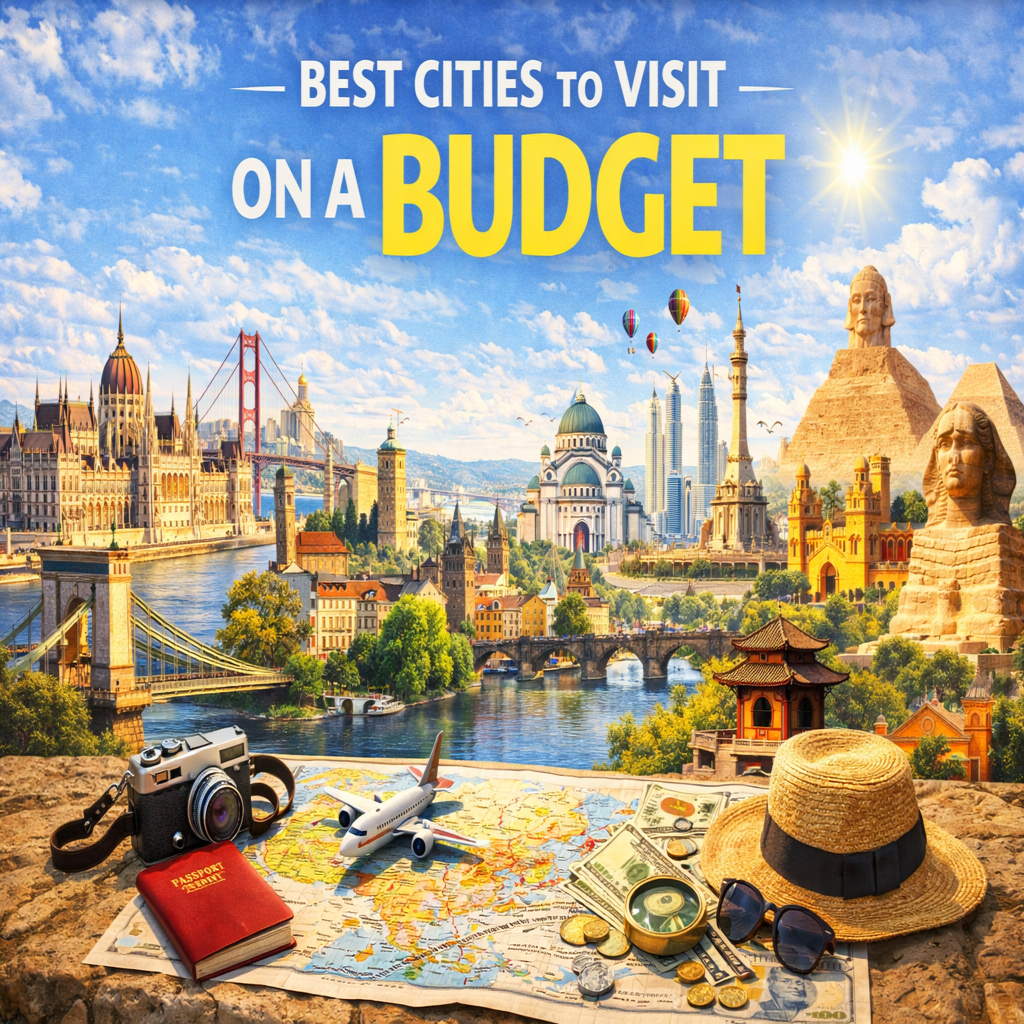
The most persistent myth in travel is that extraordinary experiences require extraordinary spending. That the cities worth visiting are the ones that demand premium prices at every turn — for the hotel, the restaurant, the museum, the taxi, the glass of wine at the end of a long day of sightseeing. That budget travel means compromise: cheaper neighborhoods, worse food, exhausting logistics, and the constant low-level anxiety of watching your balance drain faster than your itinerary progresses.
This guide exists to dismantle that myth completely.
The truth — discovered by millions of experienced travelers and confirmed by anyone who has eaten a bowl of pho in Hanoi for a dollar, watched the sun set over the Acropolis from a free hilltop, drunk excellent wine at a Lisbon tasca for two euros a glass, or wandered the medieval streets of Kraków on a Tuesday morning with almost no one else around — is that some of the world’s most extraordinary cities are also among its most affordable. And in many cases, the budget cities are not merely adequate substitutes for their expensive counterparts. They are better. More authentic, more alive, more generous with their beauty, more rewarding for the traveler who engages with them seriously.
This guide covers the best cities to visit on a budget across every region of the world — cities where your money goes further, where the food is outstanding and cheap, where the major attractions are free or nearly so, and where the experience of being in the place, in the streets and markets and cafés and viewpoints, is as rewarding as anything the premium destinations can offer. For each city, we include what makes it exceptional value, what you absolutely must do and eat, and what a realistic daily budget looks like.
Travel does not have to be expensive to be extraordinary. This guide proves it.
How We Chose These Cities
Every city in this guide was selected on four criteria: exceptional value for money relative to the quality of experience on offer, world-class or genuinely outstanding attractions that justify the journey, a food culture that delivers memorable meals at low prices, and a character and depth that makes the destination rewarding in its own right — not merely as a cheap version of somewhere more famous. These are not consolation prize destinations. They are cities that many experienced travelers consider superior to their pricier alternatives.
EUROPE’S BEST BUDGET CITIES
1. Kraków, Poland — Europe’s Most Beautiful Budget City
Kraków is the best-kept open secret in European travel — a city of extraordinary medieval and Renaissance beauty, world-class museums, an outstanding food and café culture, and some of the lowest prices of any major tourist destination on the continent. It is consistently ranked among Europe’s most beautiful cities, yet remains significantly cheaper than Prague, Budapest, or Lisbon, its most obvious competitors for the title of Europe’s finest budget destination.
The Old Town — a UNESCO World Heritage Site and one of the few medieval city centers in Central Europe to survive World War II essentially intact — is built around the vast Rynek Główny, the largest medieval market square in Europe, flanked by the Cloth Hall (Sukiennice), St. Mary’s Basilica with its extraordinary Gothic altarpiece by Veit Stoss, and the Town Hall Tower. The Royal Road leading south from the square to Wawel Hill — home to the Royal Castle and Cathedral, where Polish kings were crowned and buried for centuries — passes through some of the finest urban streetscapes in the country.
The Jewish Quarter of Kazimierz, south of the Old Town, is one of the most atmospheric and culturally rich neighborhoods in Europe — its synagogues, galleries, Jewish bookshops, vintage clothing stores, and outstanding restaurants occupying the streets where a once-thriving Jewish community of 65,000 lived before the Holocaust. The Schindler’s Factory Museum, housed in the actual factory where Oskar Schindler employed Jewish workers during World War II, is one of the finest and most emotionally powerful museum experiences in Europe. The Wieliczka Salt Mine — a UNESCO World Heritage Site 14 km from the city where miners carved an entire underground world of chambers, chapels, and sculptures from salt over seven centuries — is one of the most extraordinary day trips from any European city.
Daily budget: €45–€65 per person (hostel €12–€18; mid-range guesthouse €35–€55; pierogi lunch €4–€6; dinner at a milk bar or traditional restaurant €8–€14; beer in the Old Town €2–€3).
Don’t miss: Rynek Główny at dawn before the tourists arrive, Wawel Castle and Cathedral, Kazimierz Jewish Quarter, Schindler’s Factory Museum (book in advance), obwarzanek (the Kraków pretzel ring) from a street cart, zapiekanka (open-faced baguette with mushrooms and cheese) from Plac Nowy.
Free highlights: The Planty park circuit around the Old Town, the view from Wawel Hill, the Rynek Główny square itself, St. Mary’s Basilica exterior and the hourly trumpet call from its tower.
2. Budapest, Hungary — Grand European Capital at Half the Price
Budapest is one of Europe’s most spectacular capital cities — home to a UNESCO World Heritage riverfront, extraordinary thermal bath culture, magnificent Art Nouveau architecture, outstanding wine and food traditions, and one of the continent’s most vibrant and original nightlife scenes — at prices that are consistently 40–60% lower than equivalent Western European capitals. It is, by almost any measure, the finest value among Europe’s truly great cities.
The Hungarian Parliament Building, stretching 268 meters along the Danube and illuminated magnificently at night, is one of the most beautiful government buildings in the world and offers affordable guided tours. Buda Castle on its limestone plateau above the river, the Fisherman’s Bastion with its fairy-tale turrets and panoramic views, the Chain Bridge, and the Heroes’ Square — the monumental ensemble at the end of Andrássy Avenue — constitute a collection of urban landmarks that rival any European capital.
The thermal bath culture is uniquely Budapest’s own and uniquely affordable. The Széchenyi Thermal Bath — a magnificent Neo-Baroque building in City Park housing outdoor pools and indoor halls fed by natural thermal springs at 77°C — costs approximately €22 for a full day’s entry. The Gellért Thermal Bath, equally beautiful and equally historic, is similarly priced. Spending a morning soaking in a 19th-century thermal bath and then eating a bowl of goulash with fresh bread and a glass of Tokaji wine at a neighborhood étterem for under €10 is a perfect Budapest day — and it costs less than a single museum ticket in many Western European capitals.
The ruin bar scene — atmospheric drinking establishments created in derelict buildings in the Erzsébetváros (7th district) old Jewish Quarter — is one of the most original contributions to European nightlife culture of the past twenty years. Szimpla Kert, the original and most famous, is a labyrinthine world of mismatched furniture, hanging bicycles, and eccentric art installations that has been copied across Europe and never quite equaled.
Daily budget: €50–€75 per person (hostel €12–€20; mid-range hotel €40–€65; goulash lunch €6–€10; dinner at a traditional étterem €12–€18; craft beer at a ruin bar €2–€3.50).
Don’t miss: Hungarian Parliament tour, Széchenyi or Gellért thermal bath, Buda Castle and Fisherman’s Bastion at sunset, a ruin bar evening in the 7th district, goulash at a traditional étterem, a day trip to the Danube Bend (Szentendre and Esztergom).
Free highlights: The Fisherman’s Bastion exterior, walking the Chain Bridge, Heroes’ Square, the Great Market Hall interior browsing, the Jewish Quarter street art.
3. Lisbon, Portugal — Europe’s Most Soulful City at Surprisingly Accessible Prices
Lisbon has grown significantly more expensive over the past decade as its global reputation has soared, but it remains notably more affordable than Paris, Amsterdam, or London while offering an experience that many travelers consider superior to all three. The pastéis de nata, the fado, the azulejo tiles, the miradouros at sunset, the extraordinary food and wine — all of it comes at prices that make the French and Dutch and British capitals feel overpriced by comparison.
The city’s greatest pleasures are either free or nearly so. Riding Tram 28 through the Alfama neighborhood (€3 with a Viva Viagem card) is one of the finest urban journeys in Europe. The miradouros — particularly Santa Catarina, Portas do Sol, and the Graça viewpoint — offer panoramic views over the city and the Tagus estuary that cost nothing. The Alfama district itself, with its maze of medieval streets, laundry-strung alleyways, and the sound of fado drifting from open restaurant windows, is best explored entirely on foot. The Belém Tower and Jerónimos Monastery are the main paid attractions, both worth every cent of their modest entry fees.
The menu do dia — the set lunch offered at almost every Lisbon tasca and café — is one of Europe’s finest budget-travel institutions. For €9–€13, you receive soup, a main course (usually excellent grilled fish or meat with rice and vegetables), dessert or coffee, and often a glass of house wine or water. The quality is invariably good and frequently outstanding. A bottle of excellent Alentejo red from a supermarket costs €4–€7. A bica (espresso) at a traditional café counter costs €0.80. The mathematics of eating and drinking well in Lisbon are extraordinarily favorable.
Daily budget: €55–€80 per person (hostel €15–€22; mid-range guesthouse €45–€70; menu do dia lunch €9–€13; dinner at a neighborhood tasca €15–€22; glass of house wine €2–€3.50).
Don’t miss: Alfama neighborhood on foot, Tram 28 through the hills, Jerónimos Monastery and Belém Tower, the National Tile Museum, fado live in Mouraria (look for smaller, more authentic venues rather than tourist shows), Mercado da Ribeira food hall.
Free highlights: All miradouros, Alfama streets, Praça do Comércio, Parque das Nações riverfront, LX Factory (weekend market).
4. Porto, Portugal — Extraordinary Character at Outstanding Value
Porto delivers a richer, rawer, and in many ways more deeply affecting experience than Lisbon at prices that are consistently lower — making it arguably the finest value in Western Europe for travelers who take food, architecture, and authenticity seriously.
The port wine lodges of Vila Nova de Gaia — where the great houses of Taylor’s, Graham’s, Ramos Pinto, and Sandeman age their wines in oak barrels — offer tours and tastings for €8–€20 per person that constitute some of the finest food and drink experiences at any price point in Europe. The Dom Luís I Bridge walk, the Ribeira waterfront, the São Bento station azulejos, and the Livraria Lello bookshop are all either free or very inexpensive. The Serralves Museum of Contemporary Art, set within magnificent gardens, is one of the finest modern art institutions in Portugal.
The francesinha — Porto’s extraordinary meat and cheese sandwich drowned in spiced beer and tomato sauce — costs €8–€12 at a neighborhood restaurant and constitutes, by caloric density and flavor intensity per euro spent, one of the finest meals in Europe. The Matosinhos district, a twenty-minute metro ride from the center, is Porto’s working fishing harbor and restaurant quarter — a plate of grilled fresh fish with salad and a glass of Vinho Verde at a Matosinhos restaurant costs €12–€16 and represents some of the finest seafood cooking at the lowest possible prices anywhere in Southern Europe.
Daily budget: €50–€72 per person (hostel €14–€20; mid-range guesthouse €40–€60; francesinha lunch €8–€12; dinner in Matosinhos €14–€20; glass of Vinho Verde €1.50–€2.50).
Don’t miss: Port wine tasting in Vila Nova de Gaia, Ribeira waterfront and Dom Luís I Bridge, São Bento station azulejo panels, Livraria Lello bookshop, grilled fish in Matosinhos, a francesinha at a classic Porto tasca.
Free highlights: Ribeira waterfront walk, Dom Luís I Bridge, São Bento station interior, all neighborhood wandering in Bonfim and Cedofeita.
5. Prague, Czech Republic — The Fairy-Tale City With Fairy-Tale Prices
Prague is one of the most architecturally perfect cities in the world — a medieval, Baroque, and Art Nouveau ensemble of breathtaking completeness — and it remains one of the best value major tourist cities in Europe despite decades of increasing popularity and investment.
The Old Town Square, Charles Bridge, Prague Castle, the Josefov Jewish Quarter, and Vyšehrad are all either free to walk around or charge modest entry fees. Charles Bridge — crossing the Vltava River toward the castle hill with its Baroque sculptures lining both sides — is one of the most dramatic and free urban walks in Europe. The Prague Castle complex, the largest ancient castle in the world, charges a reasonable entrance fee for access to its interior buildings and offers extraordinary views over the city.
Czech beer culture is among the best in the world and remains exceptionally affordable. A half-liter of excellent Czech Pilsner Urquell or Kozel at a traditional pivnice (beer hall) costs €1.50–€2.50 — less than a coffee in many Western European cities. Czech cuisine — svíčková (beef sirloin in cream sauce with bread dumplings), guláš, roast pork with sauerkraut and knedlíky, trdelník pastry from street stalls — is hearty, satisfying, and cheap. A full lunch at a traditional Czech restaurant in a non-tourist neighborhood costs €6–€10.
Daily budget: €45–€65 per person (hostel €12–€18; mid-range hotel €38–€58; Czech lunch €6–€10; dinner at a traditional restaurant €12–€18; beer at a pivnice €1.50–€2.50).
Don’t miss: Charles Bridge at dawn (before 7 AM for near-solitude), Old Town Square Astronomical Clock, Prague Castle and St. Vitus Cathedral, the Josefov Jewish Quarter (entry fee but exceptional), a Czech beer at U Fleků brewery, the Nusle Valley parks away from the tourist center.
Free highlights: Charles Bridge, Old Town Square, Vyšehrad park and ramparts, Letná Park beer garden with Vltava views, all street and neighborhood wandering.
6. Tallinn, Estonia — Medieval Beauty at Northern Europe’s Best Prices
Tallinn is one of the most extraordinarily well-preserved medieval city centers in Europe — a UNESCO World Heritage Old Town of Gothic churches, merchant houses, tower-studded ramparts, and cobblestone alleys that has survived with a completeness that makes Bruges and Rothenburg ob der Tauber seem urbanized by comparison. It is also, for its quality of experience, one of the best-value cities in Northern and Western Europe.
The Old Town divides into the Upper Town (Toompea) — dominated by the Toompea Castle, the Alexander Nevsky Cathedral (a Russian Orthodox masterpiece of onion domes and vivid mosaics), and the Lutheran Dome Church (Toomkirik) — and the Lower Town, whose medieval merchant streets, guild halls, the magnificent Town Hall Square, and the 15th-century Town Hall itself constitute one of the most complete and beautiful medieval urban ensembles in the Baltic. Walking the entirety of the Old Town ramparts and towers, with views over the rust-red rooftops and the Baltic Sea beyond, is one of Northern Europe’s finest free urban experiences.
Tallinn’s restaurant scene has developed remarkably over the past decade — from simple folk-food cafeterias serving traditional Estonian staples (blood sausage, sauerkraut, potato bread, smoked sprats) to sophisticated contemporary Estonian restaurants producing some of the most interesting Nordic-influenced cuisine in the region at prices well below Helsinki, Stockholm, or Copenhagen equivalents. The Balti jaama turg (Baltic Station Market) is outstanding for food exploration.
Daily budget: €50–€75 per person (hostel €14–€20; mid-range guesthouse €40–€60; soup and bread lunch at a traditional café €5–€8; dinner at a good restaurant €15–€22; craft beer €3–€4).
Don’t miss: Old Town ramparts walk at sunset, Town Hall Square and the Town Hall tower climb, the Balti jaama turg market, Telliskivi Creative City neighborhood, traditional Estonian black bread and smoked fish, a sauna experience (essential in Estonian culture).
Free highlights: All Old Town walking, ramparts exterior, views from Toompea Hill, Kadriorg Park and Palace gardens, Pirita beach and convent ruins.
7. Belgrade, Serbia — Europe’s Most Underrated Party City With Extraordinary Value
Belgrade is the city in Europe that most consistently surprises budget travelers who arrive with modest expectations and leave having experienced one of the continent’s most vibrant, hospitable, and genuinely affordable urban destinations. Serbia’s capital — a city of 1.7 million at the confluence of the Sava and Danube rivers — combines a turbulent and fascinating history, outstanding food, a nightlife culture that rivals Berlin at a fraction of the cost, and a warmth and generosity of spirit that makes it one of Europe’s most genuinely welcoming destinations for first-time visitors.
Kalemegdan Fortress — the 2,000-year-old citadel at the confluence of the Sava and Danube, its ramparts offering panoramic views over both rivers and the flat Pannonian Plain beyond — is one of the finest free attractions in the Balkans. The Skadarlija district — a cobblestone bohemian quarter of traditional Serbian kafanas (taverns) where live music, roasted meat, and rakija (fruit brandy) have defined the neighborhood’s character for over 150 years — is Belgrade at its most atmospheric and hospitable.
The food of Belgrade is outstanding and extraordinarily cheap. A portion of ćevapčići (grilled minced meat sausages) with fresh onion, kajmak (clotted cream), and ajvar (roasted red pepper relish) in a traditional pekara costs €3–€4 and constitutes one of the finest and most satisfying meals at any price point in European travel. A full three-course dinner with wine at a good Belgrade restaurant rarely exceeds €15 per person. The city’s craft beer scene, centered on the Savamala creative district, has exploded in recent years and offers excellent quality at prices that make Western European beer drinkers weep with envy.
Daily budget: €35–€55 per person (hostel €10–€15; mid-range hotel €30–€50; ćevapčići lunch €3–€5; dinner with wine at a kafana €12–€18; beer €1.50–€2.50).
Don’t miss: Kalemegdan Fortress at sunset, Skadarlija district for evening kafana dining, Savamala creative neighborhood, the Museum of Yugoslavia (Tito’s mausoleum and extraordinary Cold War artifacts), ćevapčići at a local pekara, a floating river club (splavovi) evening.
Free highlights: Kalemegdan Fortress grounds, Skadarlija street wandering, Knez Mihailova pedestrian street, Zemun old town on the Danube.
ASIA’S BEST BUDGET CITIES
8. Hanoi, Vietnam — The World’s Greatest Street Food City at the World’s Best Prices
Hanoi is the city in the world where the ratio of food quality to food price most completely defies rational explanation. A bowl of pho — beef broth simmered for twelve hours with charred ginger, star anise, and cinnamon, served with rice noodles, thinly sliced beef, fresh herbs, lime, and chili — costs 40,000–60,000 Vietnamese dong from a street vendor beside Hoan Kiem Lake. That is approximately €1.50–€2.50. It is, by any objective standard, one of the most satisfying and complete eating experiences available anywhere in the world at any price.
The food extends far beyond pho. Bun cha (grilled pork with noodles and dipping broth), banh mi (the Vietnamese baguette sandwich, a legacy of French colonialism, filled with pork, pâté, pickled vegetables, and fresh herbs for 20,000–30,000 VND), bun bo nam bo (cold noodles with beef and herbs), banh cuon (delicate steamed rice rolls), and cha ca La Vong (turmeric-marinated fish with dill, a Hanoi specialty) — the depth and diversity of Hanoian food culture at street-food prices is staggering.
The cultural attractions are equally extraordinary and largely free or very cheap. Hoan Kiem Lake and the Temple of the Jade Mountain on its small island cost nothing to walk around. The Old Quarter’s 36 guild streets — Silk Street, Paper Street, Tin Street, each still largely dedicated to its historic trade — are best explored entirely on foot. The Temple of Literature charges a small entry fee. The Ho Chi Minh Mausoleum complex is free. The Vietnamese Museum of Ethnology, one of the finest ethnographic museums in Southeast Asia, costs approximately €2 to enter.
Daily budget: €25–€40 per person (hostel €6–€12; mid-range guesthouse €20–€35; pho breakfast €1.50–€2.50; full restaurant dinner €5–€10; beer at a bia hoi corner stall €0.30–€0.50).
Don’t miss: Pho from a street vendor before 8 AM, the Old Quarter’s 36 streets on foot, Hoan Kiem Lake at dawn, Temple of Literature, bun cha at a sidewalk restaurant, a bia hoi (fresh beer) evening at a corner stall, water puppet theatre performance.
Free highlights: Hoan Kiem Lake circuit, Old Quarter street wandering, Ho Chi Minh Mausoleum complex, Long Biên Bridge sunrise walk.
9. Chiang Mai, Thailand — Northern Thailand’s Cultural Gem at Remarkable Value
Chiang Mai consistently ranks among the world’s top destinations for budget travelers, digital nomads, and long-stay visitors — and with good reason. The combination of a rich cultural offering, outstanding food, excellent infrastructure, warm weather, and prices that make Western European budget cities look expensive creates a value proposition that is difficult to match anywhere in the world.
The city’s 300-plus Buddhist temples — concentrated in and around the moated Old City — are among the finest in Thailand and almost all free to enter (a small donation is customary and appropriate). Doi Suthep, the temple on the mountain above the city with its golden chedi visible from the valley below and panoramic views over Chiang Mai and the surrounding mountains, charges a modest entry fee and is accessible by songthaew (red shared pickup truck) from the city for very little. The ethical elephant sanctuaries around Chiang Mai — where rescued elephants are observed and cared for in a no-riding environment — cost approximately €60–€80 per person for a full day, the single most significant discretionary expense of a Chiang Mai visit and entirely worth it.
The food of Northern Thailand is extraordinary and extraordinarily cheap. Khao soi — the coconut curry noodle soup with crispy and soft noodles, pickled mustard greens, shallots, and lime that is the great dish of Chiang Mai — costs 50–80 THB (€1.30–€2.10) at a local restaurant. A full meal at the Sunday or Saturday Walking Street market, where dozens of stalls offer Northern Thai specialties, costs 100–150 THB total. The Warorot Market (Kad Luang) and the surrounding streets are outstanding for cheap and authentic eating throughout the day.
Daily budget: €30–€50 per person (guesthouse €10–€20; mid-range boutique hotel €25–€45; khao soi lunch €1.30–€2.10; dinner at a night market €5–€8; Chang beer at a local bar €1.50–€2).
Don’t miss: Old City temple circuit on a rented bicycle, Doi Suthep temple and mountain views, ethical elephant sanctuary experience, Sunday Walking Street food market, khao soi at Khao Soi Islam, a Thai cooking class (excellent value at €20–€35 including market tour).
Free highlights: All Old City temple exteriors, the old city moat circuit walk, Nimmanhaemin Road neighborhood wandering, Warorot Market.
10. Siem Reap, Cambodia — World Wonder Accessible on Any Budget
Siem Reap is the most starkly extraordinary value proposition in all of Asian travel: a city that provides access to Angkor Wat — one of the most magnificent architectural achievements in human history and the largest religious monument in the world — at prices that make it accessible to travelers at almost any budget level.
The Angkor Archaeological Pass costs $37 for one day, $62 for three days, or $72 for seven days — and provides access to the entire Angkor complex including Angkor Wat, the Bayon, Ta Prohm, Banteay Srei, and hundreds of other temples. For what is genuinely one of the transformative travel experiences of a lifetime, this represents extraordinary value. A tuk-tuk driver to take you around the temples for a full day costs $15–$20. Cycling between the main temples on a rented bicycle costs almost nothing and provides one of the most satisfying ways to experience the complex.
Outside of the Angkor pass, Siem Reap is extraordinarily cheap. A bowl of fish amok (coconut curry with fresh fish, the great dish of Cambodian cuisine) costs $3–$5 at a local restaurant. A fresh coconut from a street vendor costs $0.50. A guesthouse room in the center of town costs $8–$15 per night. The Pub Street area offers the city’s tourist-facing nightlife at prices that are cheap even by Southeast Asian standards. And the artisan villages, floating villages of Tonle Sap Lake, and the Cambodian Cultural Village all provide excellent and affordable day-trip experiences beyond the temples.
Daily budget: €25–€40 per person (guesthouse €7–€15; mid-range boutique hotel €20–€35; fish amok dinner $3–$5; Angkor temple complex day pass $37; tuk-tuk day hire $15–$20; beer at Pub Street $1–$1.50).
Don’t miss: Angkor Wat at sunrise (arrive by 5 AM), Ta Prohm temple ruins, Bayon’s stone faces, Banteay Srei temple (best preserved and most intricate carvings), a traditional Apsara dance performance, fish amok at a local restaurant, floating village tour on Tonle Sap Lake.
Free highlights: Siem Reap River walk and night market, Wat Bo and Wat Damnak temple gardens (free entry), Old French Quarter architecture.
11. Tbilisi, Georgia — Europe’s Best Kept Secret for Budget Travelers
Tbilisi is the discovery destination for serious budget travelers who have exhausted the obvious options in Eastern Europe and Southeast Asia — a city of extraordinary character, beauty, and historical depth in the South Caucasus that offers an experience unlike anywhere else in the world at prices that rival Southeast Asia.
The city’s old town — Dzveli Tbilisi — is a dreamlike ensemble of carved wooden balconies, sulfurous bath houses, Persian-influenced caravanserais, Orthodox and Armenian churches, a synagogue, and a mosque within walking distance of each other, all tumbling down the hillsides of the Mtkvari River gorge beneath the Narikala Fortress. The combination of architectural styles and religious traditions concentrated in a few square kilometers reflects Tbilisi’s extraordinary history as a crossroads of civilizations — Georgian, Persian, Ottoman, Russian, and Soviet influences are all present in the physical fabric of the city.
Georgian cuisine is one of the great undiscovered culinary traditions of the world. Khinkali — large soup dumplings filled with spiced meat, twisted at the top into a handle that is not eaten, consumed by biting a hole and drinking the broth before eating the filling — are sold for 0.70–1 GEL each (approximately €0.25–€0.35) at local dumpling houses. Khachapuri — the cheese-filled bread that comes in multiple regional variations, most famously the Adjarian version with a raw egg and butter melting in the center — costs 5–8 GEL at a local bakery. Georgian wine — one of the world’s oldest wine cultures, with natural amber wines made by fermenting grape juice with skins in clay qvevri pots — is available by the glass in local wine bars for 3–5 GEL.
Daily budget: €25–€40 per person (guesthouse €12–€18; mid-range boutique hotel €25–€45; khinkali lunch €3–€5; full dinner at a local restaurant €8–€14; glass of Georgian wine €1–€1.80).
Don’t miss: Dzveli Tbilisi old town on foot, Narikala Fortress and the cable car up, the sulfur bath houses of Abanotubani (a traditional bath session costs €4–€10), khinkali at a local dumpling house, adjarian khachapuri, natural Georgian wine at a wine bar, a day trip to the ancient cave city of Uplistsikhe.
Free highlights: Old town street wandering, Narikala Fortress exterior, Metekhi Church and riverbank views, Rustaveli Avenue, the Dry Bridge flea market (Sunday mornings).
12. Kuala Lumpur, Malaysia — Southeast Asia’s Most Underrated Food Capital at Great Value
Kuala Lumpur delivers a cosmopolitan, multicultural, and gastronomically extraordinary experience at prices that are significantly lower than Singapore (its most obvious comparison) while offering a food culture that many serious eaters consider equally or more exciting.
The Petronas Twin Towers observation deck and the Batu Caves Hindu temple complex (accessible by commuter rail for almost nothing) are the headline attractions, both representing outstanding value. The Islamic Arts Museum — housing one of the finest collections of Islamic art and architecture in Asia — is among the best-value museum experiences in Southeast Asia. The forest park of Bukit Nanas, a genuine patch of primary rainforest in the heart of the city, is entirely free.
But KL’s greatest asset at any budget level is its food. The hawker centres and kopitiams (traditional coffee shops) of Petaling Street, Jalan Alor, and the Chow Kit wet market offer some of the finest and most diverse street food in Asia at prices that are lower even than Bangkok or Hanoi. Nasi lemak from a morning hawker stall: RM4–6 (approximately €0.80–€1.20). Char kway teow from a Petaling Street kopitiam: RM8–12 (€1.60–€2.40). A full banana leaf curry lunch in Brickfields: RM10–15 (€2–€3). The mathematics of eating well in Kuala Lumpur are almost impossibly favorable.
Daily budget: €35–€55 per person (hostel €10–€16; mid-range hotel €30–€50; nasi lemak breakfast RM4–6 / €0.80–€1.20; dinner at a hawker centre RM15–25 / €3–€5; beer at a local bar RM12–18 / €2.40–€3.60).
Don’t miss: Petronas Twin Towers at sunset from KLCC Park (free), Batu Caves by KTM commuter rail, Jalan Alor night food street, nasi lemak at a morning kopitiam, banana leaf curry in Brickfields, Petaling Street Chinatown, the Islamic Arts Museum.
Free highlights: KLCC Park and fountain show (evenings), Bukit Nanas forest park, Merdeka Square, Masjid Jamek and surrounding riverfront.
THE AMERICAS’ BEST BUDGET CITIES
13. Mexico City, Mexico — One of the World’s Great Cities at Fraction of Global Capital Prices
Mexico City is one of the most culturally extraordinary cities in the world — home to the National Museum of Anthropology (one of the finest museums on Earth), the murals of Diego Rivera and José Clemente Orozco, the Zócalo (the third-largest public square in the world), the floating gardens of Xochimilco, and a street food culture of global significance — and it is available at prices that put it among the best-value major cities in the Americas.
The cultural attractions alone justify Mexico City’s place on any serious travel list. The National Museum of Anthropology charges a modest entry fee for what is genuinely a full-day experience — its 23 rooms tracing the full arc of Mexico’s pre-Columbian civilizations are a profound and irreplaceable education. The Diego Rivera murals at the Palacio Nacional — depicting the entire history of Mexico from the Aztec era to the present in a sweeping, politically charged panorama — are free to view. The Templo Mayor archaeological site, where the ruins of the great Aztec pyramid were discovered beneath the streets of the city center in 1978, charges a small fee and is extraordinary.
The street food of Mexico City is both the cheapest and among the best meals the city offers. Tacos al pastor — pork marinated in chili and spice, shaved from a vertical spit and served on a small corn tortilla with pineapple, cilantro, and onion — cost 18–25 MXN each (approximately €0.90–€1.25) at a taqueria. A comida corrida (set lunch) at a local restaurant — soup, main course, agua fresca, and tortillas — costs 80–120 MXN (€4–€6) and constitutes an excellent, filling meal.
Daily budget: €35–€55 per person (hostel €10–€16; mid-range guesthouse €28–€50; taco lunch €3–€5; comida corrida €4–€6; beer at a cantina €1.50–€2.50).
Don’t miss: National Museum of Anthropology (full day), Diego Rivera murals at Palacio Nacional (free), Templo Mayor archaeological site, tacos al pastor from a street taqueria, the Frida Kahlo Museum in Coyoacán (book in advance), Xochimilco floating gardens on a weekend morning.
Free highlights: Diego Rivera murals at Palacio Nacional, Zócalo and surrounding Centro Histórico, Bosque de Chapultepec park, all neighborhood wandering in Roma Norte and Condesa.
14. Medellín, Colombia — South America’s Most Transformed and Most Exciting Budget City
Medellín is the most remarkable urban transformation story in South America — a city that has reinvented itself from one of the world’s most notorious to one of its most dynamic, creative, and visitor-friendly in less than thirty years. It was named the Most Innovative City in the World by the Wall Street Journal and Urban Land Institute in 2013, and the innovations that earned it that recognition — the metrocable system connecting hillside comunas to the city center, the escalator system serving the steep neighborhoods of the northeast, the public libraries and parks that transformed marginalized communities — are themselves among the most compelling travel attractions in the city.
The Medellín Metro — the only metro system in Colombia — is clean, efficient, and remarkably cheap. The metrocable lines extending up the steep hillsides of the comunas offer panoramic views over the city’s dramatic valley setting and access to neighborhoods that provide genuine insight into the city’s remarkable social transformation. The Pueblito Paisa replica colonial village at the summit of Cerro Nutibara, the orchid collection at the Jardín Botánico (free), and the extraordinary collection of Fernando Botero’s sculptures in the Plaza Botero and the adjacent Museo de Antioquia are all outstanding and very affordable.
Colombian food culture is hearty, generous, and extraordinarily cheap. A bandeja paisa — the great dish of Antioquia, a platter of red beans, white rice, ground meat, chicharrón, chorizo, fried egg, arepa, and avocado — costs 18,000–25,000 COP (approximately €4–€6) at a local restaurant and constitutes one of the most filling and satisfying meals in the Americas. A tinto (small black coffee) at a neighborhood café costs 800–1,500 COP (€0.20–€0.40).
Daily budget: €30–€50 per person (hostel €8–€14; mid-range guesthouse €22–€40; bandeja paisa lunch €4–€6; dinner at a local restaurant €6–€10; beer €1–€1.50).
Don’t miss: Metrocable to the comunas for valley views and urban transformation context, Plaza Botero and Museo de Antioquia (Botero sculptures and collection), El Peñol rock day trip (a 220-meter granite monolith 60 km from the city with extraordinary views), a bandeja paisa at a local restaurant, Parque Arví ecological reserve by metrocable.
Free highlights: Plaza Botero sculptures, Jardín Botánico, El Centro historic district, Parque de los Pies Descalzos (Barefoot Park).
15. Buenos Aires, Argentina — European Grandeur in South America at Exceptional Value
Buenos Aires is one of the most elegant and culturally rich cities in the Americas — a city of grand Haussmann-style boulevards, Art Deco buildings, extraordinary steak, the birthplace of tango, and a café culture so refined and so genuinely Porteño in character that it has been inscribed on UNESCO’s Intangible Cultural Heritage list. For international visitors paying in euros or dollars, the Argentine economic situation has made it one of the best-value cities in the Americas for foreign travelers.
The cultural attractions are outstanding and almost all free or extremely affordable. The MALBA (Museo de Arte Latinoamericano de Buenos Aires) and the Museo Nacional de Bellas Artes are both world-class. The Teatro Colón — one of the world’s great opera houses, its horseshoe-shaped interior with perfect acoustics and ornate decoration rivaling La Scala and the Vienna State Opera — offers tours and affordable standing room tickets that make experiencing this architectural and cultural masterpiece accessible at virtually any budget. The Recoleta Cemetery, where Eva Perón and many of Argentina’s most significant historical figures are buried in elaborate mausoleums, is extraordinary and free.
The steak culture of Buenos Aires is one of the world’s great culinary traditions and, for international visitors, currently available at prices that are dramatically lower than equivalent quality beef restaurants in Europe or North America. A 400g bife de chorizo with chimichurri, salad, and a glass of excellent Malbec at a good Buenos Aires parrilla costs approximately €12–€18. A medialunas (Argentine croissant) and cortado at a traditional confitería costs approximately €1–€1.50.
Daily budget: €40–€65 per person (hostel €10–€16; mid-range hotel €32–€55; medialunas breakfast €1–€2; parrilla dinner with wine €14–€22; beer at a local bar €1.50–€2.50).
Don’t miss: Teatro Colón tour or performance, Recoleta Cemetery (free), San Telmo Sunday antiques market, a parrilla dinner with bife de chorizo and Malbec, tango milonga in San Telmo or Palermo (many are free or low cost to observe), MALBA art museum.
Free highlights: Recoleta Cemetery, La Boca’s Caminito street art district, Palermo parks and rose garden, San Telmo Sunday market street, Plaza de Mayo and surrounding historic buildings.
MIDDLE EAST AND AFRICA’S BEST BUDGET CITIES
16. Marrakech, Morocco — One of the World’s Most Extraordinary Cities at Remarkably Low Cost
Marrakech is a city that delivers a complete sensory and cultural overload — the souks, the Djemaa el-Fna square, the riads, the medina’s medieval street plan, the Atlas Mountains visible on the horizon — at prices that are among the lowest of any major tourist destination in the Mediterranean world.
The main paid attractions — Bahia Palace, Saadian Tombs, Medersa Ben Youssef, El Badi Palace — each cost between 70–150 MAD (€6–€14). The Majorelle Garden and Yves Saint Laurent Museum, at approximately 150–200 MAD combined (€14–€18), are the most expensive items on any Marrakech itinerary and represent outstanding value for the quality of experience. Everything else — the Djemaa el-Fna square, the souks, the medina streets, the Koutoubia Mosque gardens — costs nothing and constitutes the heart of the Marrakech experience.
Street food in Marrakech is both extraordinary and extraordinarily cheap. A bowl of harira (the thick tomato, lentil, and chickpea soup that is Morocco’s great comfort food) from a medina stall costs 10–15 MAD (€0.90–€1.40). A glass of fresh-squeezed orange juice from the Djemaa el-Fna vendors costs 5–10 MAD (€0.45–€0.90). A mechoui (slow-roasted lamb) portion from the stalls of the northern medina costs 60–80 MAD (€5.50–€7.50). A simple but excellent tagine at a neighborhood restaurant away from the tourist center costs 70–100 MAD (€6.50–€9.20).
Daily budget: €35–€55 per person (hostel €10–€16; budget riad €25–€45; harira and street food lunch €3–€5; tagine dinner at a local restaurant €6–€10; fresh orange juice €0.45–€0.90).
Don’t miss: Djemaa el-Fna at sunset from a rooftop café, the souks (spice market, dyers’ quarter, lantern souk), Bahia Palace and Saadian Tombs, Medersa Ben Youssef, Majorelle Garden, mechoui from the northern medina stalls, a traditional hammam experience.
Free highlights: Djemaa el-Fna square, all souk wandering, Koutoubia Mosque gardens, medina neighborhood exploration, rooftop views.
17. Cairo, Egypt — Ancient Wonders at the Most Accessible Prices
Cairo is the city where the gap between the magnitude of the attraction and the cost of access is wider than anywhere else in the world. The Pyramids of Giza — the only surviving ancient Wonder of the World, built over 4,500 years ago, and one of the most recognizable and awe-inspiring structures in human history — are accessible for approximately €12–€18 entry to the Giza plateau. The Egyptian Museum on Tahrir Square, housing the world’s greatest collection of ancient Egyptian artifacts including the entire treasure of Tutankhamun’s tomb, charges approximately €8–€10 entry. The Grand Egyptian Museum (GEM) near the Pyramids, which fully opened in 2023 and is the largest archaeological museum in the world, offers a world-class museum experience at very accessible prices.
Cairo is a vast, chaotic, and overwhelming city — but one that rewards travelers willing to engage with its complexity. The Islamic Cairo district — centered on the Al-Azhar Mosque and the Khan el-Khalili bazaar — is a UNESCO World Heritage ensemble of medieval mosques, madrasas, and caravanserais of extraordinary historical significance. Coptic Cairo, with its ancient churches (the Hanging Church, built on the remains of a Roman fortress gatehouse, is one of the oldest in Egypt), offers a completely different and equally fascinating historical layer. The Al-Muizz Street, once the main thoroughfare of medieval Cairo, is lined with some of the finest examples of Islamic architecture in the world.
Egyptian food is exceptional value. Ful medames (slow-cooked fava beans with garlic, cumin, and lemon — Egypt’s national breakfast dish) from a street vendor costs 5–10 EGP. Koshari — the great Egyptian street food of rice, lentils, chickpeas, fried onions, and tomato sauce layered in a bowl — costs 20–40 EGP from a local koshari shop and is one of the most satisfying meals at any price point in the world.
Daily budget: €30–€50 per person (hostel €8–€14; mid-range hotel €22–€40; koshari lunch €0.80–€1.60; dinner at a local restaurant €4–€8; entry to Giza Plateau €12–€18).
Don’t miss: Pyramids of Giza at dawn, the Sphinx, the Egyptian Museum (Tutankhamun treasure), Khan el-Khalili bazaar, Al-Muizz Street Islamic architecture, koshari from a local shop, ful medames breakfast from a street cart, sunset from the Citadel of Saladin.
Free highlights: Al-Muizz Street, Khan el-Khalili bazaar (browsing is free), Coptic Cairo church exteriors, Nile Corniche walk, Islamic Cairo neighborhood wandering.
Practical Tips for Budget Travel in Any City
Eat where the locals eat, always. The single most reliable way to cut food costs and improve food quality simultaneously. Tourist-facing restaurants near major landmarks charge premium prices for average cooking. A five-minute walk away, local families are eating better food for a quarter of the price. In every city in this guide, following the queue of locals is the best possible culinary strategy.
Book accommodation in less central but well-connected neighborhoods. A guesthouse one metro stop from the historic center is typically 30–50% cheaper than equivalent accommodation in the prime tourist zone. In cities with good public transport, this trade-off is almost always worthwhile.
Use free walking tours. Every major city in this guide offers free walking tours (tip-based) that provide excellent orientation, historical context, and local recommendations. Many experienced travelers use free walking tours on their first day in any new city and build their itinerary from the recommendations they receive.
Take public transport, not taxis. The price difference between a taxi and public transport for a typical city journey can fund an entire restaurant meal. In almost every city in this guide, the public transport is excellent. Use it.
Travel in shoulder season. April to June and September to October offer the best combination of good weather and lower prices in most European and many Asian destinations. The shoulder season price difference on accommodation alone — often 30–50% lower than peak summer — can fund an extra week of travel.
Visit free museums and attractions first. Almost every city in this guide has outstanding free attractions that most tourists overlook in favor of the paid highlights. Belgrade’s Kalemegdan Fortress, Hanoi’s Hoan Kiem Lake, Mexico City’s Diego Rivera murals, and Marrakech’s entire medina street network are all free and among the finest experiences their respective cities offer.
Cook occasionally. Even one self-catered meal per day — breakfast from a local market, lunch from a supermarket, picnic in a park — reduces food costs significantly without compromising the overall experience.
Walk between nearby attractions. In compact city centers, the walking time between attractions is often shorter than the combination of finding a taxi, negotiating or waiting for a meter, traveling, and paying. Walking also reveals the city in a way that no form of motorized transport can.
Budget Travel: A Final Perspective
Budget travel is not about deprivation. It is not about staying in grim accommodation, eating food you do not enjoy, or excluding yourself from meaningful experiences because of their cost. Done well, budget travel is about reorienting your priorities toward the experiences that most directly engage with a place and its people — the street food, the local markets, the neighborhood parks, the free viewpoints, the simple pleasure of walking through a beautiful city without a plan or a timetable — and away from the premiums charged for convenience, branding, and proximity to the most obvious attractions.
The cities in this guide prove, conclusively, that the world’s most extraordinary experiences are not reserved for the most expensive destinations. Angkor Wat at sunrise costs $37. A bowl of pho beside Hoan Kiem Lake in Hanoi costs €2. Watching the sunset from the walls of Dubrovnik or the ramparts of Tallinn’s medieval Old Town costs nothing. The Giza Pyramids have been the most overwhelming sight in the world for 4,500 years — and they are not particularly expensive to stand before.
Travel richly. Spend wisely. Go further. See more. And never accept the myth that the depth of an experience is determined by the price of a ticket to reach it.
We hope this guide to the best cities to visit on a budget has given you the inspiration and practical foundation to plan extraordinary travel without extraordinary spending. For individual city guides, neighborhood breakdowns, budget accommodation reviews, and travel inspiration at every price point, keep exploring GlobeTrailGuide — your trusted companion for smarter, deeper travel.
GlobeTrailGuide.com | Travel Smarter. Explore Deeper.