Last Updated: February 2026 |
I’ve planned over 200 trips across different countries – from spontaneous weekend getaways to month-long international adventures. I’ve made every planning mistake imaginable: booking non-refundable flights to the wrong dates, overlooking visa requirements discovered at the airport, reserving hotels in sketchy neighborhoods, and budgeting so poorly I ate instant noodles for the final week of a European trip.
Those expensive mistakes taught me that great travel doesn’t happen by accident. The difference between trips you’ll remember fondly for decades and trips you’d rather forget comes down to planning.
But here’s the truth most travel blogs won’t tell you: you can over-plan just as easily as under-plan. I’ve watched travelers so consumed with optimizing every detail that they forgot to actually enjoy their trips. I’ve seen meticulously planned itineraries abandoned within hours because they didn’t account for real-world flexibility.
This comprehensive guide shares the planning framework I’ve developed through trial, error, and countless conversations with fellow travelers. Whether you’re planning your first international trip or your fiftieth adventure, this guide will help you create trips that balance structure with spontaneity, preparation with flexibility, and dreams with realistic budgets.
The Complete Travel Planning Timeline
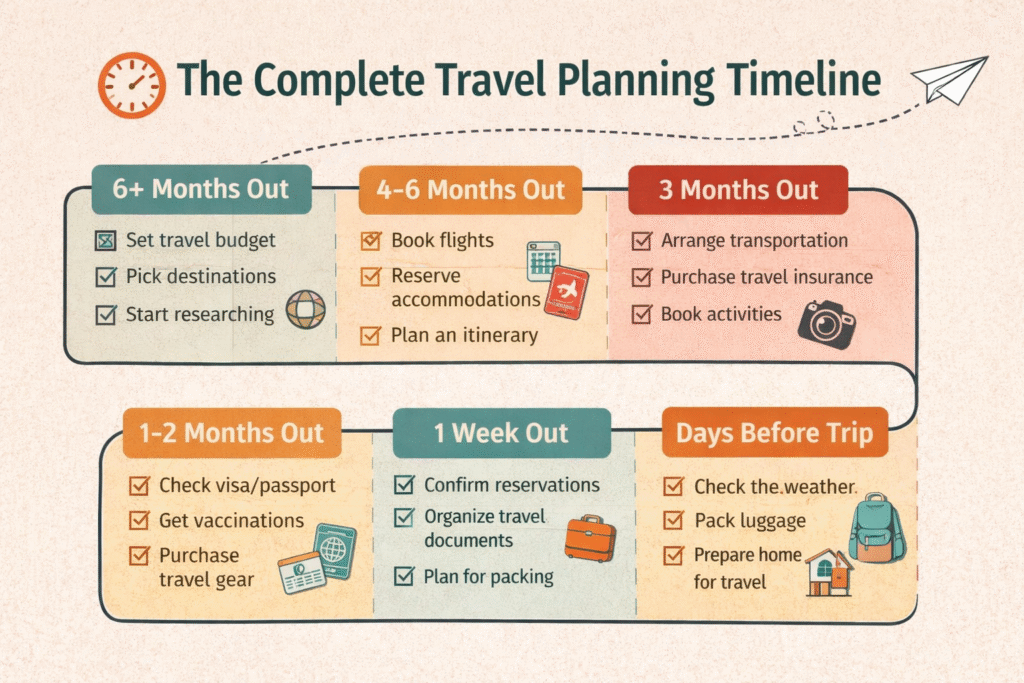
The single biggest planning mistake is starting too late or obsessing too early. Here’s the realistic timeline I follow for different trip types:
For international trips (7+ days):
- 6-9 months before: Choose destination, book flights during fare sales
- 4-6 months before: Secure major accommodations, research visa requirements
- 2-3 months before: Book activities requiring advance reservations, start detailed itinerary
- 1 month before: Finalize daily plans, make restaurant reservations, arrange transportation
- 2 weeks before: Confirm reservations, download maps, notify banks
- 1 week before: Pack, print confirmations, arrange home/pet care
For domestic trips (3-5 days):
- 2-3 months before: Book flights and accommodation
- 1 month before: Plan major activities, make any necessary reservations
- 1 week before: Finalize details, pack, confirm reservations
For weekend getaways:
- 4-6 weeks before: Book transportation and lodging
- 1 week before: Plan activities, make dinner reservations if needed
- 2 days before: Pack and confirm details
The flexibility principle: These timelines work for most trips, but adjust based on your destination. Popular destinations during peak season require earlier booking. Off-season trips to less touristy locations can be planned more spontaneously.
Step 1: Choose Your Destination (The Right Way)

Most people choose destinations backward – they pick a place that looks beautiful on Instagram, then struggle to make it work with their budget, interests, and schedule.
Start with honest self-assessment:
What genuinely interests you? Beach relaxation, cultural immersion, outdoor adventure, food experiences, historical exploration, or urban excitement? Be honest rather than aspirational. If you hate hiking, don’t plan a trip centered on mountain treks just because it seems adventurous.
What’s your actual budget? Factor in flights, accommodation, food, activities, transportation, and a 20% buffer for unexpected expenses. If you have $2,000 total, acknowledge that immediately rather than planning a $3,500 trip and hoping to “make it work.”
How much time do you really have? A 10-day trip isn’t 10 full days – it’s often 8 days after accounting for travel days. Plan for your actual available time, not calendar days.
What’s your energy level and travel style? Some people thrive on 6 AM wake-ups to maximize sightseeing. Others prefer leisurely mornings and fewer daily activities. Neither is wrong, but planning a packed itinerary when you’re a slow traveler guarantees frustration.
Match destinations to your answers:
If you want beach relaxation on $2,000 for a week, consider Mexico’s Pacific coast, Thailand, Portugal, or Greece instead of expensive Maldives or Bora Bora.
If you want cultural immersion on $3,000 for two weeks, consider Morocco, Peru, Vietnam, or Turkey rather than Japan or Norway where the same budget gets you half the time.
If you want outdoor adventure on limited time, choose destinations with concentrated natural attractions like Iceland, New Zealand’s South Island, or Costa Rica rather than vast countries requiring extensive internal travel.
The destination decision framework I use:
First, list 5-10 destinations that genuinely appeal to you based on actual interests, not social media influence.
Second, research approximate costs for each using budget travel sites and travel blogs. Include flights, accommodation, daily expenses, and activities.
Third, check visa requirements, vaccination needs, and current travel advisories for each destination.
Fourth, consider seasonal factors – weather, crowds, and price fluctuations. The “best” destination in July might be miserable in November.
Fifth, evaluate each destination against your available time. Can you reasonably see what you want in your timeframe, or will you spend half the trip in transit?
Finally, choose the destination that scores highest across budget, interests, requirements, season, and time rather than the one with the prettiest photos.
Step 2: Set a Realistic Budget (With Actual Numbers)
Most travel budgets fail because they’re aspirational rather than realistic. Here’s how to create a budget you’ll actually stick to:
Calculate your total available funds:
Start with what you can actually spend without going into debt or depleting emergency savings. Travel shouldn’t create financial stress that outlasts the memories.
Break down major expense categories:
Transportation to/from destination typically consumes 30-40% of total budget for international trips, 20-30% for domestic trips. Search flights now even if not booking yet – this gives you real numbers instead of guesses.
Accommodation usually represents 25-35% of total budget. Research actual hotel and Airbnb prices for your destination and dates. Multiply nightly rates by number of nights for realistic totals.
Food costs vary wildly by destination. Budget travelers can eat for $15-25 daily in Southeast Asia, $30-50 in Eastern Europe, $50-75 in Western Europe, and $40-60 in the US. Research actual restaurant prices and grocery costs for your destination.
Activities and entrance fees add up faster than expected. Major attractions often cost $15-50 each. Guided tours run $50-150. Adventure activities like diving or paragliding cost $75-200. List activities you definitely want to do and research actual prices.
Local transportation within your destination depends on infrastructure and distance. Public transit in cities costs $5-15 daily. Rental cars cost $30-60 daily plus gas. Private transfers and taxis add up quickly if relied upon.
Add critical buffers:
Include a 20% contingency for unexpected expenses. Missed connections, medical issues, opportunity activities, and underestimated costs happen regularly.
Factor in home expenses that don’t pause during travel: pet boarding ($25-50 daily), plant care, subscription services you’re still paying for, and bills due during your trip.
Budget example for 10-day European trip:
Let’s say you have $4,000 total available funds for a European trip. Here’s realistic allocation:
Roundtrip flights: $800 (book during sales, flexible dates)
Accommodation (9 nights at $110/night): $990
Food (10 days at $50/day): $500
Activities and entrance fees: $400
Local transportation: $200
Home pet boarding (10 days at $40/day): $400
Miscellaneous and shopping: $300
Emergency buffer (20%): $410
Total: $4,000
This is realistic because:
Flight cost reflects actual sale prices monitored for 2-3 months. Accommodation averages mid-range hotels and Airbnbs in secondary European cities. Food budget allows café breakfasts, casual lunches, and nice dinners. Activities cover major attractions plus a few guided tours. Transportation uses public transit primarily with occasional taxis.
Budget red flags to avoid:
Assuming you’ll “find cheap food” without researching actual restaurant prices in your destination. Street food in Bangkok costs $2-3 per meal; “cheap food” in Zurich costs $15-20 per meal.
Forgetting about transportation between cities within your destination. That “cheap” European trip becomes expensive when you discover trains cost $50-100 per segment.
Underestimating activity costs by only budgeting for entrance fees while ignoring equipment rentals, guides, or transportation to reach activities.
Planning to “spend money once I’m there” without designating specific amounts for different expense categories. This leads to overspending on early activities and running out of budget later.
Step 3: Book Flights Strategically
Flight booking deserves its own section because it’s typically your largest single expense and offers the most savings potential.
When to book for best prices:
For international flights, book 3-6 months in advance for optimal pricing. Airlines typically release seats 11 months out with high prices, drop prices 4-6 months before departure, then raise them as seats fill.
For domestic flights, book 1-3 months in advance. Domestic pricing follows shorter cycles with sweet spots 4-7 weeks before departure.
For peak season or holidays, book 6-9 months in advance. Summer Europe trips, Christmas destinations, and Chinese New Year travel book up early with limited price drops.
Exception to these rules: Last-minute deals exist but are unreliable for planning. If you have complete flexibility and can depart within 72 hours, you might snag deals. Otherwise, don’t count on them.
Flight search strategy that actually works:
Start with Google Flights to survey general price ranges and identify cheapest travel dates. Use the calendar view to spot price patterns – often flying Tuesday-Thursday saves $100+ versus weekend departures.
Set up price alerts on Google Flights, Hopper, and Scott’s Cheap Flights for your specific route. You’ll receive notifications when prices drop.
Search in incognito/private browsing mode. Some airlines raise prices based on browsing history, though this is less common than previously.
Consider nearby airports. Flying into Oakland instead of San Francisco, or Bergamo instead of Milan, can save $100-300 while adding only 1-2 hours of ground transportation.
Be flexible with dates by ±3 days if possible. A Wednesday departure instead of Friday often saves $150+. A Tuesday return instead of Sunday saves similarly.
Book directly with airlines rather than third-party sites when prices are equal. Direct bookings simplify changes, cancellations, and customer service. Only use third-party sites when they’re significantly cheaper and you’re certain about dates.
The mistake everyone makes:
Waiting for the “perfect” price and missing good prices while holding out for great prices. If you find flights within your budget that work for your dates, book them. The $50 you might save waiting isn’t worth the stress and risk of prices increasing $200.
Budget airline considerations:
Low-cost carriers (RyanAir, EasyJet, Spirit, Frontier) offer genuinely cheap base fares but charge for everything else. Add fees for bags, seat selection, boarding priority, and you often end up near major airline prices with worse service.
Use budget airlines strategically: for short flights (under 3 hours) where comfort matters less, for routes where major airlines are expensive, and when traveling with only a personal item (avoiding bag fees).
Avoid budget airlines for: long flights (comfort matters over 3+ hours), complex itineraries (schedule changes and cancellations are harder to rebook), and when checking bags (fees often exceed savings).
Step 4: Choose and Book Accommodation
Accommodation dramatically impacts both your budget and your experience. The cheapest option isn’t always the best value.
Accommodation types and when to choose each:
Hotels work best when:
- You want daily housekeeping and amenities
- You’re staying 1-3 nights (setup time for Airbnbs isn’t worth it)
- You prefer predictable quality and customer service
- Loyalty programs offer you status benefits or free nights
Airbnbs and vacation rentals work best when:
- You’re staying 4+ nights (better value at longer durations)
- You want kitchen access to save money on meals
- You’re traveling with family/groups (renting whole apartments costs less than multiple hotel rooms)
- You prefer living like a local in residential neighborhoods
Hostels work best when:
- You’re traveling solo and want to meet people
- You’re on a tight budget (under $50/night accommodation)
- You’re young or young-at-heart (most hostel guests are 18-35)
- You’re staying in expensive cities where hotel costs are prohibitive
Location trumps everything else:
I’d rather stay in a mediocre hotel in an excellent location than a beautiful hotel requiring 45-minute commutes to everything I want to see.
How to evaluate location:
Pull up a map and mark your planned activities, restaurants, and must-see attractions. Look for accommodation near clusters of pins.
Research public transportation access. Staying near a metro station in a large city provides easy access everywhere. Staying in areas requiring taxis inflates your daily budget.
Read recent reviews (within 6 months) specifically mentioning neighborhood safety, noise levels, and walkability. One traveler’s “vibrant neighborhood” is another’s “too noisy to sleep.”
Use Google Street View to actually see the neighborhood. Photos on booking sites show the best angles. Street View shows you reality.
Booking platform strategy:
For hotels, compare prices on Booking.com, Hotels.com, and the hotel’s direct website. Often the direct website matches third-party prices while offering better cancellation terms or loyalty points.
For Airbnb, book directly through Airbnb. Despite higher service fees than alternatives like VRBO, Airbnb provides better guest protection and customer service.
For hostels, use HostelWorld for the best selection and verified reviews, or book directly with the hostel if you’re certain of dates.
Red flags to avoid:
Hotels or Airbnbs with no reviews from the last 3 months suggest declining quality or inactive management.
Accommodations with 4+ stars overall but recent reviews mentioning cleanliness issues, safety concerns, or maintenance problems. Ignore the average rating – recent reviews matter most.
“Too good to be true” pricing. If every other hotel in the area costs $150/night and one costs $60, there’s a reason. Usually it’s location (far from attractions), quality (serious maintenance issues), or scams (fake listings).
Airbnbs with house rules mentioning “no noise after 8 PM” or extensive cleaning requirements. These hosts are problematic and will nickel-and-dime you over minor issues.
Step 5: Research and Plan Your Itinerary
This is where most travelers either under-plan (wandering aimlessly) or over-plan (scheduling every hour). The sweet spot balances structure with flexibility.
The daily activity framework I use:
Each day should include one major activity, one-two minor activities, and free time for spontaneity. This prevents burnout while ensuring you see priorities.
Major activities are experiences requiring 3-5 hours: visiting major museums, taking guided tours, hiking to viewpoints, food tours, or day trips to nearby towns.
Minor activities require 1-2 hours: exploring specific neighborhoods, visiting markets, having coffee at famous cafés, or seeing smaller attractions.
Free time allows for discovery: stumbling into interesting shops, extending activities that captivate you, resting when tired, or accepting local recommendations.
Creating a realistic itinerary:
List everything you want to do in your destination without worrying about time constraints. Include major sights, restaurants, neighborhoods, activities, and day trips.
Research how long each activity actually takes including travel time to reach it. The Louvre isn’t a 2-hour visit – it’s 3-4 hours minimum plus 30 minutes each way on the metro.
Map all activities geographically and group by location. You’ll notice natural clusters – plan days around geographic zones to minimize transit time.
Assign activities to specific days based on: operating hours/days (many European museums close Mondays), weather appropriateness (save outdoor activities for good weather), and energy requirements (don’t stack three strenuous activities in one day).
Build in rest time. After traveling for 12-24 hours to reach your destination, Day 1 shouldn’t include three major activities. Plan lighter days after particularly demanding days.
The over-planning warning:
I once created a minute-by-minute Paris itinerary: 9:00-12:00 Louvre, 12:15-1:00 lunch at specific café, 1:15-3:00 walk to Sacré-Cœur, 3:00-5:00 explore Montmartre, 5:15-6:30 dinner, 7:00-9:00 Seine river cruise.
Reality: The Louvre was amazing – I spent 4.5 hours there instead of 3. Lunch reservations became impossible to make because I was still in the museum. I was exhausted by 3 PM and needed a break, not a walk to Montmartre. The rigid schedule created stress rather than enhancing the experience.
Better approach:
Morning: Louvre Museum (plan to arrive at opening, spend 3-4 hours)
Afternoon: Lunch in Le Marais, explore the neighborhood
Evening: Depending on energy, either Seine river cruise or relaxed dinner and early night
This structure ensures I see priorities while allowing flexibility based on energy, weather, and unexpected discoveries.
Researching activities effectively:
Read multiple recent blog posts about your destination, not just one. Single sources have biases – multiple perspectives give you balanced understanding.
Watch YouTube walking tours of neighborhoods you’re considering visiting. You’ll get a feel for areas better than photos provide.
Check current TripAdvisor reviews for activities and attractions, focusing on recent reviews (within 3 months). Ignore the overall rating – places change.
Join destination-specific Facebook groups and Reddit communities. Ask locals and recent visitors for current recommendations. These communities often have updated information about closures, renovations, or new openings.
Activities worth booking in advance:
Popular museums and attractions with timed entry (Uffizi in Florence, Sagrada Familia in Barcelona, Anne Frank House in Amsterdam). These sell out weeks in advance during peak season.
Guided tours with limited group sizes. Small-group food tours, walking tours with expert guides, and specialized experiences book up 2-4 weeks in advance.
Unique experiences with limited daily capacity: hot air balloon rides, certain cooking classes, boat tours to popular islands, or adventure activities requiring guides.
Activities that don’t require advance booking:
Most restaurants (unless they’re Michelin-starred or extremely trendy). You can make reservations 2-7 days in advance, often the day before.
General admission museums without timed entry. Yes, you might wait in line, but you maintain schedule flexibility.
City walking tours offered by multiple companies. Something will be available even if your first choice is booked.
Most urban activities like neighborhoods to explore, markets to visit, or parks to enjoy.
Step 6: Handle Travel Logistics
These unglamorous details ruin trips when overlooked and are invisible when handled properly.
Visa and entry requirements:
Check requirements 3-4 months before departure. Processing times vary, and some visas require in-person appointments at consulates.
Use official government websites, not third-party visa services that charge $100+ for application help you don’t need. The US State Department website lists entry requirements for US citizens to all countries.
Some countries require passports valid for 6 months beyond your travel dates. Check this immediately – if your passport expires in 4 months, you may not be allowed to board your flight.
Vaccinations and health preparations:
Schedule appointments at travel medicine clinics 6-8 weeks before departure for required and recommended vaccinations. Some vaccines require multiple doses over several weeks.
Research malaria prevention needs for tropical destinations. Prescriptions for antimalarials must be started before departure.
Get travel insurance that includes medical coverage. Your domestic health insurance often doesn’t cover international medical care, and emergency evacuations cost $50,000+.
Money and banking:
Notify your bank and credit card companies of travel dates and destinations. Otherwise fraud detection systems may freeze your cards when you make foreign transactions.
Get a credit card with no foreign transaction fees. Using cards with 3% foreign transaction fees costs you $150 on $5,000 of spending.
Withdraw local currency at ATMs upon arrival rather than exchanging money at airport kiosks. ATM rates are better, and airport exchange kiosks charge 10-15% premiums.
Carry backup payment methods. Bring two credit cards from different networks (Visa and Mastercard) in case one doesn’t work, plus some US cash as ultimate backup.
Phone and internet:
Check your phone carrier’s international plans. Some offer affordable daily rates ($10/day) or trip packages. Others charge $2.50 per MB making even basic usage expensive.
Consider international SIM cards or eSIMs like Airalo for data-only service. These cost $5-30 for 1-10 GB and provide data in most countries.
Download offline maps for your destination using Google Maps. You can navigate without data by downloading city maps before departure.
Travel documents organization:
Create a folder (physical or digital) with copies of: passport, visas, flight confirmations, hotel reservations, travel insurance policy, vaccination records, credit card numbers, and emergency contacts.
Email yourself copies of all documents. If your phone dies and you lose physical copies, you can access everything from any internet café.
Save critical information offline on your phone including hotel addresses, emergency phone numbers, and basic destination information.
Step 7: Plan Your Packing
Packing deserves its own step because it’s the final opportunity to prepare properly or realize you’ve forgotten something critical.
The core packing principle:
Pack half the clothes you think you need and twice the money. You’ll wear the same favorite items repeatedly while half your suitcase sits unused.
Create a master packing list:
Start 2 weeks before departure and add items as you think of them. This prevents last-minute panic packing.
Organize by categories: clothing, toiletries, electronics, documents, medications, and miscellaneous items.
Check weather forecasts starting one week before departure and adjust clothing accordingly. That “light jacket” might need to be a “winter coat” if temperatures dropped.
The clothing strategy:
Choose a color palette (black, gray, navy, or khaki) so everything coordinates. You can create multiple outfits from fewer pieces.
Plan to wear items multiple times. You don’t need seven completely different outfits for a week-long trip. Three bottoms and five tops create sufficient variety.
Wear your bulkiest items on the plane: heavy jacket, boots, and thick sweater. This saves luggage space.
Pack one outfit in your personal item/day bag in case checked luggage is delayed. Include underwear, socks, one shirt, and essential toiletries.
Essential items everyone forgets:
Medications in original containers with pharmacy labels. This prevents customs issues and ensures you have prescriptions if bottles are questioned.
Power adapters and converters for your destination. US electronics need adapters in most countries, and some need voltage converters.
Reusable water bottle. Buying bottled water daily costs $2-5. A reusable bottle pays for itself immediately.
Portable charger. Your phone will die exploring cities all day. A 10,000 mAh battery pack keeps devices charged.
Small first aid kit with bandages, pain relievers, anti-diarrheal medication, and any prescription medications you take regularly.
Photocopies of passport and credit cards stored separately from originals. If theft occurs, copies expedite replacement.
Check luggage size and weight before leaving home:
Weigh your packed luggage on a home scale. Many airlines enforce 50 lb limits for checked bags and 15-22 lb limits for carry-ons.
Measure carry-ons to confirm they meet airline size restrictions (typically 22 x 14 x 9 inches). Oversized bags get gate-checked, sometimes with fees.
Step 8: Final Week Preparations
The week before departure is for confirming details, not making major decisions.
Monday (7 days before departure):
Confirm all reservations: flights (check in online opens 24 hours before), hotels (call or email to confirm), tours and activities (verify meeting times and locations), and restaurant reservations (confirm you’re still on the list).
Check flight status and airport requirements. Some airports now require reservations for security screening during peak times.
Arrange home care: pet boarding, plant watering, mail hold at post office, trash day arrangements if you’ll miss it, and lawn care for longer trips.
Wednesday (5 days before departure):
Fill prescriptions if running low. You don’t want to realize you’re out of critical medication the night before departure.
Pay bills due during your trip. Set up automatic payments or pay early to avoid late fees.
Print confirmations for flights, hotels, and activities. Digital copies are convenient until your phone dies at 2% battery in an unfamiliar city.
Friday (3 days before departure):
Notify neighbors if you’re friendly with them. They can watch for package deliveries or suspicious activity.
Set lights on timers to make home appear occupied.
Hold mail at the post office or have a trusted person collect it.
Sunday (1 day before departure):
Pack everything except items you’ll use Monday morning. This prevents forgetting toiletries and chargers you use until the last minute.
Charge all electronics fully: phone, laptop, camera, portable battery, e-reader, and any other devices.
Prepare clothes for travel day. Choose comfortable shoes, layers for airplane temperature fluctuations, and avoid jewelry that triggers metal detectors.
Set multiple alarms for departure morning. Phone alarm, backup phone alarm, and hotel wake-up call if relevant.
Monday (departure day):
Wake up 3+ hours before flight departure for international flights, 2+ hours for domestic flights. Factor in travel time to airport, security wait times, and buffer for unexpected delays.
Do final sweep of home for items you’ll need: passport, wallet, phone, chargers, medications, glasses/contacts, and jackets.
Adjust thermostat to save energy while away. Set to 55°F in winter (prevents pipes freezing) or 85°F in summer.
Double-check you have wallet, phone, and passport before leaving for airport. These are the three essentials that stop your trip if forgotten.
Common Travel Planning Mistakes to Avoid
Mistake #1: Overpacking your itinerary
New travelers often plan too many activities, assuming they’ll have endless energy. Reality includes jet lag, blisters from walking, unexpected weather, and the need for downtime.
Fix: Plan 60% of what you think you can handle. If you believe you can see four major sights daily, plan for two. You’ll add activities spontaneously when you have energy.
Mistake #2: Booking non-refundable everything to save money
Saving $50 on a non-refundable hotel seems smart until life happens: work emergencies, illnesses, family situations, or even better opportunities that conflict with rigid plans.
Fix: Pay slightly more for flexible bookings on major expenses (flights and hotels). Save money on smaller items like tours and activities where cancellation costs are minor.
Mistake #3: Planning around “best time to visit” without considering your preferences
Every destination guide says “best time to visit Destination X is April-June.” But these recommendations prioritize weather over crowds, costs, and your personal preferences.
Fix: Consider your priorities. Hate crowds? Visit during shoulder season even if weather is less perfect. On a budget? Visit during off-season and save 40% despite rain. Want perfect weather? Accept peak-season crowds and costs.
Mistake #4: Underestimating transportation time
Google Maps says the museum is “30 minutes away.” But that’s 30 minutes of driving, not accounting for walking to metro, waiting for trains, navigating transfers, and walking from station to museum – actually 60 minutes.
Fix: Add 50% to estimated transportation times for realistic scheduling. A “30-minute” journey becomes 45 minutes in your itinerary.
Mistake #5: Booking hotels based on overall ratings instead of recent reviews
A hotel with 4.5 stars earned over 5 years might have declined significantly. Recent 2-star reviews mention bedbugs, but the overall rating remains high from older reviews.
Fix: Ignore overall ratings. Read reviews from the last 3-6 months only. Sort by “most recent” not “most helpful.”
Mistake #6: Forgetting about time zones and jet lag
Booking a 9 AM walking tour the day you arrive after an overnight flight seems fine until you’re struggling to stay awake at 11 AM.
Fix: Build in recovery time. First day after overnight flights should include only light activities or free time to adjust.
Mistake #7: Not verifying opening hours and closed days
Planning to visit a museum on Monday without checking it closes Mondays. This happens constantly and wastes entire days.
Fix: Check current operating hours on official websites within 2 weeks of your trip. Hours change seasonally and museums close for renovations.
Travel Planning Tools and Resources
Flight booking and tracking:
- Google Flights: Best for flexible date searching and price tracking
- Skyscanner: Good for multi-city trips and comparing various route options
- Hopper: Excellent price prediction and alerts
- Scott’s Cheap Flights: Email alerts for genuine deal
Accommodation:
- Booking.com: Huge selection, good filters, decent cancellation policies
- Airbnb: Apartment rentals and unique stays
- HostelWorld: Best hostel selection and verified reviews
- Hotel Tonight: Last-minute hotel deals (genuinely useful for spontaneous trips)
Itinerary planning:
- Google Maps: Mark all your planned activities, restaurants, and hotels to visualize routing
- TripIt: Automatically organizes confirmation emails into cohesive itineraries
- Wanderlog: Collaborative trip planning with fellow travelers
- Rome2Rio: Figures out transportation between any two points worldwide
Research and reviews:
- Travel blogs (search “destination name + travel guide + 2026”)
- YouTube (search “destination name walking tour” for neighborhood previews)
- Reddit destination subreddits (r/tokyo, r/London, etc.)
- TripAdvisor (for current reviews despite annoying interface)
Money and budgets:
- Trail Wallet: Simple daily expense tracking while traveling
- XE Currency: Accurate exchange rates offline
- Splitwise: Tracking shared expenses with travel companions
Communication:
- Airalo: eSIM data plans for most countries
- Google Translate: Download languages for offline translation
- WhatsApp: Most of the world uses this for messaging
Frequently Asked Questions
How far in advance should I start planning a trip?
For international trips, start 6-9 months in advance to get best flight prices and accommodation selection. For domestic trips, 2-3 months is sufficient. Weekend getaways can be planned 4-6 weeks ahead. However, you can successfully plan trips in less time – these ranges optimize for best prices and availability.
How do I plan a trip on a tight budget?
Choose affordable destinations (Southeast Asia, Eastern Europe, Central America), travel during shoulder or off-season for lower prices, stay in hostels or budget hotels, use public transportation instead of taxis, eat at local restaurants not tourist areas, and prioritize free activities like hiking, beaches, and exploring neighborhoods over expensive tours.
Should I book hotels in advance or find them when I arrive?
Book major city accommodations in advance, especially during peak season. You can stay flexible in less touristy areas or during off-season by booking 2-3 days ahead or upon arrival. Balance advance booking (reduces stress, ensures availability) with flexibility (allows spontaneous route changes).
How much money should I budget per day?
Budget travelers can manage $40-60 daily in affordable destinations (Southeast Asia, Central America, Eastern Europe), $60-100 in mid-range destinations (Southern Europe, South America), and $100-150+ in expensive destinations (Western Europe, Japan, Australia, Scandinavia). This covers accommodation, food, and activities but not flights.
What’s the best way to exchange currency?
Use ATMs at your destination for best exchange rates. Avoid airport currency exchange kiosks (10-15% worse rates than ATMs), exchanging money before you leave home (unnecessary and expensive), and using credit cards at establishments that ask “charge in USD or local currency?” – always choose local currency.
How do I stay safe while traveling?
Research neighborhood safety before booking accommodation, keep valuables in hotel safes not visible in your room, use legitimate taxis or rideshare apps not unmarked vehicles, avoid displaying expensive jewelry or electronics conspicuously, trust your instincts about situations and people, stay aware of surroundings especially in crowded tourist areas, and keep digital and physical copies of important documents separate from originals.
Should I buy travel insurance?
Yes for international trips, especially expensive trips or trips involving adventure activities. Travel insurance covers medical emergencies abroad (potentially $50,000+), trip cancellations due to illness or family emergencies, lost or delayed luggage, and emergency evacuations. Skip insurance for inexpensive domestic trips with refundable bookings.
How do I deal with jet lag?
Adjust sleep schedule 2-3 days before departure, stay hydrated during flight and avoid alcohol, set watch to destination time zone when you board, get sunlight exposure upon arrival, stay awake until local bedtime even if exhausted, and consider melatonin supplements for first 2-3 nights (consult doctor first).
Creating Your Personal Planning Style
After reading this guide, you might feel overwhelmed by the number of steps and decisions involved in travel planning. Here’s the truth: not every trip requires every step.
Weekend getaways need minimal planning – book accommodation and transportation, identify 2-3 activities you definitely want to do, and leave the rest flexible.
Week-long vacations benefit from moderate planning – research thoroughly but don’t schedule every hour. Know your priorities, book time-sensitive activities, and maintain flexibility for spontaneity.
Multi-week trips or complex itineraries require comprehensive planning – especially when visiting multiple destinations, coordinating with travel partners, or traveling to challenging destinations with visa requirements.
Develop your planning style by:
Starting with thorough planning for your first few trips until you understand your preferences and common mistakes.
Gradually reducing planning intensity as you gain experience and confidence.
Recognizing which aspects of planning you enjoy (researching restaurants, mapping walking routes, finding unique accommodations) and which you find tedious – then focusing energy on what matters to you.
Learning from each trip what you over-planned, what you under-planned, and what balance works for your travel style.
Start Planning Your Next Adventure
The best travel planning balances preparation with flexibility, structure with spontaneity, and dreams with realistic budgets.
Don’t wait for the perfect time or the perfect amount of money. Start with the resources you have, the time you can carve out, and the destinations that genuinely excite you.
Your action plan for the next 7 days:
Day 1: Choose your destination using the framework in Step 1
Day 2: Research realistic budget using Step 2 guidelines
Day 3: Search flights and set price alerts
Day 4: Research accommodations and shortlist options
Day 5: Outline rough itinerary with must-see priorities
Day 6: Check visa requirements and travel advisories
Day 7: Make your first booking (flights if prices are good, accommodation if you’re certain of dates)
Planning your trip is part of the adventure. Enjoy researching restaurants you’ll visit, imagining neighborhoods you’ll explore, and anticipating experiences that will become memories.
The world is waiting. Start planning today, book that trip, and transform dreams into itineraries and itineraries into unforgettable experiences.
Ready to begin? Open a spreadsheet or notebook, set aside 30 minutes, and work through Step 1 of this guide. Your next adventure starts with a single planning decision.