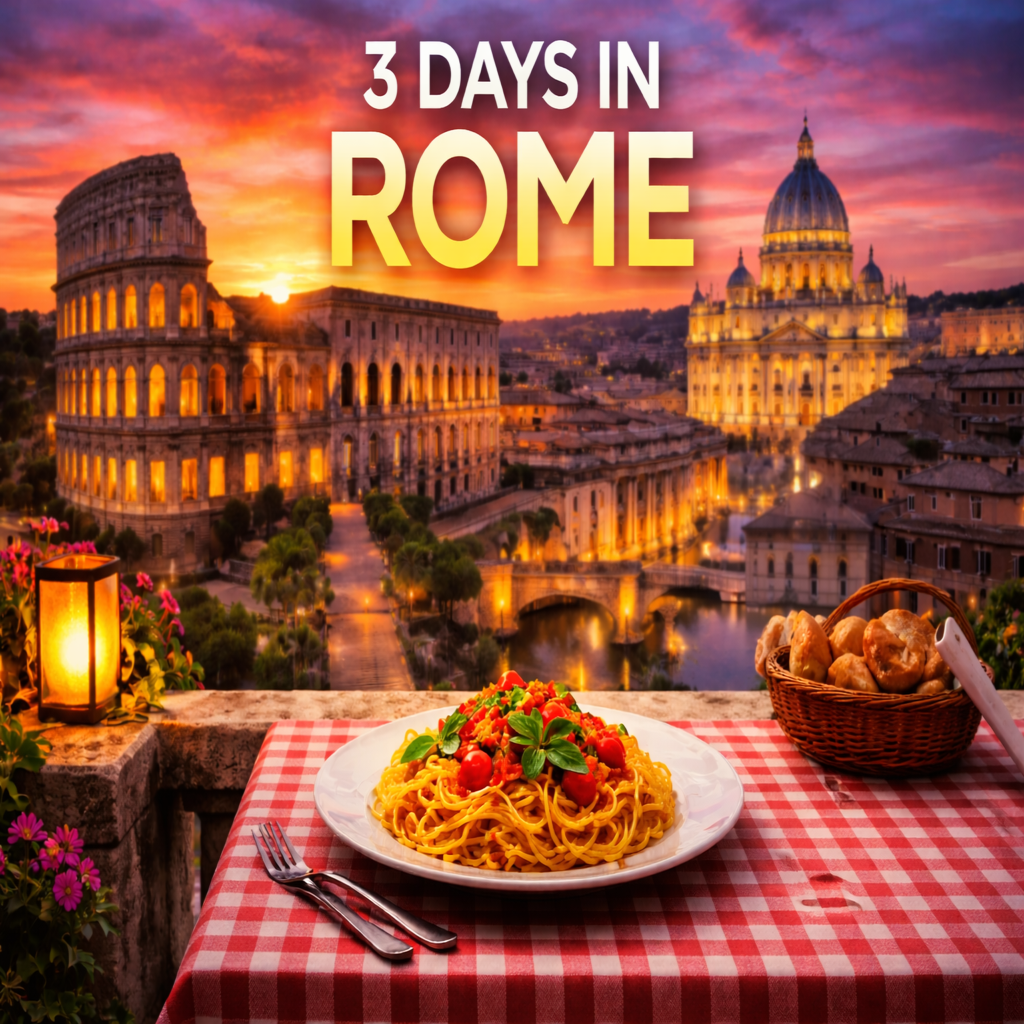
Three days in Rome is an exercise in magnificent inadequacy. The city has been accumulating greatness for nearly three thousand years — layer upon layer of republic, empire, medieval commune, Renaissance papacy, Baroque spectacle, and living modern capital, each civilization building on and over and sometimes through the one that preceded it — and three days allows you to experience perhaps the finest surface of this accumulation while understanding, with increasing clarity as the days pass, that you are standing on something of essentially infinite depth.
This is not a reason to feel inadequate. It is a reason to feel fortunate — because the specific pleasure of Rome is precisely this quality of inexhaustibility, the sense that every street turned and every church entered and every piazza discovered adds to rather than diminishes the remaining store of extraordinary things waiting to be found. Paris gives you its best things in the first twenty-four hours. Florence can be comprehended, at least intellectually, in two or three days of serious attention. Rome resists comprehension entirely and is better for it. Three days in Rome will leave you more curious about the city than when you arrived, and this is the correct response to a city that has been inspiring curiosity for three millennia.
This itinerary makes the most of those three days. It covers the genuinely essential and genuinely magnificent — the Colosseum, the Roman Forum, the Vatican, the Sistine Chapel, the Pantheon, the Borghese Gallery, the great Baroque piazzas — with the practical booking and timing strategies that turn these experiences from exhausting tourist ordeals into the genuinely moving encounters with human greatness that they are meant to be. It eats extremely well. It finds time for the unscheduled, the incidental, and the specifically Roman pleasures — the espresso at a marble counter, the afternoon in a piazza doing nothing in particular, the evening walk through neighborhoods of extraordinary beauty — that cannot be planned but must be allowed for.
It also tells you, directly and honestly, what to skip or deprioritize — because Rome is the city where poor planning costs the most, where the wrong choice of restaurant near the Colosseum can ruin a morning, where the decision not to book the Vatican in advance can consume three hours of a day that needed those hours for something irreplaceable.
Three days in Rome. Let us begin.
Before You Arrive: Essential Rome Practicalities
Getting There and Into the City
Rome has two airports. Leonardo da Vinci International Airport (FCO), universally known as Fiumicino, is the main international hub, 32 km southwest of the city center. The Leonardo Express train connects Fiumicino directly to Roma Termini (the city’s main railway station) in 32 minutes for €14 — the fastest and most reliable airport connection. Regional trains (FL1 line) connect to several suburban Rome stations for approximately €8 but take longer and require a connection for the historic center. Taxis charge a fixed fare of €50 from Fiumicino to any address within the Aurelian Walls (the historic center) — confirm this flat rate before departure. Uber operates in Rome but with limited availability.
Ciampino Airport (CIA), 15 km southeast of the city, handles low-cost carrier traffic. Terravision and SIT Bus Shuttle connect Ciampino to Roma Termini in approximately 45 minutes for €5–€7. Taxis charge a fixed rate of €31 from Ciampino to the historic center.
Getting Around Rome
Rome’s historic center is compact enough to walk between most major attractions — the Colosseum to the Pantheon is approximately 2 km on foot; the Pantheon to the Vatican is approximately 3 km. Walking is by far the most rewarding mode of transport in Rome, both for the practical reason that traffic and narrow streets make other options frequently slower, and for the cultural reason that Rome’s finest experiences — the sudden view of the Pantheon around a corner, the fragments of ancient columns incorporated into the base of a medieval church, the fountain in an unexpected piazza — are discoveries made on foot.
The Rome Metro has two main lines (A and B, with a partial C line). Line A connects the Vatican area (Ottaviano-San Pietro) to the Spanish Steps (Spagna), Barberini, and Termini. Line B connects the Colosseum (Colosseo) to Termini. For a three-day visit focused on the historic center, the Metro is rarely necessary — most major attractions are within comfortable walking distance of each other.
Buses cover the city comprehensively. The 40 and 64 express buses connect Termini to the Vatican and are useful for covering this distance quickly. Taxis and Uber serve the entire city.
Booking in Advance: The Non-Negotiable List
Rome requires more advance booking than almost any other major city in Europe. Failing to book the following will cost you hours of queuing or, in some cases, missed entry entirely:
The Vatican Museums and Sistine Chapel (biglietteriamusei.vatican.va — book at least 2–3 weeks in advance in peak season; the queue without advance booking regularly exceeds 3 hours). The Borghese Gallery (galleriaborghese.it — entry is strictly timed at 2-hour intervals with a maximum of 360 visitors per session; this is one of the most rigorously enforced booking systems in Rome and walk-ups are frequently impossible). The Colosseum, Roman Forum, and Palatine Hill (parcocolosseo.it — pre-book to skip the walk-up queue, which can be substantial). The Capuchin Crypts at Santa Maria della Concezione (book online for a small time savings). Raphael’s Rooms in the Vatican, if you wish to visit the papal apartments separately.
The Roma Pass (48 or 72 hours, covering unlimited public transport plus free or discounted entry to museums and sites) can be worth purchasing depending on your planned itinerary — calculate the individual costs of your intended sites before buying.
Neighborhoods
Rome’s historic center is broadly divided by the Tiber River — the Vatican and Trastevere on the west (Riva Destra — Right Bank), the ancient monuments, Campo de’ Fiori, the Jewish Ghetto, the Pantheon neighborhood, Piazza Navona, and the Spanish Steps on the east. The Colosseum and Roman Forum are southeast of the center, a twenty-minute walk from the Pantheon. Staying anywhere within the Aurelian Walls puts you within walking distance of the major monuments; the neighborhoods of the centro storico, Trastevere, Prati (near the Vatican), and Monti (near the Colosseum) are the most characterful and most convenient for a three-day visit.
What to See and What to Skip in Rome
Before the day-by-day itinerary, the honest assessment of Rome’s major attractions — what is genuinely essential, what is overrated, and what can be seen from the outside without purchasing an interior ticket.
See: The Borghese Gallery. The finest single collection of Baroque sculpture in the world — Bernini’s Apollo and Daphne, Pluto and Persephone, and David, along with Canova’s Pauline Bonaparte and a superb collection of Caravaggio paintings — displayed in a villa of extraordinary beauty. The 2-hour timed entry format enforces the contemplative pace the collection deserves. Unmissable. Book weeks in advance.
See: The Pantheon, free at any hour. One of the most perfect buildings ever constructed, its oculus open to the sky after nearly 2,000 years of continuous use. There is no bad time to visit but dawn and dusk are the finest — the light through the oculus is a complete architectural experience in any weather.
Skip: The Mouth of Truth (Bocca della Verità) as a primary attraction. The ancient marble mask incorporated into the portico of Santa Maria in Cosmedin has a charming legend (a liar’s hand bitten off by the mouth) and produces a reliable 40-minute queue of people photographing themselves placing their hands inside it. The church itself is beautiful and almost always overlooked by the queue outside. Enter the church, look at the lovely Cosmatesque floor and ancient columns, appreciate the building for what it actually is. Skip the photograph.
See: The Capitoline Museums. The world’s oldest public museums, founded in 1471, housing the finest collection of ancient Roman sculpture outside the Vatican and including the original bronze Marcus Aurelius equestrian statue, the Capitoline Wolf, and the extraordinary views of the Roman Forum from the terrace. Significantly less crowded than the Vatican and equally significant.
Skip: The Trevi Fountain at midday. One of the finest Baroque fountains in the world — and genuinely magnificent — but accessible only through a scrum of tourists from approximately 9 AM to 10 PM. Visit it at 5 AM or 11 PM when the square is quiet and the fountain is lit and it is possible to actually hear the water and appreciate the extraordinary theatrical quality of its architecture. Throwing the coin at any hour remains entirely optional and entirely worth doing.
See: Santa Maria Maggiore and the Roman Churches. Rome’s early Christian and medieval churches — Santa Maria Maggiore, San Clemente (with its extraordinary three layers of history descending from the 12th century to a 1st-century Mithraic temple), Santa Cecilia in Trastevere, San Luigi dei Francesi (with three Caravaggio paintings in the Contarelli Chapel that are among the finest in Rome) — are free, uncrowded, and collectively constitute one of the finest and most overlooked museum experiences in the city.
Skip: The Hard Rock Café and the restaurants with photographs on the menus immediately adjacent to the Colosseum. The single most reliable way to eat badly and expensively in Rome is to eat in the tourist restaurant belt surrounding the major monuments. Walk five minutes in any direction.
Day One: Ancient Rome — The Colosseum, Forum, and Palatine
The first day is dedicated to ancient Rome — the Colosseum, the Roman Forum, and the Palatine Hill, which together constitute the most significant and most emotionally affecting archaeological landscape in the Western world. This is a morning and early afternoon of walking on stones that Romans walked two thousand years ago, in the ruins of a civilization whose influence still shapes every aspect of the world you inhabit, and it requires time, attention, and the willingness to be genuinely moved.
Early Morning: The Colosseum at Opening Time
The Colosseo — the Flavian Amphitheatre, commissioned by Emperor Vespasian in 72 AD and completed by his son Titus in 80 AD, the largest amphitheatre ever built, capable of holding 50,000–80,000 spectators — is Rome’s most iconic monument and one of the most visited buildings in the world. It is also, when experienced at opening time with a pre-booked timed entry, one of the most genuinely overwhelming architectural encounters available in European travel.
Arrive at 9 AM (opening time) with your pre-booked ticket from parcocolosseo.it. The interior of the Colosseum — once you have walked through the vaulted corridors to the arena floor level and looked up at the surviving tiers of seating and the hypogeum (the underground network of tunnels and chambers where gladiators and animals were held before being raised by elevators to the arena) — produces a quality of historical vertigo that no photograph or film recreation prepares you for. This is the building where 400,000 people died in recorded spectacles over four centuries. The extraordinary, brutal beauty of the architecture — its three tiers of arches incorporating Doric, Ionic, and Corinthian columns in sequence, its concrete vaulting of Roman engineering genius — is inseparable from the violence it was designed to contain and present.
Allow 90 minutes for the Colosseum interior. The combined Colosseum ticket includes entry to the Roman Forum and Palatine Hill on the same day. Audio guides (approximately €7) or the official Colosseum app provide excellent contextual information.
Mid-Morning: The Roman Forum and Palatine Hill
Walk from the Colosseum west along the Via Sacra into the Roman Forum — the 600-meter-long valley between the Capitoline and Palatine Hills that was the civic, religious, and commercial heart of ancient Rome for nearly a thousand years. The Forum as it stands today is a complex of ruins ranging from the well-preserved (the Temple of Saturn, whose eight granite columns have stood for 2,500 years; the Arch of Titus, commemorating the Jewish War of 70 AD; the Arch of Septimius Severus) to the barely standing (the foundations of the Basilica Julia, the outline of the Vestal Virgins’ house) to the completely vanished (most of the Forum’s original buildings, pillaged for stone throughout the medieval period).
Walking the Via Sacra — the most important street in the ancient world, along which triumphal processions passed for a thousand years — in either direction is one of the finest walks in Rome. The Forum is best experienced slowly, without a fixed route, pausing to read the information boards at each major monument and allowing the accumulation of two and a half millennia of history to settle gradually.
Climb the Palatine Hill — the mythological birthplace of Rome, where Romulus founded the city in 753 BC according to tradition, and where the emperors built their palace complexes overlooking the Forum below — via the path at the Forum’s south side. The Palatine provides the finest elevated view over the Forum and the Colosseum and houses the remains of the imperial palaces, the Domus Augustana and the Domus Flavia, whose scale — even in ruin — communicates the extraordinary ambition of Roman imperial self-presentation. The Farnese Gardens at the Palatine’s northern end, planted in the 16th century over the ruins of Tiberius’s palace, are among the most pleasant garden spaces in central Rome.
Allow two to three hours for the Forum and Palatine combined.
Lunch: Monti Neighborhood
Walk north from the Forum into the Monti neighborhood — Rome’s most characterful and most genuinely local historic center district, its narrow streets of wine bars, independent restaurants, and artisan workshops providing the finest lunch environment within walking distance of the ancient monuments.
The Monti neighborhood is the correct antidote to the tourist-facing establishments around the Colosseum. At a traditional trattoria on Piazza della Madonna dei Monti or the surrounding streets, a lunch of cacio e pepe (pasta with Pecorino cheese and black pepper — Rome’s most beloved pasta, deceptively simple and frequently extraordinary when made well), abbacchio alla romana (Roman-style lamb with herbs and white wine, available mainly in spring), and a glass of house Frascati costs approximately €18–€25 per person and will be one of the finest meals of the trip.
Afternoon: The Capitoline Museums
From Monti, walk up the Capitoline Hill — via the cordonata (the gently ramped staircase designed by Michelangelo) to the Piazza del Campidoglio, also designed by Michelangelo and one of the finest piazzas in Rome — to the Capitoline Museums (museicapitolini.org, entry approximately €16).
The Capitoline Museums divide between two palaces facing each other across the Piazza del Campidoglio, connected by an underground passage. The Palazzo Nuovo houses the Capitoline Gaul, the Capitoline Venus, and the extraordinary Hall of Emperors — a room of Roman portrait busts so psychologically acute and so beautifully realized that spending thirty minutes moving from face to face, matching the physiognomies to the historical characters you know, is one of Rome’s most absorbing experiences. The Palazzo dei Conservatori houses the original bronze Marcus Aurelius equestrian statue (the finest equestrian sculpture from antiquity, removed from the piazza to protect it from weathering, replaced by a copy), the Capitoline Wolf (the Etruscan bronze of the she-wolf suckling Romulus and Remus — Rome’s founding symbol), and the Pinacoteca Capitolina (paintings by Caravaggio, Titian, Veronese, and Guercino that would be major attractions in any other city but are overlooked here given the sculpture collection’s quality).
The terrace of the Palazzo Senatorio at the back of the Capitoline provides the finest straight-on view of the Roman Forum from above — the best photograph of the Forum available from any public viewpoint.
Allow two to three hours.
Evening: Trastevere and the Roman Dinner Ritual
Take a taxi or walk south to Trastevere — the neighborhood on the right bank of the Tiber that is the most atmospheric and most traditionally Roman of all the historic center’s residential quarters. Its medieval street plan, its ivy-covered buildings, its neighborhood piazzas (the Piazza di Santa Maria in Trastevere, with the 12th-century basilica lighting the square gold at night, is one of the most beautiful evening spaces in Rome), and its density of excellent restaurants and bars make it the finest evening neighborhood for a first Rome visit.
The Basilica di Santa Maria in Trastevere — founded according to tradition in the 3rd century AD and one of the oldest churches in Rome, its 12th-century mosaics in the apse among the finest Byzantine-influenced religious art in the city — is best entered in the early evening when the gold of the mosaics catches the late light. Entry is free.
Dinner in Trastevere at a traditional Roman trattoria — avoiding the most tourist-facing establishments on the main piazza and walking one or two streets deeper into the neighborhood for the real thing. The Roman dinner requires: a carciofi alla giudea starter (the Jewish-style deep-fried artichoke, originating in the adjacent Jewish Ghetto, the finest fried thing in Rome), a pasta of cacio e pepe or amatriciana (tomato, guanciale cured pork cheek, Pecorino — another of Rome’s defining pasta preparations), a secondo of saltimbocca alla romana (veal with prosciutto and sage in white wine) or supplì (Roman rice croquettes, the finest street food in the city, available fried from many Trastevere restaurants and shops), and a dessert of tiramisù with a glass of limoncello or grappa. The bill for two, with a carafe of house wine, should be €50–€70 at a good Trastevere trattoria.
Day Two: The Vatican — the Greatest Art Repository in the World
The Vatican deserves a full day. This is not hyperbole — the Vatican Museums alone contain approximately 54 galleries and 20,000 works of art on permanent display, and the Sistine Chapel and St. Peter’s Basilica are each individually capable of occupying several hours of serious attention. A rushed half-day Vatican visit is one of the most common and most regrettable mistakes made by first-time Rome visitors. Give it the day it deserves.
Early Morning: Vatican Museums at Opening Time
Pre-book a 9 AM timed entry at biglietteriamusei.vatican.va (entry approximately €20). Arrive fifteen minutes before your slot to clear security. Then do what almost no one does: ignore the signs to the Sistine Chapel and turn left.
The Vatican Museums contain one of the greatest collections of ancient sculpture in the world, and the Cortile Ottagono (Octagonal Courtyard) in the Pio-Clementino Museum — housing the Apollo Belvedere, the Laocoön and His Sons, and the Torso Belvedere — is where to begin. The Laocoön — the 1st-century BC group sculpture of the Trojan priest and his sons being killed by sea serpents, discovered in a vineyard near the Colosseum in 1506 and immediately identified by Michelangelo as the greatest sculpture in existence — is one of the most powerful works of ancient art. Stand in front of it for ten minutes before moving on.
The Gallery of Maps — a 120-meter corridor whose walls are covered in 40 topographical maps of the Italian regions painted between 1580 and 1583, the ceiling painted with scenes from the history of the Church in a scheme of overwhelming decorative complexity — is among the most astonishing single rooms in the Vatican and is usually walked through rather than lingered in. Stop in the center of the gallery and look at the ceiling properly. It will take your breath away.
Raphael’s Rooms — the suite of four rooms frescoed by Raphael between 1509 and 1524 for Pope Julius II — contain the School of Athens in the Stanza della Segnatura (the most famous fresco in the Vatican after the Sistine Ceiling, depicting the philosophers of antiquity in a vast classical hall, with Plato (Leonardo’s face) and Aristotle at the center) and the Fire in the Borgo in the Stanza dell’Incendio di Borgo (whose illusion of architectural depth and spatial drama makes it arguably the more painterly masterwork). Allow at least 45 minutes in the Raphael Rooms.
Mid-Morning: The Sistine Chapel
The Sistine Chapel — the papal chapel whose ceiling was painted by Michelangelo between 1508 and 1512 and whose altar wall he returned to paint with the Last Judgment between 1536 and 1541 — is the most famous painted room in the world and, in person, genuinely exceeds its photographic reputation.
The challenge is the visitors. The Sistine Chapel at 11 AM in high season contains several hundred people simultaneously, speaking is officially prohibited (though rarely enforced), and the crowd management system moves people through at a pace that does not naturally encourage the extended contemplation the paintings deserve. The strategy: arrive early, find a position against the side walls (the security benches along both long sides of the chapel are the finest viewing positions), and look up for as long as you need.
What to look for: The central nine scenes of the ceiling — from the Separation of Light from Darkness above the altar to the Drunkenness of Noah above the entrance — chart the history of the world from creation to the corruption of humanity in nine panels of increasing narrative and compositional sophistication, Michelangelo’s technique and ambition visibly growing as the work progressed and he moved from the entrance panels (painted last, looking back toward the altar) to the Creation of Adam (the most famous single image) and the Separation of Light from Darkness (the simplest and most abstract, painted in a single day at the work’s completion). The ignudi (the twenty nude youths on the architectural thrones between the central scenes) are Michelangelo’s most purely physical expressions of the male figure. The sibyls and prophets in the triangular spandrels are his most psychologically complex. The Last Judgment on the altar wall — painted twenty-three years after the ceiling, by an older, darker, more complex Michelangelo — is a different and equally extraordinary work: Christ as a powerful, almost wrathful figure at the center, the saved ascending to the left and the damned falling to the right, including Michelangelo’s self-portrait on the flayed skin of Saint Bartholomew.
Allow at least 30–45 minutes in the Sistine Chapel. Photography is prohibited — put the phone down and look.
Lunch: Prati Neighborhood
Exit the Vatican Museums and walk into the Prati neighborhood — the grid of streets immediately north of the Vatican, whose combination of good traditional restaurants, excellent pizza al taglio shops, and authentic neighborhood character makes it the finest lunch area near the Vatican. Avoid the restaurants on the Via della Conciliazione (the street leading from St. Peter’s Square to the Tiber — almost entirely tourist-facing and mediocre); walk two or three streets north into Prati proper.
A pizza al taglio lunch — the Roman version of pizza sold by weight from trays behind a counter, cut to order with scissors — at any well-regarded Prati bakery is one of the finest and most Roman casual meals available: a slice of potato and rosemary, a slice of zucchini flower and anchovy, and a square of the classic pomodoro for approximately €7–€10 total.
Afternoon: St. Peter’s Basilica and the Dome
St. Peter’s Basilica — the largest church in the world, built between 1506 and 1626 on the site of the original 4th-century Constantinian basilica over the tomb of Saint Peter — is one of the great architectural achievements of the Renaissance and Baroque periods. The facade by Carlo Maderno, the nave (longer than a modern aircraft carrier), Bernini’s baldachin (the enormous bronze canopy over the papal altar, cast partly from bronze stripped from the Pantheon’s portico — “What the barbarians did not do, the Barberini [the papal family] did”), the dome by Michelangelo and Giacomo della Porta, and the Pietà — Michelangelo’s marble sculpture of the Virgin holding the dead Christ, completed when the artist was 24 years old and now protected behind bullet-proof glass following a 1972 attack — are all of extraordinary quality.
Entry to the basilica is free. The queue through the St. Peter’s Square security can be 30–60 minutes in peak season — time the visit for mid-afternoon when the morning Vatican tour groups have dispersed.
The dome climb (entry approximately €8 on foot up the stairs, €6 by elevator to the drum level with stairs continuing to the lantern) provides the finest close-up view of Michelangelo’s dome from the drum level walkway, a panoramic view over Rome from the lantern at 132 meters, and the remarkable aerial view of the Bernini colonnade’s oval from above — the famous photograph of St. Peter’s Square from directly above, showing the ellipse of 284 columns in its full architectural glory.
Bernini’s colonnade — the two curving arms of 284 travertine columns and 88 pilasters reaching out from the basilica facade to embrace the square — is best appreciated from within the colonnaded space itself, where Bernini’s intention (a church “opening its arms to receive Catholics, to strengthen heretics, and to illuminate the unbelievers”) is physically felt in the enclosure of the oval space.
Evening: Castel Sant’Angelo and the Tiber at Night
Walk south from St. Peter’s Square to the Castel Sant’Angelo — the circular fortress on the Tiber built originally as the mausoleum of Emperor Hadrian (139 AD) and converted by successive popes into a military fortress, papal residence, treasury, and prison. Entry approximately €14. The rooftop terrace provides one of the finest panoramic views over Rome — the dome of St. Peter’s to the west, the bridges of the Tiber below, the city spreading south and east — at a height that makes the architectural relationship between the Vatican and the city immediately comprehensible.
The Ponte Sant’Angelo — the pedestrian bridge lined with Bernini’s angels leading to the Castel — is one of the most beautiful bridges in Rome and one of the finest evening walks in the city. Stand on the bridge at dusk, watch the Tiber catch the last light, and observe the dome of St. Peter’s turning golden in the final minutes before sunset.
Dinner in the Prati neighborhood or back in Trastevere — a carbonara (egg, guanciale, Pecorino, black pepper — the most demanding of the Roman pasta canon, perfect when made correctly and inedible when made with cream, which no authentic version contains), followed by a coda alla vaccinara (oxtail braised in tomato, celery, pine nuts, and dark chocolate — the most Roman of all the city’s secondi, a dish of extraordinary depth that requires the confidence of a trattoria that has been making it for decades).
Day Three: Baroque Rome, the Borghese Gallery, and the Spanish Steps
The third day covers the Rome of the 17th century — the Baroque city of Bernini, Borromini, and Caravaggio, of the great fountains and the grand piazzas, of the art collection that contains the finest Bernini sculptures outside the Vatican and three of the greatest Caravaggio paintings in the world.
Morning: Borghese Gallery — Rome’s Most Extraordinary Collection
The Galleria Borghese (galleriaborghese.it, entry approximately €15 plus €2 booking fee, timed entry every two hours with maximum 360 visitors) is the most important advance booking in Rome and one of the finest museum experiences in the world. The collection — assembled by Cardinal Scipione Borghese, Bernini’s greatest patron and the nephew of Pope Paul V, between 1608 and 1633 — contains six Bernini sculptures, six Caravaggio paintings, and works by Raphael, Titian, Rubens, and Veronese, displayed in a 17th-century villa of extraordinary decorative richness in the Villa Borghese park.
The Bernini sculptures are the unquestionable highlights and constitute the finest single-artist experience in Rome. Apollo and Daphne (1622–1625) — the white marble group in which Apollo reaches Daphne at the exact moment she begins transforming into a laurel tree, her fingers already becoming leaves and bark already forming at her feet — is the most technically extraordinary marble sculpture in existence, the transformation between flesh and vegetable matter rendered in stone with a virtuosity that appears physically impossible. Pluto and Persephone (1621–1622) — Pluto’s fingers pressing visibly into the marble flesh of Persephone’s thigh as she attempts to escape — is equally technically astounding and considerably more disturbing. The David (1623–1624) — depicting the instant before the stone is released, the face contorted in fierce concentration (Bernini’s own face, observed in a mirror while his patron Cardinal Borghese held the mirror and watched him work) — is the most psychologically intense of the three.
The two hours of the timed entry are exactly sufficient for a focused and complete experience of the collection. Do not rush — the Bernini sculptures in particular reward extended looking.
Mid-Morning: Villa Borghese Park and the Pincio Terrace
After the Borghese Gallery, walk through the Villa Borghese park — Rome’s finest and largest urban park, its English landscape garden surroundings providing a complete contrast to the city’s dense urban fabric — to the Pincio Terrace at the park’s southwestern edge. The Pincio terrace provides one of the finest and most comprehensive panoramic views over Rome — from the Gianicolo hill in the south to the Pantheon dome and the Victor Emmanuel Monument in the center to the distant hills of the Castelli Romani on the horizon. On clear days the full extent of the city is visible from a single viewpoint in a way that the city’s typically dense street level rarely allows.
Late Morning: Piazza del Popolo and Santa Maria del Popolo
Descend from the Pincio to the Piazza del Popolo — the great northern gateway to Rome, its oval space centered on an Egyptian obelisk and flanked by the twin churches of Santa Maria dei Miracoli and Santa Maria in Montesanto. The piazza was the first thing travelers arriving from the north saw as they entered Rome for centuries and was designed accordingly — on a scale and with a theatrical self-confidence that announces a city certain of its own magnificence.
Santa Maria del Popolo, in the corner of the piazza beside the ancient Porta del Popolo gate, contains two of Caravaggio’s finest Roman works in the Cerasi Chapel: The Conversion of Saint Paul on the Road to Damascus (in which the conversion is depicted as a purely physical event — a man fallen from a horse, arms thrown up, the horse enormous and indifferent above him) and The Crucifixion of Saint Peter (in which ordinary workmen labor to raise the cross with the old man nailed to it, the scene rendered as pure physical effort without mystical illumination). Both are free. Both will stop you completely. Allow thirty minutes.
Lunch: Campo de’ Fiori and the Jewish Ghetto
Walk south from the Piazza del Popolo through the heart of the historic center to the Campo de’ Fiori — the lively morning market square (the flower, vegetable, and food market runs until approximately 2 PM on weekdays and Saturdays) dominated by the brooding statue of Giordano Bruno, the philosopher burned at the stake here in 1600. The market stalls offer excellent Roman street food: supplì, pizza bianca (the Roman plain flatbread, extraordinary warm from the oven), and seasonal produce.
The adjacent Jewish Ghetto — the neighborhood bounded by the Portico d’Ottavia, the Theater of Marcellus, and the Tiber, where Rome’s ancient Jewish community (the oldest Jewish community in Western Europe, continuously present since the 2nd century BC) was confined for centuries — is the finest lunch neighborhood in central Rome and one of the most historically layered. The Roman Jewish cuisine — carciofi alla giudea, filetto di baccalà (battered and fried salt cod fillets, sold from a few specialist shops), stracciata (ricotta and vegetable frittata), and the extraordinary ricotta and sour cherry tart that is the definitive dessert of the Roman Jewish table — is among the finest and most distinctive cooking in the city.
The Portico d’Ottavia — the ancient Roman covered walkway built by Augustus in 23 BC, its columns partly incorporated into the medieval church of Sant’Angelo in Pescheria — is one of Rome’s most evocative ancient monuments, and the Theater of Marcellus behind it, whose curved exterior wall was converted into a Renaissance apartment building whose residents still inhabit it today, is one of the city’s most extraordinary examples of architectural continuity.
Afternoon: Pantheon, Piazza Navona, and the Baroque Fountains
The Pantheon — the temple to all gods built by Emperor Hadrian between 113 and 125 AD, its concrete dome the largest unreinforced concrete dome in the world, its oculus open to the sky in the center, its proportions (the dome’s diameter exactly equals the distance from oculus to floor, meaning a perfect sphere would fit precisely inside) a masterwork of classical geometry — is the finest single ancient building in Rome and the best-preserved ancient building in the world. Entry approximately €5 (recently introduced after centuries of free entry). The Pantheon is best experienced at opening time or in the evening — during the middle of the day it is exceptionally crowded.
The oculus — the 9-meter circular opening in the dome’s apex, open to rain, sunshine, moonlight, and the occasional pigeon — is the building’s defining element and the source of its specific, profound atmospheric quality. When rain falls through the oculus, the water is drained through 22 small holes in the granite floor, an original Roman drainage system still functioning after nineteen centuries. When sun falls through the oculus, a precise disc of light moves slowly around the interior walls in a way that has led to speculation about the building’s use as a solar calendar.
From the Pantheon, walk the short distance to Piazza Navona — the finest Baroque piazza in Rome and the finest oval public space in Italy, built on the site of the ancient Stadium of Domitian whose shape it preserves. Bernini’s Fountain of the Four Rivers (1648–1651) — the central fountain whose four river gods (the Nile, the Ganges, the Danube, and the Río de la Plata) recline around a central Egyptian obelisk — is the finest fountain in Rome and a masterwork of theatrical spatial organization. The competing story that the figure representing the Río de la Plata shields his eyes from the sight of Borromini’s Sant’Agnese in Agone church on the piazza’s western edge (Bernini’s supposed commentary on his rival’s architecture) is entirely apocryphal and entirely irresistible.
Walk from Piazza Navona to the Trevi Fountain via the Via della Scrofa and the Via della Croce — a twenty-minute walk through the finest section of the historic center, passing the church of Sant’Agostino (with Caravaggio’s Madonna of the Pilgrims, in which the Virgin is depicted as a Roman peasant woman holding a very large child while two kneeling pilgrims with dirty feet reach toward her — simultaneously the most human and most criticized of all his religious paintings) and through neighborhoods of extraordinary Baroque palaces and fountains.
Visit the Trevi Fountain in the late afternoon when the crowds are marginally thinner than midday and the light is at its best on the sculptural program — the central figure of Oceanus riding his triumphal chariot, the flanking allegorical figures, the extraordinary depth of the theatrical architectural backdrop — and throw the coin.
Evening: Spanish Steps and a Final Roman Night
Walk north from the Trevi Fountain to the Spanish Steps — the 135 steps built between 1723 and 1726 connecting the Piazza di Spagna below with the French church of Trinità dei Monti above, the finest Baroque staircase in Rome and one of the finest public stairways in the world. Sitting on the steps in the early evening, watching the city’s social life flow through the piazza below, is one of the great simple pleasures of Rome — free, unhurried, and offering a street-level panorama of the city’s human variety that no monument can replicate.
The final dinner of three days in Rome should be at a restaurant that has earned your trust — perhaps a return to the Monti trattoria, perhaps a new discovery in the Ghetto or Trastevere. Order the cacio e pepe one more time. Order the supplì. Drink the local Castelli Romani white wine. Eat slowly and without hurry, in the specifically Roman understanding that a meal is not a transaction but a ceremony — one of the city’s oldest and most tenaciously preserved traditions, unchanged in its essential character from the banquets that Horace and Livy and Cicero attended in these same neighborhoods two thousand years ago.
After dinner, walk. Walk to the nearest piazza and sit for a while. Walk to the nearest fountain — there is always a fountain — and listen to the water. Walk along the Tiber in the dark, the bridges lit and the domes visible above the roofline, and allow Rome to make its final case for itself in the way it does best: not through any single monument or painting or piazza, but through the cumulative, overwhelming, entirely specific quality of being in a city that has been making this case, successfully, for three thousand years.
You will not feel finished with Rome. You were warned at the beginning. But you will feel — correctly — that three days here have been among the finest days of your traveling life, and that whatever version of the world you return to will be slightly altered by the experience of having stood in a place of such implausible, irreplaceable, and entirely unapologetic greatness.
Three Days in Rome: Practical Summary
Essential advance bookings: Vatican Museums and Sistine Chapel (2–3 weeks ahead minimum in peak season, biglietteriamusei.vatican.va), Borghese Gallery (often 1–2 weeks ahead, galleriaborghese.it — the most strictly enforced booking in Rome), Colosseum and Forum (parcocolosseo.it, 1–2 weeks ahead for peak season). St. Peter’s Basilica and the Pantheon require no advance booking but benefit from early morning visits.
The best free things in Rome: The Pantheon interior (entry fee introduced recently but modest), all of Rome’s Baroque churches (San Luigi dei Francesi, Sant’Agostino, Santa Maria Maggiore, San Clemente, Santa Cecilia — collectively one of the finest free art collections in Europe), the Forum and Palatine views from the Capitoline terrace, all piazzas and fountains, the Pincio terrace view, the Trastevere streets at night, the Tiber walk at any hour.
Roman food essentials: Cacio e pepe and amatriciana (the two essential Roman pasta preparations), supplì (Roman fried rice balls, available from specialist shops and pizzerias), pizza al taglio (by weight, from bakeries, for lunch), carciofi alla giudea (Jewish Ghetto specialty, the finest fried vegetable in Rome), gelato from a gelateria artigianale (artisanal, recognizable by the gelato stored in covered metal containers rather than the brightly colored piled-high mounds of tourist gelaterias).
The single most important advice: Book everything in advance and arrive everywhere at opening time. Rome’s major attractions are visited by a genuinely extraordinary number of people — approximately 10 million visitors annually for the Vatican alone — and the difference between the experience at 9 AM and 11 AM, between pre-booked timed entry and walk-up queue, is the difference between a moving encounter with greatness and an exhausting struggle with crowds. Three days in Rome is exactly enough time to do this correctly. Use it well.
We hope this three-day Rome itinerary has given you the inspiration and practical foundation to plan an extraordinary visit to the Eternal City. For more Italy guides, day trip itineraries from Rome, regional food and wine deep-dives, and travel inspiration across the full breadth of the country, keep exploring GlobeTrailGuide — your trusted companion for smarter, deeper travel.
GlobeTrailGuide.com | Travel Smarter. Explore Deeper.