Europe has a tourist problem — or rather, European tourism has a concentration problem. Every year, hundreds of millions of visitors funnel themselves through the same dozen cities, the same famous squares, the same queues for the same monuments, creating a kind of feedback loop in which the most visited places become more visited still, while an extraordinary continent of 44 countries, thousands of years of layered history, and an almost incomprehensible diversity of landscapes, cultures, and cuisines sits largely unexplored just beyond the well-worn path.
The traveler who has done Paris and Rome and Barcelona and Prague — who has stood in the queue for the Louvre and navigated the Dubrovnik crowds in August and eaten a tourist-trap pizza in Florence — often senses, correctly, that there is another Europe waiting. One where the medieval square belongs to pigeons and local pensioners rather than selfie sticks. Where the restaurant menu is handwritten and changes daily and the waiter is confused but pleased that you have found the place. Where the castle on the hill has a view over a valley that no Instagram filter has yet flattened into cliché, and where you can stand in a space of extraordinary historical significance and be, astonishingly, almost entirely alone.
That Europe exists. It is vast, it is varied, and it is waiting for the traveler willing to look slightly further than the obvious. This guide covers the most underrated destinations in Europe — cities, towns, regions, and islands that are genuinely world-class in their beauty, history, food, or character, and genuinely undervisited relative to what they offer. Not obscure for the sake of obscurity. Not destinations that require suffering in the name of authenticity. Simply extraordinary places that the mainstream tourist trail has not yet fully discovered — and that reward the traveler who gets there first.
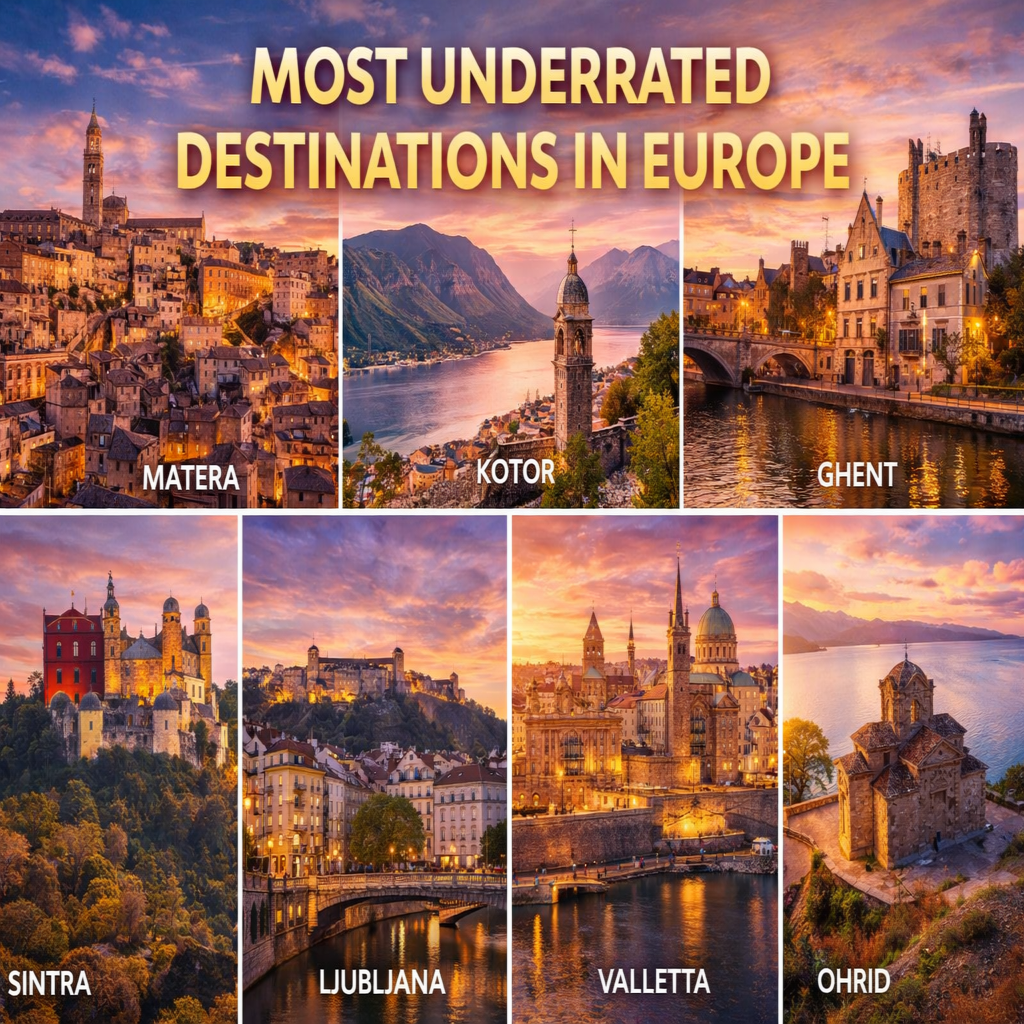
1. Matera, Italy — The Ancient Cave City That Will Stop You in Your Tracks
Matera is one of the most extraordinary and unexpected places in Europe — a city in the Basilicata region of southern Italy whose ancient sassi (cave dwellings) carved into the sides of a ravine have been continuously inhabited for at least 9,000 years, making it one of the oldest continuously occupied human settlements in the world. It was designated a UNESCO World Heritage Site in 1993 and named a European Capital of Culture in 2019, and yet it remains almost entirely absent from the standard Italy itinerary, overshadowed by Rome, Florence, and the Amalfi Coast to its north and west.
The sassi are the defining experience of Matera — an entire city of cave houses, rock-cut churches, and underground cisterns cascading down the sides of the Gravina gorge in a way that produces a skyline unlike anything else in Europe. Walking through the Sasso Caveoso and Sasso Barisano districts — where cave dwellings that were inhabited as recently as the 1950s (and evacuated by government decree as an embarrassment to modern Italy, only to be rehabilitated as hotels and restaurants in the 1980s and 1990s) have been converted into boutique hotels, wine bars, and restaurants of genuine quality — is one of the most disorienting and beautiful urban experiences in Italy.
The rupestrian churches — rock-cut Byzantine chapels with ancient frescoes still visible on their cave walls, distributed throughout the ravine landscape — are extraordinary. The view from the Civita (the ancient town center, perched on a spur above the sassi) across the Gravina gorge at sunset, when the cave city opposite glows amber in the fading light, is one of the finest views in southern Italy. And the food — the cucina povera of Basilicata, built around bread baked in wood-fired ovens, aged Pecorino di Filiano cheese, peperoni cruschi (crispy dried sweet peppers), and the excellent Aglianico del Vulture red wine from the regional volcanic soils — is deeply satisfying and almost entirely unknown outside the region.
Getting there: Fly to Bari or Naples, then bus or rental car to Matera (approximately 1.5 hours from Bari). A car is strongly recommended for exploring the surrounding Basilicata region.
Don’t miss: Walking the sassi at dawn before the day visitors arrive, the rupestrian churches of the Murgia Materana park (accessible by foot across the ravine), a cave hotel dinner with Aglianico del Vulture, the view from the Belvedere di Murgia Timone at sunset.
How long: Two to three days is ideal. Combine with a drive through the extraordinary Basilicata and Puglia countryside for a southern Italy trip of genuine distinction.
2. Kotor, Montenegro — The Adriatic’s Most Beautiful Secret
Kotor is what Dubrovnik was twenty years ago — a perfectly preserved medieval walled city on the Adriatic coast, its Venetian Gothic architecture intact, its bay setting jaw-droppingly beautiful, and its tourist infrastructure developed enough to be comfortable without being so overwhelmed that the city has lost the quality of lived authenticity that makes Adriatic destinations worth visiting in the first place. It is, by almost any measure, one of the most beautiful towns in Europe and one of the most undervisited relative to that beauty.
The Bay of Kotor — often described as the southernmost fjord in Europe (though technically a submerged river canyon) — is the most dramatic coastal setting in the Eastern Adriatic. The bay is enclosed on three sides by the Dinaric Alps, which rise almost vertically from the water to heights over 1,700 meters, creating a landscape of extraordinary intensity that makes the drive along the bay’s edge one of the finest coastal drives in Europe. The old town of Kotor, at the bay’s innermost point, sits at the foot of a 1,355-meter mountain, its medieval walls climbing the near-vertical rockface above in a fortification system whose sheer ambition of scale is visible from miles away.
The old town itself — a UNESCO World Heritage Site — is a compact maze of Venetian palaces, Romanesque churches, and stone-paved squares that rewards aimless wandering with constant discovery. The Cathedral of Saint Tryphon, built in 1166 and housing an extraordinary treasury of Byzantine and Venetian religious art, is one of the finest Romanesque buildings on the Adriatic coast. The climb to the fortress of San Giovanni above the town — 1,350 steps up the medieval walls, rewarded with panoramic views over the bay and the mountains beyond — is one of the finest short hikes in the Western Balkans.
Montenegro itself is an extraordinary and largely undiscovered country — its interior offers the Durmitor National Park (one of Europe’s finest mountain landscapes), the canyon of the Tara River (the deepest canyon in Europe after the Grand Canyon), and a wine culture centered on the indigenous Vranac grape that is well worth exploring.
Getting there: Fly to Dubrovnik (Croatia) and take a 2-hour coastal bus or car south into Montenegro. Tivat Airport, 8 km from Kotor, also has direct connections from several European cities.
Don’t miss: The fortress climb at dawn, the Cathedral of Saint Tryphon, a boat trip to Our Lady of the Rocks (a baroque church on a man-made island in the bay), the drive along the bay to Perast, Montenegrin seafood at a waterfront konoba.
How long: Two to three days in Kotor, with a day trip to Perast and the surrounding bay. Combine with a Durmitor National Park extension for one of the finest nature-culture combinations in the Balkans.
3. Ghent, Belgium — The City That Outshines Bruges and Nobody Knows It
Bruges receives the international visitors. Ghent, just 30 minutes away by train, receives the Belgians who know better — and the growing number of international travelers who have discovered that Ghent offers everything Bruges offers in terms of medieval canals, Gothic architecture, and extraordinary Belgian food and beer culture, plus a living, working university city energy that Bruges, for all its beauty, has largely lost to the weight of its own tourist industry.
The Ghent Altarpiece — Jan van Eyck’s Adoration of the Mystic Lamb, completed in 1432 and described by many art historians as the most influential painting in Western art — has returned to its original location in the St. Bavo Cathedral after decades of complex restoration. Seeing it in the purpose-built viewing room of its home church, in the city where it was created, is one of the most significant art experiences available in Northern Europe and one of the most underappreciated. The Cathedral itself, with its extraordinary treasury and the extraordinary perspective of the altarpiece in its original architectural context, is a world-class cultural experience that attracts a fraction of the visitors it deserves.
The Gravensteen — the 12th-century Castle of the Counts, rising dramatically from the medieval city center — is one of the finest and best-preserved medieval fortresses in Belgium, and the views from its ramparts over Ghent’s towers and waterways are among the finest in Flanders. The Graslei and Korenlei — two medieval guild house quays facing each other across the Leie River — constitute one of the most beautiful urban waterfront ensembles in Northern Europe, and the evening light on their facades, reflected in the still canal water, rivals anything in Bruges.
Ghent’s food and drink culture is outstanding. The city’s beer culture — with excellent local breweries and specialist beer cafés concentrated in the Patershol neighborhood — is the equal of anywhere in Belgium. The city’s restaurant scene, driven by the university population and a sophisticated local food culture, produces excellent Flemish cooking (waterzooi, the creamy fish or chicken stew that originated in Ghent, is the city’s signature dish) at prices well below Brussels or Amsterdam equivalents.
Getting there: Direct trains from Brussels (30 minutes), Bruges (30 minutes), and Amsterdam (2.5 hours). Ghent-Sint-Pieters is the main station, with tram connections to the historic center.
Don’t miss: The Ghent Altarpiece at St. Bavo Cathedral (book a timed entry), Gravensteen Castle, the Graslei and Korenlei at sunset, waterzooi at a traditional Ghent restaurant, the Patershol neighborhood for evening beer culture, the STAM city museum for Ghent history.
How long: Two days is ideal and allows a relaxed exploration of everything above. Easily combined with Bruges for a Belgian art cities itinerary.
4. Ljubljana, Slovenia — Europe’s Most Charming Small Capital
Ljubljana is the capital of Slovenia and, with a population of approximately 280,000, one of the smallest capital cities in Europe — which is precisely what makes it so appealing. It is a city of human scale, entirely walkable in its historic center, possessed of a café and restaurant culture that punches well above its weight, and set in a country of extraordinary natural wealth that makes it an outstanding base for day trips to Lake Bled, the Soča Valley, and the Adriatic coast at Piran.
The old town — clustered around the Ljubljanica River and overlooked by the Ljubljana Castle on its wooded hill — is a delightful ensemble of Baroque and Art Nouveau architecture, outdoor café terraces, and pedestrianized streets that fills with students, cyclists, and market vendors on weekend mornings. The Triple Bridge (Tromostovje), designed by the great Slovenian architect Jože Plečnik, is one of the most elegant bridge ensembles in Central Europe. The dragon, symbol of the city, appears on the Dragon Bridge and on dozens of other architectural details throughout the old town.
Jože Plečnik — the Ljubljana architect who redesigned much of the city’s public space in the early 20th century — is one of the most fascinating and underappreciated figures in European architectural history, and the Plečnik House museum and the city-wide trail of his works constitute one of the finest single-architect architectural itineraries available in any European city.
The food scene of Ljubljana — influenced by its Central European, Mediterranean, and Balkan neighbors — is outstanding and represents extraordinary value. Slovenian cuisine, based on buckwheat, dairy, pork, and freshwater fish, is deeply satisfying and almost entirely unknown internationally. The Odprta Kuhna (Open Kitchen) market on Friday evenings, from March to October, is one of the finest outdoor food markets in Central Europe.
Getting there: Fly to Ljubljana Airport (connections from most major European hubs) or arrive by train from Vienna (6 hours), Venice (3.5 hours), or Zagreb (2.5 hours).
Don’t miss: Ljubljana Castle at sunrise for city views, the Plečnik architectural trail, Friday Odprta Kuhna market, Lake Bled day trip (1 hour by bus — one of the most beautiful lakes in Europe), the Metelkova alternative cultural center, Slovenian wine tasting at a city wine bar.
How long: Two days in Ljubljana plus one or two days for Lake Bled and the surrounding Julian Alps.
5. Valletta, Malta — Europe’s Smallest Capital and One of Its Most Beautiful
Valletta is the smallest capital city in the European Union — just 0.8 square kilometers, with a population of approximately 6,000 within the historic walls — and one of the most architecturally concentrated and historically significant in the entire continent. Built in the 1560s by the Knights of St. John after the Great Siege of Malta, it is an entire city conceived and largely executed as a single Renaissance urban plan, with a grid of Baroque palaces, churches, and fortifications that earned it the status of UNESCO World Heritage Site in 1980 and European Capital of Culture in 2018.
The city is, in the most literal sense, a fortress — built on a narrow peninsula between two of the finest natural harbors in the Mediterranean, its honey-colored limestone walls rising directly from the sea on three sides. The views from the Upper Barrakka Gardens over the Grand Harbour — where the fortifications of the Three Cities rise on the opposite shore and the water is alive with ferries and fishing boats and the occasional superyacht — are among the most dramatically beautiful harbor views in Europe.
The artistic heritage concentrated within Valletta’s small area is extraordinary. The St. John’s Co-Cathedral, built between 1573 and 1578, contains the finest collection of Caravaggio paintings outside Rome — the Beheading of Saint John the Baptist, the largest painting Caravaggio ever made and widely considered his masterpiece, hangs in the Oratory and produces in first-time viewers a quality of stunned silence that very few paintings in the world can still reliably achieve.
Malta itself — tiny, sun-drenched, and steeped in a history that encompasses Phoenician, Roman, Arab, Norman, Knights Hospitaller, British, and contemporary Maltese layers — is one of the most historically dense and most overlooked islands in the Mediterranean.
Getting there: Direct flights from most major European cities to Malta International Airport, 8 km from Valletta.
Don’t miss: St. John’s Co-Cathedral and Caravaggio’s Beheading of St. John (book in advance), the Upper Barrakka Gardens Grand Harbour view, the Grandmaster’s Palace, a water taxi across the Grand Harbour to the Three Cities, Maltese ftira (flatbread with tuna, olives, and capers) from a local bakery, the prehistoric Ħaġar Qim temples (older than Stonehenge).
How long: Two days in Valletta, combined with a day trip to the prehistoric temples and the Blue Lagoon at Comino for a Malta itinerary of remarkable variety.
6. Plovdiv, Bulgaria — The Balkans’ Most Underrated Cultural City
Plovdiv is one of the oldest continuously inhabited cities in Europe — older than Rome, older than Athens, with a history of continuous settlement stretching back at least 8,000 years — and it is almost entirely unknown to international travelers, despite being named a European Capital of Culture in 2019 and possessing a historic center of considerable beauty and cultural depth.
The Old Town (Stariat Grad) — a UNESCO World Heritage ensemble of Bulgarian National Revival architecture from the 18th and 19th centuries, with its characteristically overhanging upper floors painted in vivid colors above cobblestone streets — is one of the most distinctive and beautiful small historic neighborhoods in the Balkans. The houses of the wealthy Bulgarian merchants who built this quarter during the Ottoman period — the Hindliyan House, the Balabanov House, and the Kuyumdzhioglu House (now the Ethnographic Museum) — are masterpieces of decorative craftsmanship, their interiors painted with elaborate murals of exotic landscapes and their woodwork carved to an extraordinary level of intricacy.
The Roman Theatre — a 2nd-century AD amphitheater seating 7,000, remarkably well preserved and still used for concerts and performances — is one of the finest Roman monuments in Bulgaria and offers panoramic views over the old town from its upper tiers. The Kapana (Trap) district — a former craftsmen’s quarter whose narrow streets have been transformed into a creative hub of galleries, independent cafés, craft beer bars, and artisan workshops — is one of the liveliest and most enjoyable urban regeneration projects in the Balkans and provides an outstanding evening destination.
Bulgaria itself is an extraordinary and largely undiscovered country for European travelers — the Rhodope Mountains, the Rose Valley, the Black Sea coast, and the monasteries of the Bulgarian Orthodox tradition all provide exceptional day trip material from Plovdiv.
Getting there: Fly to Sofia (Bulgaria’s capital, 1.5 hours by bus or train from Plovdiv) or directly to Plovdiv International Airport (seasonal connections from several European cities).
Don’t miss: The Old Town Bulgarian Revival houses, the Roman Theatre at sunset, the Kapana district for evening food and drinks, the Bachkovo Monastery day trip (one of the finest medieval monasteries in the Balkans), Bulgarian banitsa (cheese-filled pastry) from a local bakery for breakfast.
How long: Two to three days, with a day trip to Bachkovo Monastery and the Rhodope Mountains.
7. Sintra, Portugal — Beyond the Day Trip
Sintra appears in most Portugal travel guides as a day trip from Lisbon — and it is an excellent day trip. But treating it only as a day trip means missing the experience of Sintra after the tour buses have left, when the extraordinary UNESCO World Heritage landscape of forested hillsides, Romantic palaces, and Atlantic mist settles into a quieter, more mysterious version of itself that fully deserves an overnight stay and a slower, more complete exploration.
The combination of palaces concentrated within a few square kilometers in Sintra is unmatched in Portugal and exceptional even by European royal standards. The Palácio Nacional da Pena — the 19th-century Romantic fantasy of towers, turrets, and vivid yellow and red paintwork perched on the highest point of the Serra de Sintra — is extraordinary. The Quinta da Regaleira, with its initiatic well (a 27-meter spiral staircase descending into the earth, used for initiation ceremonies by a secret society), its underground tunnels, its Gothic chapel, and its elaborately symbolic garden, is one of the most mysterious and romantic properties in Europe. The Palácio de Monserrate, the least visited of the main palaces and arguably the most beautiful — a Moorish-Gothic-Indian fantasy set in subtropical gardens of extraordinary botanical richness — rewards the visitor who reaches it.
Staying overnight in Sintra — in one of the small guesthouses or boutique hotels in the village center — transforms the experience. The evening, after the last tour buses to Lisbon have departed, belongs to overnight guests and the remarkable atmospheric quality of a hilltop forest village wrapped in Atlantic mist. Dinner at a village restaurant, a morning walk to a palace before it opens, the particular quality of light in the Serra de Sintra forest — these are experiences that no day trip can provide.
Getting there: Train from Lisbon Rossio station (40 minutes, approximately €2.25 each way). The most convenient and recommended transport option.
Don’t miss: Palácio Nacional da Pena, Quinta da Regaleira (book timed entry in advance in summer), Palácio de Monserrate, the walk along the Serra ridge to the Moorish Castle ruins, travesseiros (puff pastry with almond cream — Sintra’s famous pastry) from Casa Piriquita in the village center.
How long: One overnight minimum to experience the village after the day-trippers leave. Two nights allows relaxed exploration of all the major palaces.
8. Trieste, Italy — The City That Europe Forgot and Writers Never Could
Trieste is the most melancholy, most literary, and most unexpectedly beautiful city in Italy — a port city at the northeastern tip of the country, wedged between Slovenia and the Adriatic, that spent centuries as the main seaport of the Habsburg Empire and is still, in its architecture, its café culture, its multilingual character, and its specific quality of graceful, slightly faded grandeur, more Central European than Italian.
James Joyce lived in Trieste for eleven years and wrote much of Dubliners and A Portrait of the Artist as a Young Man here. Rainer Maria Rilke wrote the Duino Elegies at the castle 12 km along the coast. Italo Svevo, one of the most important Italian novelists of the 20th century, was born and died here. The city has a literary density that is extraordinary for its relatively modest size, and the café culture that sustained all of these writers — the Caffè degli Specchi, the Caffè San Marco, the Caffè Tommaseo, all still operating in historic premises — is one of the finest in Europe.
The Piazza Unità d’Italia — the largest sea-facing square in Europe, its three sides lined with monumental Habsburg buildings and its fourth open directly to the Adriatic — is one of Italy’s most dramatically conceived public spaces and almost entirely unknown to the Italian tourism mainstream. The Miramare Castle, built for the Habsburg Archduke Maximilian on a white limestone promontory above the sea, and its extraordinary maritime park, are among the finest 19th-century royal properties in Italy. The Carso plateau above the city — a limestone karst landscape of dramatic sinkholes, underground caves, and traditional osmize (farm wine bars where local Teran wine is poured directly from the barrel) — is one of the finest day trip landscapes in northeastern Italy.
Getting there: Direct trains from Venice (2 hours), Ljubljana (3 hours), and Vienna (6.5 hours). Trieste Airport has limited connections but is convenient.
Don’t miss: Piazza Unità d’Italia at sunset, the historic cafés (Caffè degli Specchi for coffee, Caffè San Marco for the atmosphere), Miramare Castle and park, an osmize in the Carso for local wine and food, the James Joyce itinerary through the city.
How long: Two days for Trieste, with a day trip to the Carso and potentially extending to Ljubljana or Piran (the beautiful Slovenian Adriatic town, 1 hour by bus) for a northeastern Italy–Slovenia combination of rare quality.
9. Wrocław, Poland — Central Europe’s Most Joyful and Undervisited City
Wrocław (pronounced “Vrots-wahf”) is the capital of Lower Silesia and one of Central Europe’s most beautiful and most overlooked cities — a place that has been Polish, Bohemian, Habsburg, and German at various points in its thousand-year history and carries all of those influences in its extraordinary Gothic and Baroque architecture, its outstanding museums, and a cultural vitality that reflects a city rebuilt almost entirely from scratch after World War II with a fierce determination to reclaim its identity.
The Rynek (Market Square) — one of the largest medieval market squares in Central Europe, its perimeter lined with colorful Gothic and Baroque merchant houses — is among the finest public spaces in Poland and less crowded than Kraków’s equivalent. The Cathedral Island (Ostrów Tumski), the oldest part of the city, rising from the Oder River in a cluster of Gothic churches, Baroque bridges, and gas-lit lanterns (the last gas-lit street in Poland), is one of the most atmospheric urban islands in Europe, particularly at dusk when the lanterns are lit by hand each evening.
Wrocław’s dwarfs — small bronze sculptures of the mythical krasnale (gnomes) hidden throughout the city, originating as symbols of the Orange Alternative anti-communist protest movement of the 1980s and now numbering over 600 — provide an enchanting scavenger hunt dimension to urban exploration that makes the city particularly rewarding for walkers. The city’s food and nightlife scene, driven by its large university population, is excellent and extremely affordable.
Getting there: Direct flights from London, Berlin, and several other European cities to Copernicus Airport Wrocław. Also accessible by train from Warsaw (3.5 hours) and Berlin (3 hours).
Don’t miss: The Rynek at sunset, Cathedral Island at dusk, the Panorama of Racławice (a monumental 19th-century cyclorama painting of a Polish battle, displayed in a purpose-built rotunda), dwarf spotting throughout the city, pierogi at a neighborhood milk bar, the modernist Centennial Hall (UNESCO World Heritage Site).
How long: Two to three days. Easily combined with Kraków for a southern Poland cultural itinerary.
10. The Faroe Islands — Europe’s Most Dramatic and Remote Landscape
The Faroe Islands occupy a unique position in European travel — an autonomous territory of Denmark, sitting in the North Atlantic midway between Norway and Iceland, so remote, so dramatically beautiful, and so completely unlike anywhere else in Europe that the experience of arriving there produces in most visitors a quality of stunned geographical awe rarely available on a continent as thoroughly documented as Europe.
The landscape is the destination. Eighteen volcanic islands of sheer black basalt cliffs, hanging valleys, cascading waterfalls that fall directly into the sea, and an Atlantic light of extraordinary, ever-changing quality — dramatic one hour, tender the next — constitute a visual environment of intense and almost overwhelming beauty. The Múlafossur waterfall on Vágar, tumbling over a cliff edge into the village of Gásadalur below; the dramatic lake of Sørvágsvatn that appears from a specific angle to hang above the sea (an optical illusion created by the cliff below); the puffin colonies of Mykines island in summer; and the sea stacks of Drangarnir, rising from the Atlantic like the ruins of a natural cathedral — these are images that have defined the Faroe Islands’ recent emergence as a destination of global fascination.
The Faroese capital of Tórshavn — a small city of 20,000 with a charming old town of brightly painted grass-roofed wooden houses, an excellent restaurant scene centered on the extraordinary Faroese seafood and lamb traditions, and a café and arts culture surprisingly sophisticated for its size — provides the practical base for exploring the islands.
Getting there: Direct flights from Copenhagen (2 hours), Reykjavik (1 hour), and London (2.5 hours) to Vágar Airport.
Don’t miss: Múlafossur waterfall and Gásadalur village, the Sørvágsvatn lake optical illusion viewpoint (guided hike recommended), Mykines island for puffins (May–August), the old town of Tórshavn, Faroese lamb and fresh fish at a Tórshavn restaurant, driving the dramatic coastal roads of Eysturoy and Streymoy.
How long: Four to five days minimum to explore multiple islands. Car rental is essential and the quality of the driving roads and tunnel connections between islands is excellent.
11. Évora, Portugal — The Alentejo’s Ancient and Overlooked Jewel
Évora is one of the finest and most historically rich small cities in Portugal and, outside of the domestic market, one of the least visited — a UNESCO World Heritage walled city in the vast, cork-forested plains of the Alentejo that contains within its Roman walls a Roman temple, a medieval cathedral, one of Portugal’s oldest universities, extraordinary azulejo tile traditions, and the haunting Chapel of Bones (Capela dos Ossos), whose walls and ceiling are built from the bones of approximately 5,000 monks with a 16th-century inscription above the entrance reading “We bones that are here await yours.”
The Templo Romano — the best-preserved Roman temple in Portugal, its fourteen Corinthian columns dating from the 2nd century AD still standing to almost full height in the center of the city — is one of the finest Roman monuments on the Iberian Peninsula, and the experience of walking past it on a Tuesday morning with almost no one else around, in a city of 56,000 people going about their ordinary business, is one of those moments of understated wonder that underrated destinations uniquely provide.
Évora is also the gateway to the Alentejo — the vast, sparsely populated region that covers roughly a third of Portugal and produces some of its finest wine, olive oil, cork, and cuisine. The surrounding countryside, with its prehistoric stone circles (the Cromeleque dos Almendres is one of the largest megalithic complexes in the Iberian Peninsula), its cork oak forests, and its whitewashed hilltop villages, is among the most beautiful and least explored landscapes in Western Europe.
Getting there: Direct buses from Lisbon (1.5 hours by express Rede Expressos service). A rental car is strongly recommended for exploring the surrounding Alentejo.
Don’t miss: The Templo Romano, the Cathedral of Évora and its roof terrace views, the Chapel of Bones at the Church of São Francisco, the Cromeleque dos Almendres megalithic complex, migas (the great Alentejo bread and pork dish) at a local tasca, Alentejo red wine at a city wine bar.
How long: Two days in Évora, extended with a rental car exploration of the Alentejo for one of Portugal’s most rewarding regional itineraries.
12. Ohrid, North Macedonia — The Jerusalem of the Balkans
Ohrid is one of the most beautiful and most historically significant towns in the Balkans — a UNESCO World Heritage city on the shores of Lake Ohrid (one of the oldest and most biodiverse lakes in the world, shared between North Macedonia and Albania) that served as the cultural and religious capital of the medieval Bulgarian Empire and the place from which Cyrillic literacy spread across the Slavic world in the 9th century.
The old town climbs from the lake shore to the hilltop fortress of Tsar Samuel in a dense layering of Byzantine churches, Ottoman houses, and medieval streets that is extraordinary in its concentration and almost entirely unknown to Western European travelers. The Church of Saint Sophia, with its 11th-century Byzantine frescoes — among the finest examples of Byzantine art outside of Istanbul and Thessaloniki — and the Church of Saint John at Kaneo, perched on a rocky promontory above the lake with a view that is one of the most photographed in the Balkans, are both outstanding.
Lake Ohrid itself — 30 km long, up to 289 meters deep, and so clear that visibility extends to 22 meters — is a natural wonder of the first order. Swimming in its crystalline waters below the old town, watching the afternoon light on the Albanian mountains across the lake, and eating fresh Ohrid trout (an endemic species found nowhere else in the world) at a waterfront restaurant constitute a combination of natural beauty and gastronomy that is available for almost nothing and is almost entirely undiscovered by the broader European travel market.
Getting there: Fly to Skopje (North Macedonia’s capital, 3 hours by bus from Ohrid) or to Ohrid’s own St. Paul the Apostle Airport (seasonal connections from several European cities).
Don’t miss: The Church of Saint John at Kaneo at sunset, the Church of Saint Sophia frescoes, Samuel’s Fortress and the city walls, a boat trip on Lake Ohrid, swimming in the lake below the old town, Ohrid trout at a waterfront restaurant, the National Workshop for Handmade Paper (a centuries-old craft unique to Ohrid).
How long: Two to three days. Combine with a day trip across the border to Pogradec in Albania for an extraordinary lake circuit.
How to Find and Plan Underrated European Destinations
Follow the European Capital of Culture trail. The EU’s annual European Capital of Culture program designates two or three cities per year to receive major cultural investment and international attention. Past designees include Matera, Plovdiv, Valletta, Wrocław, and Ghent — all in this guide — and many more outstanding and undervisited destinations. Future designees are announced years in advance and provide an excellent forward-looking guide to emerging European cultural destinations.
Go to the countries, not just the cities. The most underrated European destinations are often not cities at all but regions — the Alentejo, the Faroe Islands, the Rhodope Mountains, the Julian Alps of Slovenia — whose extraordinary landscapes and cultures are accessible from a small city or town base but extend far into a countryside that almost no international tourists reach.
Travel in shoulder season. The distinction between a discovered and an undiscovered destination often comes down to timing. Sintra in May feels like a secret. Sintra in July feels like a queue. Many of the destinations in this guide are only genuinely uncrowded in spring and autumn — plan accordingly.
Combine with better-known neighbors. Every destination in this guide can be combined with a more visited anchor city on the same trip — Matera with Naples or the Amalfi Coast, Kotor with Dubrovnik, Ghent with Brussels or Bruges, Ljubljana with Venice or Vienna, Valletta as a standalone from Malta. This approach removes the logistical anxiety of building a trip around an entirely unfamiliar destination while ensuring that the underrated gem receives the time it deserves.
Trust the UNESCO World Heritage list. Every destination in this guide either has UNESCO World Heritage status or is located within a short distance of a UNESCO site — not because UNESCO is infallible, but because the list reliably identifies places of exceptional cultural or natural significance, many of which are less visited than their designation deserves.
Final Thoughts: The Other Europe Is Waiting
The Europe described in this guide — the cave city of Matera, the Habsburg harbor of Trieste, the Byzantine frescoes of Ohrid, the Romantic palaces of Sintra, the Flemish masterpiece hidden in a Ghent cathedral — is not a lesser Europe. It is not a consolation prize for travelers who could not get tickets to the Louvre or find accommodation in Dubrovnik in August. It is, in many respects, a richer and more rewarding Europe — one where the history is as deep, the beauty as genuine, the food as extraordinary, and the experience of being in a place as fully alive and specific as anything the famous destinations can provide.
The difference is simply that you have to choose it. You have to be willing to book a train to a city whose name you might not be able to pronounce with confidence, to walk into a restaurant where the menu is not in English, to navigate a city without the safety net of a thousand recent TripAdvisor reviews. To be, in the truest sense, a traveler rather than a tourist.
The rewards for that choice — the Roman temple in Évora with no one else around, the Caravaggio in Valletta that stops you breathing for a moment, the view over the Bay of Kotor at dawn from the fortress steps — are the rewards that travel was always supposed to provide, and that the most visited places in Europe increasingly struggle to deliver.
The other Europe is extraordinary. It is waiting. And it will be yours, almost entirely, if you simply show up.
We hope this guide to the most underrated destinations in Europe has given you the inspiration and practical foundation to plan an adventure beyond the obvious. For more hidden gem guides, regional deep-dives, and travel inspiration across the full breadth of the continent, keep exploring GlobeTrailGuide — your trusted companion for smarter, deeper travel.
GlobeTrailGuide.com | Travel Smarter. Explore Deeper.