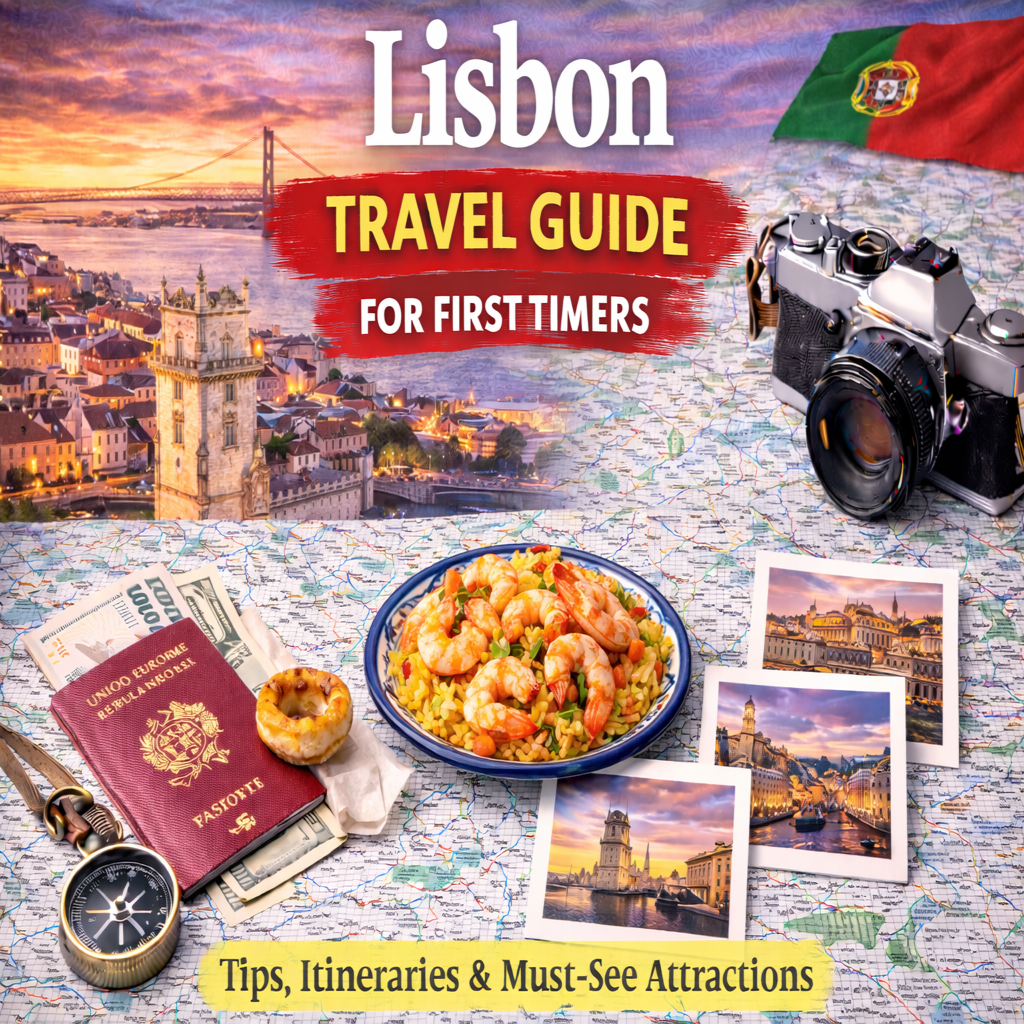
There is a particular moment that Lisbon gives almost every first-time visitor, and it tends to arrive quietly, without announcement. It might come on the upper deck of Tram 28, rattling through the Alfama’s narrow streets as the city’s rooftops and the silver line of the Tagus estuary appear between the buildings below. Or in the Jerónimos Monastery in Belém, standing in the nave and understanding for the first time the full ambition of what a small country on the edge of the Atlantic once achieved. Or most likely it comes at a miradouro at dusk — one of the city’s hilltop viewpoints, a glass of wine in hand, watching the Tagus turn gold as the sun drops behind the suspension bridge — when you realize that you are not simply looking at a beautiful view but feeling the specific, irreplaceable quality of a place that has found its way entirely inside you.
Lisbon is the city that most consistently surprises experienced travelers. They arrive knowing it is beautiful — they have seen the photographs of the yellow trams and the azulejo-tiled facades and the seven hills tumbling toward the river — and they leave having been moved in ways they did not expect by a city of extraordinary depth and soulfulness. It is the oldest capital in Western Europe, founded by the Phoenicians and shaped by Romans, Visigoths, Moors, and the Portuguese navigators who launched from its shores in the 15th century to map the world. It is the city of fado — that music of exquisite, bittersweet longing — and of pastéis de nata warm from the oven, and of azulejo tiles covering entire building facades with a blue-and-white artistry that turns the city into a permanent open-air museum.
It is also, by the consensus of a growing global travel community, one of the finest cities in Europe to simply be in — to walk, to eat, to drink, to sit at a café table in the afternoon light and do nothing in particular with the specific quality of contentment that Lisbon produces more reliably than almost anywhere else on the continent.
This Lisbon travel guide covers everything you need: the best time to visit, how to get there and around, the top attractions, the neighborhoods, the food and drink culture, the practical tips, a suggested itinerary, and the insider knowledge that will help you fall genuinely and irrevocably in love with one of Europe’s greatest and most soulful cities.
Why Visit Lisbon
Lisbon makes its case for itself immediately and powerfully. The seven hills, the Tagus estuary, the Atlantic light, the ancient Alfama neighborhood with its Moorish street plan unchanged in a thousand years — the city’s physical setting and historical character create an atmosphere of beauty and depth that is available the moment you arrive and intensifies the longer you stay.
But Lisbon’s deepest appeal is harder to articulate and more lasting in its effect. It is a city shaped by the concept of saudade — the untranslatable Portuguese word describing a bittersweet longing for something beautiful that is absent or lost, a melancholy awareness of the transience of beautiful things — and this quality permeates everything from the music to the food to the architecture to the light itself. Lisbon is a city that has been through empire and earthquake and revolution and economic hardship and has arrived at something like wisdom — a quiet, proud, unhurried relationship with its own extraordinary past that communicates itself to visitors with unusual directness.
The practical case is equally compelling. The food — built on the finest Atlantic seafood, exceptional cured meats, the extraordinary pastéis de nata, and a wine culture that includes some of Europe’s most underrated bottles — is among the best in Europe. The cost of eating and drinking well remains, despite a decade of tourism growth, significantly lower than equivalent quality in Paris, London, or Amsterdam. The city is walkable, compact in its historic core, and possessed of a public transport system that includes trams and funiculars of considerable charm. The people are warm, proud, and genuinely hospitable in a way that makes the city feel welcoming rather than merely service-oriented.
Lisbon is also the perfect base for some of the finest day trips in Europe — Sintra’s fairy-tale palaces forty minutes by train, the beaches of Cascais and Estoril along the Estoril Line, the wine country of the Setúbal Peninsula, and the hill towns of the Arrábida Natural Park all within reach of an afternoon.
Best Time to Visit Lisbon
Lisbon’s climate is one of the most favorable in Western Europe — more than 290 days of sunshine annually, mild winters, warm springs and autumns, and summers that are hot but tempered by the Atlantic breeze in a way that makes the city more bearable in July and August than the temperatures alone would suggest.
Spring (March to May) — The Finest Season
Spring is the best time to visit Lisbon by a significant margin. The city is warm and beautiful — temperatures of 17°C–24°C (63°F–75°F) — the jacaranda trees that line the Avenida da Liberdade and several other major avenues burst into spectacular purple bloom in April and May, and the quality of light in the long spring evenings is extraordinary. The tourist crowds are present but manageable, prices are below the summer peak, and the city has an energy and aliveness — outdoor café life, evening miradouro culture, the particular pleasure of long spring evenings in the Bairro Alto — that is specifically and perfectly Lisbon in spring.
The Festas de Lisboa in June — centered on the Dia de Santo António on June 12–13, the most important popular festival in the city’s calendar — is the finest single event in the Lisbon year. Grilled sardines fill the streets of the Alfama and Mouraria with smoke and fragrance, traditional arraial street parties with live music animate every neighborhood, and the city celebrates its patron saint with a warmth and communal joy that is one of the most authentic and moving urban festival experiences in Europe. Accommodation books out significantly for this period — reserve months in advance.
Autumn (September to November) — Excellent and Underrated
September and October are excellent alternatives to spring, with similar temperatures, beautiful amber light, and a city that has shed the peak-season crowds and returned to its authentic everyday rhythm. October is particularly fine — warm days, cool evenings, the golden light of Iberian autumn on the city’s azulejo facades, and prices notably below the spring and summer peaks. November brings more rain and cooler temperatures but retains the city’s essential charm and offers the lowest prices and the most local, unhurried experience of the year.
Summer (June to August) — Hot, Busy, and Still Wonderful
Lisbon in summer is genuinely hot — 28°C–35°C (82°F–95°F) — and significantly more crowded and expensive than the shoulder seasons. July and August bring the city’s largest international tourist volumes, with accommodation prices at their annual peak and the most famous attractions (particularly Sintra) operating at capacity. The heat is manageable with the Atlantic breeze and the city’s shade, but early morning starts for sightseeing and long midday breaks are advisable. The compensation is the full vibrancy of Lisbon’s outdoor culture — the miradouros packed with people until midnight, the riverside Ribeira and Cais do Sodré terraces full of life, and the particular electric energy of a southern European city at the height of summer.
Winter (December to February) — Mild, Quiet, and Genuinely Charming
Lisbon’s winter is the mildest in mainland Europe — average daytime temperatures of 13°C–17°C, rarely dropping below 7°C at night, with rain more frequent but rarely sustained. The city in winter is at its most authentically local — quieter, cheaper, and in many respects more rewarding for the visitor who wants to experience Lisbon as its residents live it rather than as a tourist attraction. The Christmas decorations along the Avenida da Liberdade are beautiful, the museums and monuments are uncrowded, and a rainy afternoon in a traditional tasca with a glass of Alentejo red and a plate of bacalhau has its own deeply satisfying quality that summer cannot replicate.
How to Get to Lisbon
By Air: Lisbon Humberto Delgado Airport (LIS) sits just 7 km from the historic center — remarkably close for a major European capital — and is served by extensive international connections from across Europe, North America, Brazil, Africa, and beyond. TAP Air Portugal is the national carrier with particularly good transatlantic and Lusophone Africa connections. From London, flights take approximately 2.5 hours; from New York approximately 7 hours; from São Paulo approximately 9 hours.
The Metro Red Line connects the airport directly to the city center (Alameda, with connections to Oriente and the Baixa-Chiado area) in 20–30 minutes for approximately €1.85 on a rechargeable Viva Viagem card — one of the finest and most affordable airport connections of any European capital. Aerobus coaches serve key city stops for €4. Official taxis charge a flat rate of approximately €15–€20 to the historic center. Uber and Bolt are widely available and slightly cheaper than taxis.
By Train from Spain: The overnight Lusitânia Comboio Hotel connects Madrid with Lisbon (approximately 10 hours) — a classic and atmospheric intercity rail experience, particularly enjoyable in a private cabin with dinner in the dining car. The Alfa Pendular from Porto to Lisbon (approximately 3 hours) is the most frequent and comfortable domestic rail connection.
By Bus: FlixBus and Rede Expressos connect Lisbon with cities across Portugal and Spain. The main Lisbon bus terminal is at Sete Rios, connected to the Metro.
Getting Around Lisbon
Lisbon is a city of hills — seven of them, officially, though the topography is considerably more complex in practice — and this shapes how it is best navigated. The historic core is compact and in many respects best explored on foot, but the hills make certain routes demanding and the city’s extraordinary collection of historic transport options provides both practical assistance and considerable charm.
Walking: The essential and most rewarding way to explore Lisbon’s historic neighborhoods. The Alfama, Mouraria, Bairro Alto, Chiado, and Baixa are all best navigated on foot — their streets are narrow, their architectural details are at eye level, and their best discoveries are made by following something that looks interesting rather than following a map. Comfortable shoes with good grip are essential — Lisbon’s pavements are calçada portuguesa (traditional Portuguese stone mosaic paving), beautiful but slippery when wet and uneven in many historic areas.
Tram 28 (E28): The iconic yellow tram that rattles through the Alfama, Mouraria, Graça, and Estrela neighborhoods is simultaneously Lisbon’s most famous tourist attraction and a genuinely useful public transport route. The full journey from Martim Moniz to Prazeres cemetery takes approximately 45 minutes and passes through some of the city’s most atmospheric streets. Ride it in the early morning (before 9 AM) to experience it without the worst of the tourist crush; a Viva Viagem card (€1.85 per journey) is significantly cheaper than buying a ticket on board. Beware of pickpockets on this specific route, which is the most targeted in the city.
Funiculars and Elevators (Ascensores): Three historic funiculars — Glória (connecting the Baixa to the Bairro Alto), Bica (connecting the Cais do Sodré area to the upper Bica neighborhood), and Lavra (Lisbon’s oldest, in the Intendente area) — and the extraordinary Elevador de Santa Justa (a neo-Gothic iron elevator in the Baixa, designed by a pupil of Gustave Eiffel, connecting the lower city to the upper Chiado district) provide both practical assistance with the city’s topography and some of its finest incidental pleasures.
Metro: Lisbon’s Metro covers four lines and connects most major neighborhoods and tourist destinations efficiently. The Viva Viagem card covers all metro journeys. The stations themselves are worth noting — several, including Oriente, Cais do Sodré, and Baixa-Chiado, are decorated with outstanding tilework and public art.
Bus and ElétricoLisboa: The broader CARRIS bus network covers the entire city and is essential for reaching Belém (Bus 714, 727, or 751 from Praça do Comércio), the LX Factory, and neighborhoods not served by tram or metro.
Taxis and Rideshares: Taxis are metered and generally reliable. Uber and Bolt are widely available in Lisbon, transparent in pricing, and slightly cheaper than traditional taxis for most journeys.
Cycling: Lisbon has invested significantly in cycling infrastructure over the past decade — the riverside path from Belém to Cais do Sodré and beyond is excellent for cycling. GIRA, the city’s bike-sharing scheme, provides affordable access to bikes at docking stations throughout the city. The hills make cycling demanding in certain areas but the flat riverside routes are outstanding.
Lisbon’s Neighborhoods: A Guide to the City’s Distinct Characters
Alfama — The Ancient Moorish Heart
Alfama is the oldest and most atmospheric neighborhood in Lisbon — the only area to survive the devastating 1755 earthquake largely intact, its Moorish street plan of narrow, winding alleyways, steep stone stairs, and whitewashed houses unchanged in essential character for over a thousand years. It climbs from the waterfront to the hilltop São Jorge Castle in a dense, labyrinthine network of ruas and becos that reward aimless exploration with constant discovery — unexpected viewpoints, hidden courtyards, the sound of fado drifting from an open restaurant window, cats sleeping on warm stone steps.
This is where fado was born — or at least where its deepest roots lie — and the neighborhood’s connection to the music is felt in the density of fado houses, the murals of legendary fadistas on certain building facades, and the specific quality of melancholy beauty that the Alfama possesses more completely than any other neighborhood in Lisbon.
The Feira da Ladra — Lisbon’s famous flea market, held on Tuesday mornings and Saturday all day in the Campo de Santa Clara at the Alfama’s eastern edge — is one of the finest and most entertaining markets in Portugal, its stalls selling everything from genuine antiques and vintage treasures to extraordinary junk with a cheerful indifference to categorization.
Mouraria — The Multicultural Soul
Mouraria is Lisbon’s most historically layered and most genuinely multicultural neighborhood — the area to which the city’s Moorish population was confined after the Christian reconquest of Lisbon in 1147, and which has been continuously home to successive waves of migrants and outsiders ever since. Today it is home to communities from Bangladesh, China, Cape Verde, and Angola alongside its Portuguese residents, and the resulting cultural mixture — the spice shops alongside the fado birthplace of Amália Rodrigues, the Chinese restaurants beside the traditional tascas — produces an authenticity and vibrancy that the more tourist-heavy Alfama increasingly lacks.
The Intendente square, at the upper edge of Mouraria, has been beautifully regenerated in recent years and is now one of Lisbon’s most pleasant and genuine neighborhood squares — its outdoor café terraces populated by a mix of local residents and in-the-know visitors that represents Lisbon’s social mix at its best.
Bairro Alto and Chiado — Bohemian Culture and Literary Cafés
Bairro Alto (Upper Quarter) and the adjacent Chiado district form Lisbon’s cultural and nightlife heart — a hillside neighborhood of independent bookshops, traditional tascas, fado houses, and, after dark, a dense concentration of bars that makes it one of the finest areas in Europe for evening exploration.
The Chiado, more refined and commercial than the Bairro Alto proper, is home to the Brasileira café — where a bronze statue of the poet Fernando Pessoa sits outside at a table, one of Lisbon’s most beloved public art pieces — the Bertrand Bookshop (the oldest operating bookshop in the world, founded in 1732), and the Museu do Chiado, with its collection of Portuguese art from the 19th century to the present.
The Bairro Alto itself is best experienced in the evening, when the neighborhood’s characteristic rhythm — dinner at a neighborhood restaurant, drinks at a tiny bar spilling onto the street, the gradual intensification of the night — creates one of Lisbon’s most authentically pleasurable experiences.
Baixa and Rossio — The Grand Pombaline Center
The Baixa (Lower Town) is the city’s monumental heart — rebuilt in an extraordinary feat of Enlightenment urban planning by the Marquis of Pombal after the 1755 earthquake destroyed the medieval city, its perfectly rectilinear grid of wide pedestrianized streets lined with identical Pombaline buildings is one of the finest examples of 18th-century urban design in Europe.
The Praça do Comércio (Commerce Square) — the enormous riverside square open to the Tagus on its southern side, flanked by the yellow arcades of government ministries and centered on the equestrian statue of King José I — is one of the finest public squares in Portugal and the ideal arrival point for a Lisbon walking itinerary. The Rua Augusta arch at its northern end leads through to the Baixa’s pedestrianized shopping streets and the Praça da Figueira, and from there to the Rossio — the city’s main everyday square, its wave-pattern calçada portuguesa pavement a masterpiece of the stone-mosaic tradition.
Príncipe Real — Lisbon’s Most Elegant Neighborhood
Príncipe Real is Lisbon’s most refined and quietly fashionable neighborhood — a hillside district of 19th-century palaces, antique shops, design boutiques, garden squares, and some of the city’s finest independent restaurants and wine bars. The Jardim do Príncipe Real — a shaded garden square with an enormous centuries-old cedar tree at its center — is one of the finest small urban green spaces in Lisbon and the venue for an excellent organic food and artisan market on Saturday mornings.
The Embaixada — a neo-Moorish palace converted into a concept store of Portuguese independent brands — and the surrounding streets of design shops and excellent restaurants make Príncipe Real the ideal neighborhood for a slow afternoon of browsing and eating.
Belém — The Gateway to the Age of Discovery
Belém is not a neighborhood in the conventional sense but a riverside district 6 km west of the historic center, connected by bus and tram, whose extraordinary concentration of monuments related to Portugal’s 15th and 16th-century Age of Discovery makes it essential for any visit of two days or more.
The Jerónimos Monastery — commissioned by King Manuel I in 1502 to commemorate Vasco da Gama’s discovery of the sea route to India and built over a century in the extraordinary Manueline style — is one of the finest buildings in Portugal and one of the great Gothic-Renaissance hybrid masterworks in Europe. Its south portal, carved with an almost incomprehensible density of maritime imagery, saints, and decorative detail, is one of the most extraordinary pieces of architectural sculpture in the world.
The Torre de Belém — the small fortified tower built on a promontory in the Tagus between 1516 and 1521, its Manueline decoration including a rhinoceros carved in stone on the northwestern turret (the first sculpture of a rhinoceros in European art) — is Lisbon’s most iconic image and a UNESCO World Heritage Site alongside the Monastery.
The Padrão dos Descobrimentos (Monument to the Discoveries) — a 52-meter modernist monument built in 1960 depicting Henry the Navigator at the prow of a ship, surrounded by 32 historical figures of the Age of Discovery — stands on the riverfront below the monastery and provides outstanding views from its lift-accessible summit. The enormous wind rose mosaic on the pavement below, a gift from South Africa in 1960, depicts the routes of the Portuguese explorers across the world.
And Pastéis de Belém — the bakery on Rua de Belém that has been producing pastéis de nata from the original secret recipe of the Jerónimos monks since 1837 — is a Lisbon pilgrimage site of the highest order.
LX Factory — Industrial Lisbon Reinvented
The LX Factory is a former 19th-century textile factory complex in the Alcântara neighborhood, beneath the Ponte 25 de Abril suspension bridge, that has been transformed into Lisbon’s finest creative hub — a community of independent restaurants, concept stores, design studios, music venues, and creative businesses operating in the extraordinary industrial architecture of the original factory buildings.
The Sunday market (10 AM–6 PM) is the finest weekly market in Lisbon — food producers, vintage clothing, books, ceramics, and a general atmosphere of creative commerce that draws a thoroughly mixed crowd of locals and visitors. The Ler Devagar bookshop — a towering three-story bookshop in the former printing hall, its walls lined with books and a vintage bicycle suspended from the ceiling — is one of the most beautiful bookshops in Portugal.
Top Attractions in Lisbon
1. Jerónimos Monastery — Portugal’s Greatest Building
The Mosteiro dos Jerónimos in Belém is the architectural masterpiece of the Manueline style — Portugal’s own elaborately maritime Gothic, developed in the reign of Manuel I (1495–1521) to celebrate the wealth brought by the spice trade and the glory of the Age of Discovery. The monastery’s south portal, the interior nave (whose stone palm-tree columns branch into a lace-like ceiling vault of extraordinary complexity), and the double-story cloister (perhaps the finest in the world, its arches combining Gothic, Renaissance, and Moorish elements in a synthesis that is completely and specifically Portuguese) are all exceptional.
The monastery also houses the tombs of Vasco da Gama and the poet Luís de Camões — two of the defining figures of the Portuguese golden age — in the church’s nave. Standing beside these tombs, in this building, in this city from whose shores the voyages of discovery departed, produces a quality of historical connection that is specific and irreplaceable.
Book tickets in advance at patrimoniocultural.gov.pt. Entry approximately €10, with a combined ticket available for the Torre de Belém.
2. Museu Nacional do Azulejo — The World’s Finest Tile Museum
The National Tile Museum, housed in a 16th-century convent in the Xabregas neighborhood east of the historic center, is one of the most distinctive and rewarding museums in Europe — a comprehensive survey of the Portuguese tile-making tradition from its 15th-century Moorish origins to the present day, displayed in a building whose own tilework and architecture are themselves part of the collection.
The highlight is the extraordinary panoramic panel of pre-earthquake Lisbon — a 23-meter-long tilework panorama of the city as it appeared before the 1755 earthquake, assembled from over 1,300 tiles, providing an irreplaceable visual record of a lost city and one of the most beautiful large-scale tilework compositions in existence. The decorated church of the former convent, its walls entirely covered with azulejo panels depicting the life of St. Anthony, is a masterwork of 18th-century Portuguese decorative art.
Allow two to three hours. Entry approximately €5. Accessible by Bus 718 or Tram 28E from the Martim Moniz area.
3. Museu Calouste Gulbenkian — One of Europe’s Finest Private Collections
The Gulbenkian Museum houses the extraordinary private collection of the Armenian-Portuguese oil magnate Calouste Gulbenkian (1869–1955) — approximately 6,000 objects spanning ancient Egypt, Greece, Rome, Islamic art, Far Eastern art, and European art from the 11th to the 20th century, assembled with the specific taste and enormous resources of a man who spent his life acquiring only what he personally considered the finest examples of each tradition.
The collection’s breadth and quality are remarkable — a Greek goddess-head from the 4th century BC, Islamic illuminated manuscripts of extraordinary delicacy, Rembrandt portraits, Rubens’s Flight into Egypt, Renoir’s Portrait of Madame Claude Monet, and Lalique’s extraordinary Art Nouveau jewelry and glass — each piece chosen not for institutional completeness but for individual excellence. The modern building, set in a beautiful garden designed to complement the collection, is itself outstanding.
The adjacent Centro de Arte Moderna (Modern Art Center) houses the Gulbenkian Foundation’s collection of Portuguese and international modern art, including outstanding examples of Portuguese modernism.
Entry approximately €10 for the permanent collection. Garden access is free and one of the finest public garden spaces in Lisbon.
4. São Jorge Castle — Ancient Fortress and Finest City View
The Castelo de São Jorge, perched on Lisbon’s highest hill above the Alfama, is the city’s most prominent landmark and its most ancient — a fortification that has occupied this strategic hilltop since at least the 1st century BC, most significantly developed by the Moors between the 8th and 11th centuries and captured by the Christian forces of Afonso Henriques in 1147.
The castle complex offers the finest panoramic view over central Lisbon — the Baixa’s grid of streets, the Tagus estuary, the Ponte 25 de Abril and the Christ the King statue on the south bank, the hills of Alfama and Mouraria below — and is one of the most beautiful and historically resonant viewpoints in Portugal. Within the castle walls, archaeological excavations have revealed layers of occupation from the Iron Age through the Moorish and medieval Portuguese periods, displayed in situ with good interpretive material.
The castle’s Torre de Ulisses houses a camera obscura offering a real-time 360-degree panorama of the city — unusual and genuinely interesting. Entry approximately €15. Opening early in the morning to avoid the midday queues and heat is strongly recommended.
5. MAAT — Museum of Art, Architecture and Technology
The MAAT (Museu de Arte, Arquitetura e Tecnologia) on the Tagus riverfront in Belém is one of the most architecturally striking contemporary art museums in Europe — an undulating white ceramic-tiled building designed by Amanda Levete, opened in 2016, whose curved roof forms a public walkway with outstanding river views. The museum’s collection focuses on contemporary art, architecture, and technology, with a strong commitment to Portuguese artists and internationally significant rotating exhibitions.
The adjacent Central Tejo — the former electric power station that supplied Lisbon’s power for decades, now housing permanent exhibitions on energy and technology — is equally impressive architecturally, its enormous turbine halls providing a spectacular industrial backdrop to the museum’s programming.
Entry approximately €9 for both buildings. The rooftop walkway and riverside promenade access are free.
6. Pastéis de Belém — The World’s Most Famous Custard Tart
Not a museum, not a monument, but an essential Lisbon experience of the highest order. The Pastéis de Belém bakery at Rua de Belém 84-92 has been producing pastéis de nata from the secret recipe of the Jerónimos monks since 1837, making it the origin of what became Portugal’s — and arguably the world’s — most beloved pastry.
The pastel de nata — a flaky pastry shell filled with a rich, subtly caramelized egg custard cream, dusted with cinnamon and icing sugar, and eaten warm — is available everywhere in Lisbon, but the Pastéis de Belém version has a specific quality of pastry and custard, a particular char on the top of the cream, that is noticeably superior and recognizably different from every imitation. The counter seating in the azulejo-tiled rooms at the back of the bakery, with a bica (espresso) alongside, is one of the quintessential Lisbon pleasures.
Expect a queue on weekends and in summer. The queue moves quickly and is entirely worth it.
What to Eat and Drink in Lisbon
Lisbon’s food culture is one of the most honest, ingredient-driven, and quietly outstanding in Europe — built on the finest Atlantic seafood, exceptional cured meats and cheeses, fragrant olive oil, and a repertoire of slow-cooked, deeply flavored dishes that reflect both Portugal’s maritime heritage and its extraordinary agricultural regions.
Pastéis de Nata: Already discussed above, and worth repeating: the warm custard tart dusted with cinnamon, eaten at a counter with an espresso, is the most perfect small food experience in Lisbon and should be repeated at least once daily.
Bacalhau (Salt Cod): Portugal’s most beloved ingredient — dried and salted cod, rehydrated and cooked in what is said to be 365 different ways. In Lisbon, Bacalhau à Brás (shredded salt cod with scrambled eggs, matchstick potatoes, olives, and parsley) and Bacalhau com Natas (with cream and potato gratin) are the most commonly encountered preparations. Eating bacalhau in Lisbon is participating in a culinary tradition that stretches back to the 15th century, when Portuguese fishing fleets began bringing salt cod from Newfoundland.
Grilled Sardines: The definitive summer food of Lisbon — whole fresh sardines, charcoal-grilled and seasoned with sea salt, served on a slice of bread to absorb the juices, with roasted peppers alongside. During the Festas de Lisboa in June, the smell of sardines grilling on street braziers fills the entire city. At other times of year, the best are found at traditional tascas and at the Mercado da Ribeira.
Petiscos: Portugal’s version of tapas — small plates of cheese, presunto (cured ham), chouriço, amêijoas à Bulhão Pato (clams in garlic, white wine, and coriander), pataniscas de bacalhau (salt cod fritters), and many others — shared across a table at a traditional tasca or a contemporary petiscos bar. The best petiscos culture in Lisbon is found in the Mouraria, Alfama, and Intendente neighborhoods.
Caldo Verde: Portugal’s most beloved soup — a thick, silky broth of potato and onion with fine ribbons of couve galega (Portuguese kale) and slices of chouriço — available at every traditional restaurant in Lisbon and deeply comforting in the cooler months.
A Ginjinha: The cherry liqueur that is Lisbon’s most traditional drink — a sweet, dark, slightly syrupy liqueur made from ginja (sour cherries) macerated in aguardente, served in a tiny chocolate cup or a small glass at one of the traditional ginjinha bars around the Rossio and Largo de São Domingos. A Ginjinha bar in Largo de São Domingos has been serving it since 1840 and charges approximately €1.50 per small glass. It is sweet, powerful, and entirely Lisbon.
Wine: Portugal is one of the world’s great wine countries and Lisbon is the finest city in which to explore its extraordinary diversity. Vinho Verde from the Minho — light, slightly sparkling, and refreshingly acidic — is the perfect warm-weather wine. The powerful reds of the Alentejo and Douro are world-class with slow-cooked meat dishes. The whites of the Setúbal Peninsula (Moscatel de Setúbal is one of Portugal’s finest sweet wines) are excellent with fish. And the increasingly celebrated whites of the Douro and Dão — complex, mineral, and outstanding with seafood — represent some of the best value in European fine wine.
The Menu do Dia: The set lunch menu available at almost every Lisbon tasca — soup, main course, dessert, and often a glass of wine for €9–€13 — is one of the finest budget dining institutions in Europe and the best way to eat well cheaply in the city.
Lisbon Travel Tips for First Timers
- Buy a Viva Viagem card immediately. Available at Metro station ticket machines for €0.50, the rechargeable Viva Viagem card covers all Metro, tram, bus, and funicular journeys at the lowest fare. Load it with credit (zapping) rather than buying individual tickets for significant savings. The 24-hour unlimited travel pass (approximately €6.80) is excellent value for days of intensive city exploration.
- Ride Tram 28 early. The iconic yellow tram is a genuine experience but genuinely overcrowded in high season from mid-morning onward. Ride it before 9 AM or after 8 PM for something closer to the experience without the sardine conditions.
- The miradouros are best at sunset. Lisbon’s viewpoints — Santa Catarina, Portas do Sol, Graça, Santa Luzia — are best around 6–8 PM when the light on the Tagus is extraordinary. Bring a bottle of wine from a nearby supermarket (€4–€7 for excellent quality) rather than paying restaurant prices.
- Book Sintra tickets in advance. The Palácio Nacional da Pena and Quinta da Regaleira both sell out on popular dates. Book at sintramuseusepacos.pt well before your visit.
- Eat the menu do dia. The set lunch at any neighborhood tasca — served between noon and 3 PM — provides the best quality-to-price ratio in the city and is how most Lisbonites eat on weekdays.
- The Alfama is best explored early. Before 9 AM the neighborhood belongs to residents, delivery workers, and the occasional early-rising visitor. The difference between a 7 AM walk and a 11 AM walk through the same streets is extraordinary.
- Learn a few words of Portuguese. Bom dia, obrigado/obrigada, por favor, faz favor, and uma bica se faz favor (an espresso please) are warmly appreciated and distinguish you immediately from the majority of tourists who default to English without attempting the language.
- Fado houses vary enormously. Tourist-oriented fado restaurants in the Alfama serve average food at elevated prices alongside performances of variable quality. For authentic and serious fado, look for smaller, more intimate venues — particularly in Mouraria — and ask your accommodation for current recommendations. The Museu do Fado in the Alfama provides excellent context for understanding the tradition.
- Belém requires a dedicated half-day. The Jerónimos Monastery, Torre de Belém, MAAT, Padrão dos Descobrimentos, and Pastéis de Belém are all in Belém, 6 km from the historic center. Take Bus 714 or 727 from Praça do Comércio, dedicate a full morning, and combine with a riverside walk back toward the city center in the afternoon.
- The Lisbon Card is worth considering. The Lisboa Card (24, 48, or 72 hours at €21, €37, or €46 respectively) includes unlimited public transport plus free or discounted entry to 38 museums and monuments including the Jerónimos Monastery, the National Tile Museum, and the Gulbenkian. Calculate based on your planned itinerary — for heavy sightseers it provides excellent value.
Suggested 3-Day Lisbon Itinerary
Day One: The Historic Core and Belém
Early morning: Alfama neighborhood on foot — São Jorge Castle at opening time (9 AM), viewpoints, Feira da Ladra market (Tuesday and Saturday). Midday: Bus to Belém — Jerónimos Monastery (pre-booked, allow 2 hours), Pastéis de Belém for lunch, Torre de Belém exterior and interior. Late afternoon: Return along the waterfront — MAAT museum rooftop, Praça do Comércio riverside walk. Evening: Pre-dinner ginjinha at Largo de São Domingos, petiscos and wine in the Bairro Alto.
Day Two: Neighborhoods, Tiles, and Fado
Morning: Museu Nacional do Azulejo (allow 2–3 hours, accessible by bus). Midday: Return via the Intendente area and Mouraria — explore the neighborhood, lunch at a Mouraria tasca. Afternoon: Príncipe Real neighborhood — Jardim do Príncipe Real, antique shops, Embaixada design store. Sunset: Santa Catarina miradouro with wine. Evening: Museu Gulbenkian (open late on selected evenings), followed by fado in a Mouraria venue.
Day Three: Sintra Day Trip and Final Evening
Morning: Early train to Sintra from Rossio station (40 minutes, €2.25). Pre-booked tickets for Palácio Nacional da Pena and Quinta da Regaleira. Travesseiros pastry from Casa Piriquita. Return to Lisbon mid-afternoon. Late afternoon: LX Factory for browsing and a coffee (Sunday market if applicable). Final evening: Long dinner at a traditional Lisbon restaurant — bacalhau à Brás, grilled fish, Alentejo red wine — in the Alfama or Chiado, followed by a late walk along the waterfront.
Lisbon Budget Guide
Lisbon has grown significantly more expensive over the past decade — the city’s emergence as one of Europe’s most desirable destinations has pushed accommodation prices substantially upward, particularly in the historic center neighborhoods. However, it remains notably more affordable than Paris, London, or Amsterdam while offering a comparable or superior quality of food, culture, and experience.
Accommodation: Budget hostel dorm from €18–€28 per person. Mid-range boutique guesthouse in the historic center €75–€130 per night for a double room. Design hotels and luxury properties in the Chiado and Príncipe Real €150–€300+. Prices spike significantly in June (Festas de Lisboa) and July–August — booking 2–4 months in advance for these periods is essential.
Food and drink: Pastel de nata at Pastéis de Belém: €1.20. Bica (espresso) at a neighborhood café counter: €0.80–€1.00. Menu do dia set lunch at a tasca: €9–€13. Petiscos dinner at a neighborhood restaurant (two people, sharing dishes, with wine): €30–€50 total. A bottle of excellent Alentejo or Douro wine from a supermarket: €5–€9.
Attractions: Jerónimos Monastery: €10. Museu Nacional do Azulejo: €5. Museu Calouste Gulbenkian: €10. São Jorge Castle: €15. MAAT: €9. Tram 28 (Viva Viagem card): €1.85. Sintra train return: €4.50.
Comfortable daily budget: €80–€110 per person covers a mid-range guesthouse, excellent restaurant meals, two or three paid attractions, and all local transport. Budget travelers in hostels eating menu do dias can experience Lisbon very well for €50–€65 per day.
Final Thoughts: Lisbon Will Get Into Your Soul
Every city that earns the description “one of the world’s great cities” does so through a different combination of qualities — Rome through its history, Paris through its beauty, Tokyo through its perfection, Istanbul through its complexity. Lisbon earns it through something less immediately definable but equally powerful: through soul.
It is a city shaped by saudade — by the awareness of loss, by the beauty of impermanence, by the specific quality of light on water that a city at the edge of the Atlantic and the mouth of a great river receives every evening and has been receiving for millennia. It is a city that has been through extraordinary things — empire and earthquake, revolution and economic hardship — and has arrived at something like equanimity: a quiet pride in its own identity, a warmth toward visitors who engage with it seriously, and a capacity to produce moments of simple, profound pleasure — the warm custard tart, the glass of wine at a miradouro at sunset, the fado heard late at night in a small room — that stay with people for years.
Go slowly. Eat everything. Ride the trams and the funiculars. Watch the Tagus from the Praça do Comércio in the evening light. Let the Alfama get you lost and be grateful for it. Sit in the Gulbenkian garden on a Tuesday afternoon with a book. And allow the specific quality of Lisbon — its saudade, its beauty, its deep and particular way of being a city in the world — to work on you at its own pace.
It will. And you will be glad it did.
We hope this Lisbon travel guide has given you the inspiration and practical foundation to plan an unforgettable trip to one of Europe’s most captivating and soulful cities. For more Portugal guides, Sintra day trip itineraries, Douro Valley wine country deep-dives, and travel inspiration across the full breadth of the country, keep exploring GlobeTrailGuide — your trusted companion for smarter, deeper travel.
GlobeTrailGuide.com | Travel Smarter. Explore Deeper.